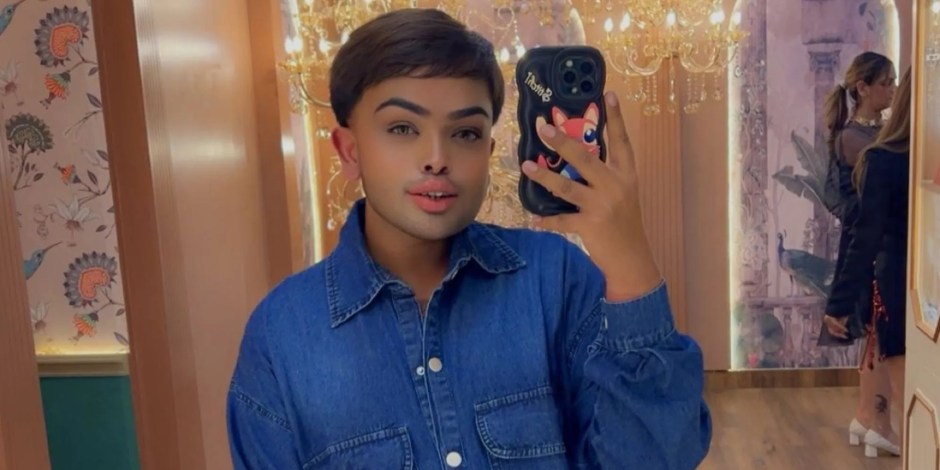
The murder of Mad Sandhu has stayed with me.
Not simply because a young, openly gay content creator was shot dead in Amritsar. Not simply because he was someone who had made a place for himself in the public eye by being unapologetically himself. And not simply because he was part of a community that I, too, belong to.
It has stayed with me because it has brought back a question I have been asking myself for some time:
What exactly are we celebrating in India today?
I have seen people repeatedly point to 2018 and say that unprecedented rights were “given” to LGBTQIA+ people by the government. But let us be precise about what happened.
In 2018, the Supreme Court of India decriminalised consensual sex between adults of the same sex by striking down the application of Section 377 to such relationships.
That was not a government bestowing a special favour upon gay people.
It was the judiciary recognising that gay people are human beings and that our fundamental rights cannot depend upon the sexual orientation of the majority.
And frankly, I struggle with the idea that this should be presented as some extraordinary achievement.
Being told that I am no longer a criminal for loving another consenting adult is not a privilege.
It is a basic human right.
It was a colonial criminalisation that should never have existed in the first place.
And decriminalisation is only the beginning.
I can have sex with another man without being a criminal. Wonderful.
But can my partner and I marry under Indian law?
No.
Can our relationship automatically provide us with the legal protections, inheritance rights, medical decision-making rights, pension rights and family rights that heterosexual married couples take for granted?
No.
Is there a comprehensive civil-union framework that recognises our relationships?
No.
Can a queer couple simply adopt jointly as a couple in the same way a married heterosexual couple can?
No.
The law has, in effect, told us:
You are not criminals. But neither are you fully recognised as families.
That distinction matters.
Because discrimination does not disappear merely because the criminal code stops punishing you.
And while we debate these questions in comfortable rooms and on social media, people continue to live with the consequences of hatred.
Mad Sandhu was openly gay. He was a public figure. He created content around LGBTQIA+ issues and had experienced homophobic abuse online. He was shot dead in Amritsar on 3 October.
At this point, we do not know whether his murder was legally a hate crime. The police investigation is ongoing, and there are several angles being examined, including previous tensions surrounding his social-media content.
But that uncertainty should not make us blind to the larger question.
Why should anyone have to wonder whether being visibly queer makes them a target?
I am a gay man.
I am also a content creator.
I have been creating content publicly for years. I know what it means to put a part of yourself on the internet and invite strangers into your life. I know what it means to be visible.
And perhaps that is why Mad Sandhu’s death feels particularly disturbing to me.
My grandmother’s surname was Sandhu. I come from a Sikh family on my father’s side and a Parsi family on my mother’s side. I have never really followed religion in the conventional sense. I have spent years reading about religion, questioning it, trying to understand it and trying to understand what it means to be a human being in a world in which people are willing to kill one another over competing ideas of God.
And one thing I have noticed repeatedly is that the most beautiful parts of religions are remarkably similar.
Love.
Compassion.
Charity.
Non-violence.
Human dignity.
Brotherhood.
The recognition that we are part of something larger than ourselves.
Yet somehow, so much of our public discourse has become the exact opposite.
We are encouraged to identify the person who is different from us.
The Muslim.
The Hindu.
The Sikh.
The Christian.
The queer person.
The woman who refuses to behave as society expects her to.
The person who speaks a different language.
The person whose politics are different from ours.
And once we have identified the “other”, we are encouraged to hate them.
I recently had a conversation with someone at my gym who seemed to believe that the only legitimate response to the problems created by Islamist extremism is to talk about Muslims, jihadis and the violence committed in the name of Islam.
I understand the anger at terrorism.
I condemn terrorism.
I condemn religious extremism.
I condemn the murder of innocent people regardless of who commits it or what God they claim to be acting for.
But I cannot accept the idea that violence becomes more acceptable because it is committed by someone whose religion, politics or identity I happen to agree with.
Violence is violence.
A murdered gay man does not become less worthy of justice because someone else can produce a list of crimes committed by Muslims.
A murdered Muslim does not become less worthy of justice because someone can produce a list of crimes committed by Hindus.
A raped woman does not become less worthy of justice because the accused belongs to a political party we support.
And a tree being cut down does not become less tragic because the project creating the destruction promises economic growth.
This is where I find our current discourse so deeply disturbing.
We have begun to confuse political loyalty with morality.
We are told to celebrate economic development, industrialisation and national power. But what happens when development destroys forests? What happens when rivers and groundwater are poisoned? What happens when habitats disappear? What happens when the air becomes unbreathable and the natural resources that sustain us become commodities?
What exactly have we gained then?
Money?
Infrastructure?
A bigger economy?
And what have we lost?
Clean air.
Clean water.
Forests.
Animals.
Biodiversity.
Beauty.
Perhaps most importantly, our sense of responsibility towards one another.
I also cannot accept the argument that because a government has done some things that I might agree with, I must therefore overlook everything else.
That is not how democracy is supposed to work.
A government is not a parent.
A political party is not a religion.
A prime minister is not a king.
And citizenship is not supposed to require gratitude.
We are supposed to question those who govern us.
We are supposed to demand accountability.
We are supposed to protect institutions.
We are supposed to defend the rights of minorities even when we are not members of those minorities ourselves.
And we are supposed to be able to say, “I support this policy, but I oppose that one.”
That is not betrayal.
That is democracy.
We are currently witnessing protests over allegations of electoral manipulation and voter suppression, including anger over changes to electoral rolls and demands for accountability from the Election Commission. These allegations must be investigated properly rather than simply accepted or dismissed according to our political loyalties.
Because democracy is not merely the act of voting.
Democracy is the belief that my vote matters.
That your vote matters.
That the person whose politics I despise has exactly the same right to participate in the democratic process as I do.
Without that principle, elections become theatre.
And that is dangerous for every one of us.
We have also seen the disturbing spectacle of convicted criminals occupying positions of political influence, as well as governments granting remission to convicted criminals in extraordinarily controversial circumstances. In the Bilkis Bano case, eleven men convicted of gang rape and murder were released early by the Gujarat government in 2022 before the Supreme Court overturned the remission and ordered them back to prison.
That episode should have forced all of us to ask an uncomfortable question:
Do we actually believe in justice, or do we believe in justice only when it happens to people we dislike?
I ask myself the same question.
Because I don’t want a country in which justice is determined by religion.
I don’t want a country in which justice is determined by political affiliation.
I don’t want a country in which justice is determined by sexuality.
I don’t want a country in which justice is determined by gender.
I don’t want a country in which justice is determined by caste, wealth or social status.
I want a country in which a human being’s humanity is enough.
And this is where my understanding of Hinduism also differs profoundly from the political version of Hinduism that is increasingly presented to us.
I am not Hindu, and I don’t claim to speak for Hinduism.
But I have read enough about India’s religious traditions to know that Hindu thought is extraordinarily diverse, internally argumentative and philosophically expansive. It contains traditions that have contemplated plurality, coexistence, questioning, debate and the possibility of approaching the divine in different ways.
I do not recognise the idea that Hinduism needs to become a rigid political identity defined primarily by whom we oppose.
Nor do I accept the remaking of Hindu thought into a narrow, exclusionary framework simply because that makes for effective political mobilisation.
Religion can be beautiful.
But the moment religion becomes an excuse for deciding that another human being is inherently inferior, something has gone terribly wrong.
And this isn’t really about Hinduism.
It is about us.
What kind of people are we becoming?
Because somewhere along the way, we seem to have forgotten that there is a difference between being right and being humane.
You can win an argument and still be cruel.
You can defeat your political opponent and still be unjust.
You can prove that another religion has extremists and still be a bigot.
You can condemn Islamist terrorism and still be incapable of condemning Hindu extremism.
You can celebrate the decriminalisation of homosexuality and still fail to fight for queer families.
You can call yourself progressive and still participate in misogyny.
You can call yourself religious and still behave in a manner completely opposed to the compassion your religion teaches.
And you can call yourself patriotic while destroying the very land, water, animals and people that make up the country you claim to love.
Mad Sandhu’s death has brought all of this back to the surface for me.
Because it is very easy to say, “This doesn’t affect me.”
Until it does.
It is easy to ignore homophobia when the victim is someone else.
It is easy to ignore religious hatred when the victim worships a different God.
It is easy to ignore misogyny when the woman being silenced is not someone you know.
It is easy to ignore environmental destruction when the tree being cut down isn’t outside your home.
It is easy to ignore attacks on democratic institutions when you believe your own political side will benefit.
Until one day, the hatred reaches your doorstep.
And then it is too late to wonder why nobody spoke.
So perhaps that is the question we should be asking ourselves now.
Not:
“What has this government given us?”
But:
“What kind of country are we building?”
A country where a gay man can be murdered for being visible?
A country where minorities are taught to fear majorities and majorities are taught to fear minorities?
A country where political loyalty is more important than truth?
A country where forests are expendable and rivers are commodities?
A country where women have to protest to be heard?
A country where democratic institutions are questioned but accountability is treated as political warfare?
Or a country where we finally understand that rights are not gifts handed down by governments.
They belong to us because we are human.
The right to love.
The right to live without fear.
The right to worship — or not worship.
The right to disagree.
The right to vote.
The right to dignity.
The right to exist.
These are not achievements that a government should expect gratitude for.
They are the minimum conditions of a humane society.
And perhaps Mad Sandhu’s death should make us stop and ask ourselves, before the next person is killed, silenced, raped, displaced, imprisoned, persecuted or simply forgotten:
What are we waiting for?
How much hatred do we need to witness?
How much blood do we need to see?
How close does violence need to come to our own front door before we decide that something has gone terribly wrong?
Because by then, it may already be too late.

