Dad,
Through the years, I have always wondered how important a father’s role is in his children’s lives. To his son, he becomes a model to emulate, an example of the man he might become. To his daughter, he becomes the first example of the opposite sex. In you, we had neither. We had no recourse but to look to our mother for hope and faith in our ability to become worthy citizens of the world: the kind of people who would be valued as a part of society. Hope is a very strange thing. I am sorry to say you provided us with none. I don’t even think you made any attempt whatsoever to provide us with it.
I have always wondered how you chose to become a father, twice, and yet could afford no vestige of parental affection towards your children. You lived your life on your own terms, and you lived in a kingdom of your own making, protecting your own privileges and affording none to the wife and children you chose to bring into your domain. I write this to you wondering what prompted you to behave this way. Why does a father choose alcohol over the family he himself once wanted to have?
Last year was filled with chaos. The pandemic swept across lives, uprooting many and devastating many. People who could afford to live in their homes did; people who were left to fend for themselves had to move. The poor had left their villages and come to the city looking for work, wages and food. With no work, there were no wages and no food. Their employers could not afford to pay them. They did not want to live on alms. So many made their way back to their villages, defying orders. Some were stopped. Some were punished. But they kept going without transport, without food and without water.
I saw their plight, and within their plight I realised I was given hope. Within their plight, I noticed their determination. They certainly had hope. There were migrants who travelled hundreds of kilometres on foot, and yet they carried with them animals that they loved. Through their migration, we learned their stories, filled with grit and stoicism. And I thought of you, Dad. You, who had abandoned your own family. Yet your family survived. After all, we had a mother who provided us with what we needed to become worthy individuals. The migrants survived because they had hope! Humanity survives because we know that today might be cruel, but tomorrow may yet be kind.
I suddenly remembered the boy, Shunahshepa, whose story is found in Indian myth. Once, the ruler of the local kingdom promised to sacrifice his son, the prince, to a god. But then he changed his mind, for he loved his son too much. He decided to adopt a son and sacrifice the adopted child instead. He offered a hundred cows to any man who gifted him a son. One man, Ajigarta, father of three, forced by hunger, offered his middle son to the king. The eldest was dear to him and the youngest dear to his mother. So, the unwanted second son could be spared. Shunahshepa, unloved by his father and the king, started to weep. When those who are supposed to protect and provide for you turn against you to provide and protect themselves, what does one do? Whom could he turn to? In his moment of helplessness and hopelessness, Shunahshepa composed hymns that are part of the Rig Veda. His is the voice of those devoid of hope. It is meant to evoke the spirit of generosity and empathy in all humans.
I always wonder how some people who haven’t been blessed with the love of at least one parent feel. I have a mother who loves me. People tell me to look at the brighter side of things, to see what I have been given instead of what I lack. I did not know whether to think of this optimistically or pessimistically. But then I realised that what they are asking me to seek out is some kind of hope: the thing that poets and writers over centuries have written about. They all speak about humans being humane.
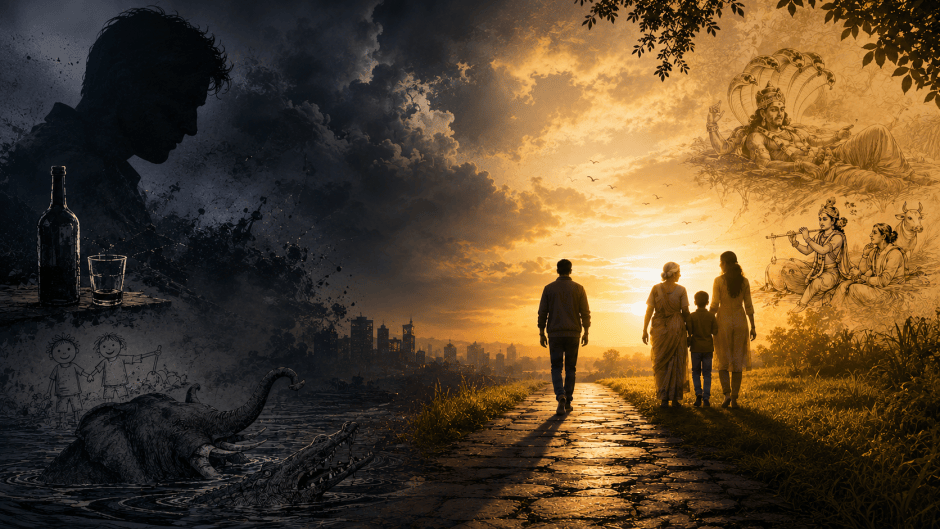
Our world is filled with conflict. With trauma, fear, pain and loss. Where there is conflict, there is raṇa-bhoomi, a battleground, filled with fear, chaos and blood. When you would come into the house, Dad, you would bring in chaos. There would be fights and fear. And there were other times at home when you were not around or were in a stupor, and Mom or Daadi would spend time with us as kids. Then our small world would transform into a rang-bhoomi. Love, ideas and help would be intermixed in our lives.
Daadi would shield us from your abuse when Mom wasn’t around. She would make food for us that I shall never forget the taste of. She sat and watched movies with us that she couldn’t understand because they were in English. She would take us to all the places we wanted to visit. I learned from my Daadi, your Mom, that a generous heart can fill a life with joyful memories. She thought of us besides thinking of herself. I guess that is how she created hope.
There was a story I read in a comic book once, about Gajendra, the king of elephants, who once entered a pond filled with lotus flowers. There, a crocodile grabbed him by his foot and tried to drown him. Gajendra struggled to escape, but the crocodile’s jaws were too strong. No one came to his rescue. Alone, he raised his trunk and begged for help. Gajendra then picked up a lotus flower and offered it to whoever was listening. Suddenly, the clouds parted, the sun shone bright, and gliding on the wind came Vishnu on his eagle, Garuda. Vishnu hurled his discus and struck the crocodile. The crocodile was forced to release the elephant-king from his terrible grip.
The story of Gajendra is a metaphor. In nature, the crocodile is not a villain and the elephant is not a victim. In nature, animals do not ask for help, and no god will come between a predator and its prey. This story is important because we can equate ourselves to it. Your neglect and abuse, Dad, could correspond to the crocodile. My sister and I struggled through the years of fearing you, wanting you to be a better parent. We tried to escape the desire for a father figure. In essence, then, we were the trapped elephant. We waited to be rescued. And in exchange, as the lotus, all we could offer to my Mom or Daadi were our own existences. They derived pleasure from us and, because they were related to us, they extended their love and help. They would be our Vishnu, emerging from the dark clouds to save the day, protect us and shield us from you. In exchange, then, they were given our admiration, support and love.
However, seen as a larger metaphor, this story represents humans dragged down by an uncaring system that impersonally consumes people to sustain itself. Animals are not designed to help, except as members of their herd or pack. But humans can help everyone, even strangers, even enemies. That is why we all have expectations of being helped. I certainly have. I am sure you must have them, too, in some form or another.
We are all children, essentially, standing before a larger-than-life system that acts as a controlling parent. I used to wish that the system would change. I wished that you would change. And there were many chances for you to change, Dad. You did not, but I realised one thing: that I could be what you weren’t. I could be more like Mom or Daadi. I could help those who were seeking help, in some form or another.
Somewhere, caught in my own feelings of inadequacy and victimhood, I realised that thinking about these things only fed my own insecurities about never having had a loving father. The world is a larger place. There are so many elephants who are still trapped in the jaws of other crocodiles. They have no jobs, no business, no income, no savings, no support; they are trapped by debt, insecurity, loneliness and hopelessness. They are crying out for help. I was so focused on my own hunger that I didn’t notice theirs. Much in the same way, you didn’t care about your family’s hunger and need.
You know who else you remind me of? Remember the time when Chacha borrowed money from the family property, and you had a row with Daadi? You behaved like the king of the gods, Indra, who focused only on his hunger and no one else’s. Like in the story when an asura defeated Indra and took all that he had. Indra sought Krishna’s help. Krishna fought the asura and restored Indra’s wealth, and Indra was grateful. However, Krishna did not just want Indra’s gratitude. He wanted Indra to be generous, to share his wealth. He asked Indra to give the Parijata tree from his garden to Krishna’s queen, Satyabhama. But Indra refused to part with this beloved tree. He feared that if he lost the tree, he would lose everything. Giving up even one tree seemed momentous. He was not willing to part with even one possession.
A fight followed between Krishna and Indra. Krishna then overpowered Indra and forcibly took the Parijata tree from Indra’s kingdom and planted it in Dwarka, his home.
You know this is exactly what happened when Daadi asked you to share. When you didn’t want to, she took matters into her own hands and gave Chacha what she wanted to give him from her own property. I guess this is why there are many temples in India to Krishna, but none for Indra. Indra is grateful for his prosperity, but he is not generous with it. You always wanted possessions. You wanted things that were not yours. You didn’t want to participate in providing, but always wanted to possess. This is why you are like Indra and could never be like Krishna.
Indra creates a raṇa-bhoomi, a battleground. You fought for your rights and your entitlements. And I am glad that I do not wish to wrestle for what is not mine. We need to create Vishnu’s rang-bhoomi, where people share and take care of each other. This is not based on laws or commandments or policies. It is based on contentment and empathy: happiness with what you have and concern for what others do not have. I learnt this from my Mom and my Daadi. They struggled to provide, but they were content with what they had. It may not have been a mansion that Mom bought for us, but the home she eventually created came out of hard work and sacrifice. She didn’t do this for herself but to secure her children’s future.
When we are not generous with wealth, we will be surrounded by people who will feel we have stolen their share of wealth. After all, the Earth from which all wealth is generated belongs to everyone. We are all Earth’s children. Why should Earth’s wealth belong to some and not all? Why should Earth’s wealth not be shared with the hungry? These are complex questions with no easy answers. But what is simple to understand is that hungry people are angry people. From hunger, conflict is created, and the world becomes a hostile place. You were angry and you remained so. Because of your anger, there was a time when I was so angry at the injustice of it all. Why couldn’t I have a better father? Why did my mother have to marry you? Why would you abuse me because of your inadequacies as a parent? In my twenties, I was so consumed with anger against all authority figures. But, over time, I have learnt from your mistakes, Dad, and my own; predominantly because I chose to focus on the examples I had that provided hope.
I think what happened last year is a wake-up call to everyone who feels and behaves like you. COVID-19 happened because there are people like you who want everything for themselves and refuse to share what they have. The Earth’s resources are being plundered as we speak. Have you imagined what it means when we say that over half of the world’s net wealth belongs to the top 1% of the entire world population? This just means that a very few people in this world corner all the wealth. Not only do they have it, but they are too insecure to share it. The rest of the population feel tricked, cheated, denied, deprived, oppressed and abandoned. When social injustice like this happens, Vishnu has to wake up.
When the Earth is happy, Vishnu sleeps under the hood and on the coils of a serpent that floats on the ocean of milk. But when the Earth cries, he descends to the realm of mortals as a mortal. He becomes a king and a cowherd, his avatars, to teach the world what it means to be human. We need to do daan. Be generous.
How difficult is it to help your domestic help when they can’t afford to buy groceries? How difficult is it to reach out to your friend who cannot pay his rent because of a pay cut? How difficult is it to take care of an abandoned animal you see on the road? Why can we not find meaning in committing the tiniest act of generosity, if we cannot be selfless?
Why must we be like Indra and think only of our hunger? Isn’t being human also equivalent to being empathetic to all? We must learn to share. If we pass on our hungers, fears and delusions, why can we also not learn to create a generous heart and a desire to share? If only we could learn to give before we ask, provide before we receive, show that we can be helpful before we ask for help. Isn’t that what being a good father means? Isn’t that what being a good human being means?
I wish you could have seen this and understood this. But your being you has taught me how not to be you. Your presence has served a purpose in my life. It has shown me what I can do better, how I can be better. I must say, you have shown me, by your example, what I should not be. And by setting that example, I can love and care for the people who care about me. If need be, I can also be there for those to whom I owe nothing. So, in essence, you were a father, since you taught me something invaluable. And so, I thank you.
In gratitude,
Your son.

 Hearts Still Care
You must be logged in to post a comment.