When a Film Becomes Memory, Music, and Something Personal
There are films you watch.
And then there are films that take you somewhere you didn’t expect to go.
Michael did that to me tonight.
I walked into a near-empty auditorium for a midnight preview—barely ten of us scattered across seats—and yet, from the very first beat of “Wanna Be Startin’ Somethin’”, I wasn’t in that theatre anymore.
I was a child again.
The First Time I Met Michael
My earliest memory of Michael Jackson isn’t from a concert or a cassette—it was from television. Someone else’s house. Early 1980s. The first time I ever saw MTV.
And there he was.
Thriller.
I didn’t have the language for what I was seeing, but I knew I was witnessing something… otherworldly. Something that didn’t belong to just music—it belonged to movement, to imagination, to rhythm that travelled straight into your bones.
As I grew up, his music grew with me—
Beat It,
Bad,
Smooth Criminal,
Billie Jean,
and so many more.
And then, in college, I began to understand the man behind the music.
We Are the World wasn’t just a song.
Heal the World wasn’t just melody.
Earth Song and
They Don’t Care About Us weren’t just performances.
They were statements.
He wasn’t just entertaining us—he was speaking to us.
The Film: A Performance Recreated, Almost Too Perfectly
Walking into Michael, I had one hope—that it would do justice to someone who didn’t just define pop culture, but reshaped it.
And surprisingly, it does.
Jaafar Jackson—his own nephew—steps into the role with a kind of precision that is almost unsettling. The voice, the pauses, the body language, the stillness before movement—it’s all there.
At moments, it doesn’t feel like imitation.
It feels like invocation.
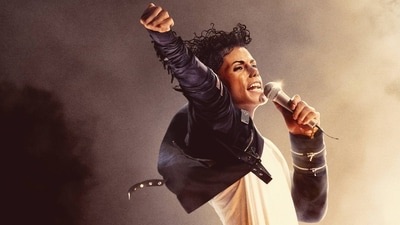
The recreations of iconic performances—Thriller, Beat It, his early Grammy stage, the London performances of Bad—are electric. Even in a nearly empty theatre, the energy felt full. Charged.
And yet, I couldn’t help but feel a quiet sadness.
How is a story like this… not filling seats?
How did we forget what global cultural history looks like when it stands right in front of it?
The Parts That Stayed With Me
There were moments I didn’t expect to be affected by.
One of them was the infamous Pepsi commercial accident—the burns, the pain, the shock. I had heard about it before, but the film brings you uncomfortably close to it. Close enough to feel the fragility behind the myth.
But what truly stayed with me was something far more personal.
His childhood.
His father.
The abuse.
There’s a moment where he asks others—lawyers, executives—to speak to his father on his behalf. And I understood that immediately.
Because I’ve lived that.
When you grow up with fear, with authority that crushes rather than guides, you don’t always find your voice directly. Sometimes, you borrow someone else’s.
Watching that wasn’t just watching Michael.
It was watching a version of myself I’ve known too well.
The Mother, The Apology… and What It Opened in Me
There is a scene where his mother says something I have never heard in my own life:
“I’m sorry I couldn’t protect you.”
And in that moment, something shifted inside me.
Because I realised—that absence of apology leaves a mark.
A quiet, persistent fracture.
It made me confront something I still carry. Not anger alone, but the weight of something that was never acknowledged.
This is what powerful cinema does.
It doesn’t just tell a story.
It reveals your own.
The Man Behind the Myth
The film also leans heavily into Michael’s gentleness—his love for animals, his childlike wonder, the softness that existed alongside his genius. His closeness to Barrie’s Peter Pan and the idea of Neverland. Guess what I have tattooed on my left arm. Tinker bell and Peter Pan soaring through the sky in silhouette.
At times, it feels almost too kind. Almost protective. There’s a noticeable absence of anything that might complicate his image.
Is it whitewashing?
Perhaps.
But it also raises a question—what if this was him, at his core?
And if it was, then the world didn’t just lose an artist.
It lost something far rarer.
Direction, Rhythm, and Restraint
From a filmmaking perspective, Michael understands balance.
It doesn’t drown you in music, nor does it strip it away. It moves between performance and personal life with a rhythm that feels intentional. The edits are sharp, the pacing controlled, and the emotional beats are given just enough space to land.
And importantly—it knows when to stop.
The film ends with his London performances, with a quiet suggestion:
His story continues.
And I hope it does.
Because there is so much more left to explore.
Final Thoughts
I walked into the theatre expecting a biopic.
I walked out having revisited my childhood, my relationship with music, and parts of myself I usually sit with.
Michael isn’t perfect.
But it is sincere.
It is immersive.
And at times, deeply, unexpectedly personal.
And perhaps the saddest part of the night wasn’t anything in the film—
It was how few people were there to witness it.

