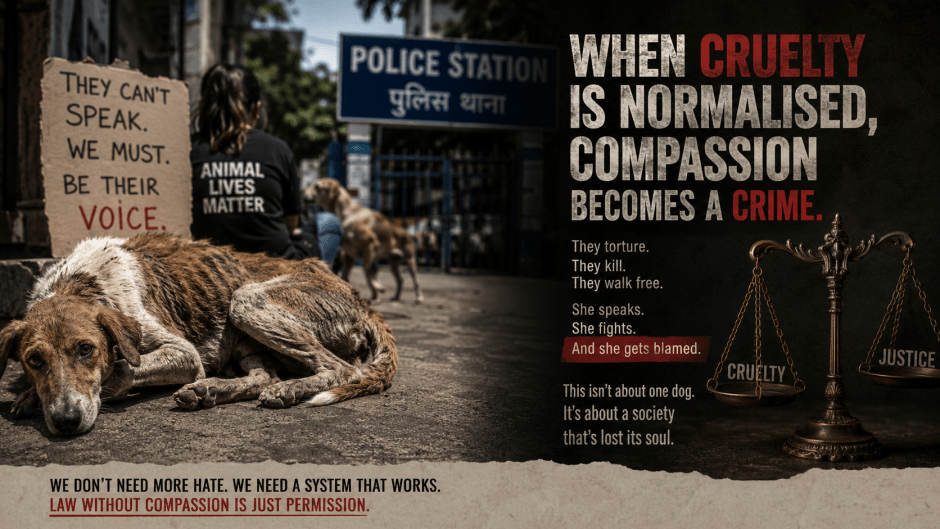
I watched a disturbing video yesterday involving an animal activist who had allegedly just learned that a rescued dog she cared about had died after being brutally assaulted. The injuries described were horrific — a broken spine, shattered legs, a helpless animal beaten so severely that it did not survive. Standing near what appeared to be a police station, she confronted the man accused of the act and physically lashed out.
And what frightened me was not the activist’s anger.
What frightened me was understanding it.
Because there was a time when people believed institutions would intervene before human beings reached emotional breaking points. There was a time when the law felt like an authority citizens could turn towards rather than a maze they had to emotionally and socially exhaust themselves navigating.
But what happens when people lose faith in that protection?
What happens when acts of cruelty towards animals are repeatedly trivialised? When FIRs become uphill battles? When enforcement feels inconsistent, delayed, indifferent, or absent altogether? When ordinary citizens begin to feel that vulnerable beings have no meaningful protection unless someone physically stands between them and violence?
That is the point at which societies become dangerous.
Not because activists are angry, but because institutional trust has eroded so deeply that anger begins replacing faith in due process.
And perhaps the most demoralising part is this: I already know what will happen next.
The activist will be dissected more thoroughly than the cruelty itself.
People will analyse her rage frame by frame. They will call her unstable, hysterical, uncivilised, aggressive, emotional. Endless debates will emerge about whether she “went too far,” while far less energy will be spent confronting the suffering that triggered the reaction in the first place.
That is the pattern now.
The person who breaks emotionally under the weight of repeated brutality becomes easier to scrutinise than the brutality itself.
Because outrage against cruelty demands moral participation. Outrage against the activist is safer. Cleaner. More socially comfortable.
Anyone involved in rescue work in India already knows this emotional fatigue intimately. Feeders and rescuers are constantly told to “follow the law,” yet often find themselves struggling simply to have cruelty acknowledged with seriousness. Meanwhile, street animals continue suffering through beatings, illegal relocation, starvation, dehydration, and neglect while much of society either looks away or actively resents the people trying to help them.
And perhaps that resentment reveals something deeply broken in us.
Because no one carrying food and water through burning summer nights for thirsty animals is doing it for power or profit. They are responding to visible suffering. They are filling a moral vacuum left behind by public apathy and institutional weakness.
Yet increasingly, compassion itself is treated as provocation.
People complain about feeders while ignoring the conditions that create suffering in the first place. Cities expand without ecological thought. Heat intensifies. Concrete replaces shade. Human beings create brutal urban environments and then grow irritated at the sight of animals trying to survive within them.
What disturbs me most is not isolated cruelty, but the emotional climate surrounding it. The normalisation. The numbness. The speed with which empathy is dismissed as impractical sentimentality.
I used to believe very deeply in patience, dialogue, and peaceful civic engagement. And I still believe societies cannot survive if citizens abandon law altogether. But I now understand how dangerous it becomes when people feel the law has already abandoned the vulnerable.
Because once citizens stop believing institutions care, they stop emotionally investing in institutions at all.
That is the real warning sign.
Not one activist losing control in grief and rage, but an entire culture steadily losing confidence that justice, compassion, and accountability still function in any meaningful way.
And if that trust collapses completely, we will not merely have failed animals.
We will have failed the very idea of civilisation itself.

