
When understanding scares me

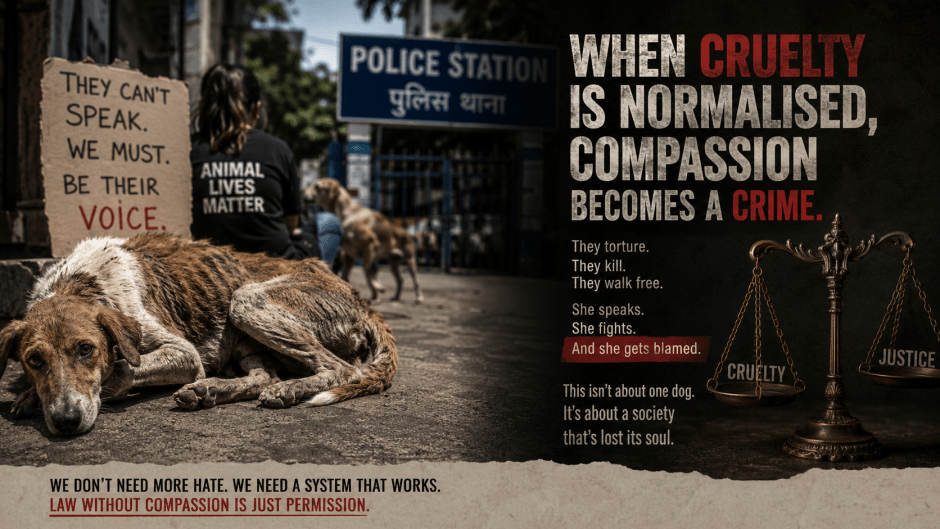
I watched a disturbing video yesterday involving an animal activist who had allegedly just learned that a rescued dog she cared about had died after being brutally assaulted. The injuries described were horrific — a broken spine, shattered legs, a helpless animal beaten so severely that it did not survive. Standing near what appeared to be a police station, she confronted the man accused of the act and physically lashed out.

And what frightened me was not the activist’s anger.

What frightened me was understanding it.

Because there was a time when people believed institutions would intervene before human beings reached emotional breaking points. There was a time when the law felt like an authority citizens could turn towards rather than a maze they had to emotionally and socially exhaust themselves navigating.

But what happens when people lose faith in that protection?

What happens when acts of cruelty towards animals are repeatedly trivialised? When FIRs become uphill battles? When enforcement feels inconsistent, delayed, indifferent, or absent altogether? When ordinary citizens begin to feel that vulnerable beings have no meaningful protection unless someone physically stands between them and violence?

That is the point at which societies become dangerous.

Not because activists are angry, but because institutional trust has eroded so deeply that anger begins replacing faith in due process.

And perhaps the most demoralising part is this: I already know what will happen next.

The activist will be dissected more thoroughly than the cruelty itself.

People will analyse her rage frame by frame. They will call her unstable, hysterical, uncivilised, aggressive, emotional. Endless debates will emerge about whether she “went too far,” while far less energy will be spent confronting the suffering that triggered the reaction in the first place.

That is the pattern now.

The person who breaks emotionally under the weight of repeated brutality becomes easier to scrutinise than the brutality itself.

Because outrage against cruelty demands moral participation. Outrage against the activist is safer. Cleaner. More socially comfortable.

Anyone involved in rescue work in India already knows this emotional fatigue intimately. Feeders and rescuers are constantly told to “follow the law,” yet often find themselves struggling simply to have cruelty acknowledged with seriousness. Meanwhile, street animals continue suffering through beatings, illegal relocation, starvation, dehydration, and neglect while much of society either looks away or actively resents the people trying to help them.

And perhaps that resentment reveals something deeply broken in us.

Because no one carrying food and water through burning summer nights for thirsty animals is doing it for power or profit. They are responding to visible suffering. They are filling a moral vacuum left behind by public apathy and institutional weakness.

Yet increasingly, compassion itself is treated as provocation.

People complain about feeders while ignoring the conditions that create suffering in the first place. Cities expand without ecological thought. Heat intensifies. Concrete replaces shade. Human beings create brutal urban environments and then grow irritated at the sight of animals trying to survive within them.

What disturbs me most is not isolated cruelty, but the emotional climate surrounding it. The normalisation. The numbness. The speed with which empathy is dismissed as impractical sentimentality.

I used to believe very deeply in patience, dialogue, and peaceful civic engagement. And I still believe societies cannot survive if citizens abandon law altogether. But I now understand how dangerous it becomes when people feel the law has already abandoned the vulnerable.

Because once citizens stop believing institutions care, they stop emotionally investing in institutions at all.

That is the real warning sign.

Not one activist losing control in grief and rage, but an entire culture steadily losing confidence that justice, compassion, and accountability still function in any meaningful way.

And if that trust collapses completely, we will not merely have failed animals.

We will have failed the very idea of civilisation itself.

They Can Only Hope

They can’t explain their hunger to you.

They can’t tell you they want your care.

They can only hope you won’t tie them up,

and drag them behind your motorbike,

until they rip apart, long after they strangulate.

They can only hope you give them a kind thought,

and allow them to crawl into the shutter gap,

away from the torrential rains,

your own greed has brought into the world.

They can only hope you won’t use plastic

to wrap their helpless newborn children,

and toss them in flowing or stagnant water,

or take time to bury them alive.

They can only hope.

Because they don’t know human beings.

They don’t know the stupid wars you fight,

and the way you shoot down anyone

who doesn’t belong to the majority vote.

They don’t know your history and greed.

They don’t know you have invaded their lands

and driven them out.

Your acts of genocide are unknown to them.  

They can only hope that you may give them a scrap of unwanted food,

under a godless sky, over a parched cement block,

and maybe just maybe 

let them be.

When Two Judges Can Move Thousands of Dogs—but Five Judges Won’t Move on Marriage Equality

India just witnessed something extraordinary: a two-judge bench of the Supreme Court ordered Delhi–NCR to round up every stray dog and move them into shelters within eight weeks, warning of contempt for anyone who resists. The order, passed on 11 August 2025, explicitly rubbishes the government’s own Animal Birth Control (ABC) Rules, 2023—which require sterilise-vaccinate-return (SVR) and bar relocation. Meanwhile, on the fundamental question of marriage equality, a five-judge Constitution Bench in Supriyo v. Union of India (17 Oct 2023) declined to recognise same-sex marriage, saying Parliament must act. The contrast is stark—and troubling.       

The duplicity problem

• On stray dogs (2025): Multiple outlets report the Supreme Court directed MCD/NDMC/Noida/Gurugram/Ghaziabad to remove all street dogs to shelters and never release them back—contrary to ABC 2023’s core SVR principle. Reports also quote the bench calling the “sterilise and return” rule “absurd”, and warning NGOs not to obstruct. Subsequent coverage shows the CJI indicating the Court “will look into” conflicts with earlier SC positions that barred killing/relocation.     

• On marriage equality (2023): A five-judge bench held that recognising same-sex marriage under the Special Marriage Act is for Parliament, not the Court. The Court acknowledged discrimination against LGBTQ+ people but refused to read queer couples into the SMA, instead suggesting a government committee to consider limited benefits.    

If a two-judge bench can, in effect, override a central rule and upend the ABC policy nationwide (de facto, via a Delhi–NCR precedent), why was a five-judge bench unwilling to interpret the SMA to uphold equal citizenship? The institutional posture flips: muscular, near-legislative urgency for dogs; judicial restraint for queer families.

Why the dog order is legally and practically dangerous

• Conflicts with law & policy: The ABC Rules, 2023 (notified under the Prevention of Cruelty to Animals Act) codify sterilisation, vaccination, and return to the same locality. They also provide for designated feeding points and humane management. The SC’s relocation directive collides with this framework.   

• Unworkable on the ground: Delhi–NCR lacks the shelter infrastructure to permanently house tens of thousands of dogs. Civic bodies and activists warn of overcrowding, disease, and cruelty if mass detention is attempted. Even cities outside NCR are saying they simply cannot emulate this model.   

• Counterproductive for public health: ABC’s SVR model is designed to reduce bites and rabies by stabilising territorial packs and maintaining vaccination coverage. Forced removals often trigger ecological gaps, influx of unvaccinated dogs, and more conflict.  

Given these risks, the Court’s willingness to make a sweeping, arguably suo motu-style intervention (as several reports characterise it) feels less like adjudication and more like policy-making.  

Meanwhile, queer couples are told to wait for Parliament

In Supriyo, the Court affirmed dignity and non-discrimination but declined to provide a workable remedy through interpretation—despite doing exactly that in many rights cases. It was content to ask the executive to study “benefits” while keeping the door shut on equal marriage and adoption. For LGBTQ+ Indians, the message is: your equality is a legislative grace, not a judicial guarantee.  

Is this about politics?

I worry this sudden, headline-grabbing “law-and-order” posture on dogs is a political distraction at a time when allegations about election integrity are flaring. Rahul Gandhi and the Congress have launched campaigns on “vote theft,” citing manipulation across dozens of constituencies and fake voters—charges that, if true, strike at the heart of democracy. These remain allegations, and must be investigated transparently; but the timing is conspicuous.   

What the record shows (for readers who want the receipts)

• Stray dog order (Aug 11, 2025): Reuters, Indian Express, DD News and others report the Court directed capture and relocation to shelters within eight weeks; follow-ups note possible review because of conflicting past orders.     

• ABC Rules, 2023 (Mar 10, 2023): Government-notified rules mandate sterilise-vaccinate-return, designated feeding areas, and humane management by local bodies/AWOs.   

• Marriage equality (Oct 17, 2023): Five-judge bench in Supriyo declines to recognise same-sex marriage; says Parliament must decide; suggests an executive committee for limited rights. Official judgment and reputable summaries available.   

• Election integrity claims (Aug 2025): Rahul Gandhi alleges “vote-chori” in 48 seats, protests announced; these are currently claims by the opposition, not findings by a court or inquiry.   

My stance

When courts flex power to reorder city life overnight—but plead restraint on core constitutional equality—the result feels like duplicity. Stray dogs are not pawns in a political game; they are sentient beings protected under our laws. Delhi–NCR should implement ABC 2023 rigorously—high-coverage sterilisation, mass anti-rabies vaccination, monitored feeding points, quick response to aggression—rather than unlawful, unscientific mass detention. And LGBTQ+ Indians deserve more than dignity in theory; they deserve equality in fact.

If we can uproot an entire animal-management regime with two signatures, surely we can find the constitutional courage to read equality into our marriage laws—or at the very least, to stop treating queer rights as someone else’s homework.

Note on sources & fairness: I’ve cited mainstream reporting, government notifications, and the Supriyo judgment. The bench composition and some characterisations (e.g., “absurd” remark on SVR) come from multiple reports; if the Court issues a formal clarification or stay, that will need to be reflected. Allegations of “vote theft” are presented as claims by Rahul Gandhi and the Congress, pending independent verification.