The Weight of Love

On Monday, I took Xena to see Dr Dipti. She has always been steady and clear with me, never dramatic, never vague. She told me that the mast cell cancer may have reached her lymph nodes. She saw new tumours forming around Xena’s right eye. The large mast cell tumour on her chest — the one we have been monitoring so closely — has grown from three centimetres to four.

She said Xena’s pain would likely sit at four or five out of ten. Not sharp. Not acute. Chronic. A quiet inflammation spread through the body. Not the kind of pain we recognise with a cry — but the kind that lingers like background static.

I see it. The tumours are multiplying. Three on her chest. One large one on her hip, exactly where the nappy used to tie — I have stopped using it because the friction made it form and then bleed. Another one near the collar of her T-shirt. So now, before she slept, I removed the shirt. I bandage the lesions under her chest so she does not scratch at them in the night.

Every evening, my mother, Anand and I sit down together and dress her wounds. Paraffin gauze. Gauze. Fixomull tape. Earlier we were using silver nitrate and Placentrex; now we are more careful, more protective. I give her Maxmoist epithelial cyclosporine drops. Ocupol DX for her eyes. She is on Keppra, Gabapin, Avil, Famocid, Condrovet, Sucrafil, Prolivit, Quercetin, Ceterizine. The list feels endless. She is filled, almost overflowing, with medication.

And yet — at five o’clock l, every evening, and a half hour after midnight — she rises.

She lifts her head. She takes a toy in her mouth. She runs after Zuri. Given half a chance, she will steal the toy from Zuri’s mouth as well. There are tumours on her paws, on her hips, on her chest, near her eye. There is a lipoma near her anus that we clean gently every day. Her body is fighting a war. She still wants to play in the sunset. 

That is the cruelty of this stage. The body falters. The spirit does not.

Dr Dipti gently said that we need to start thinking about letting her go. I called Geeta immediately. She was in Jammu. She took a flight and came down last night. That is what love looks like in our family — we gather when it matters.

I am not ready. Not after losing Zach less than a month ago. I cannot bear the thought of losing another child so soon. It feels like Zuri all over again — that tearing open of the chest, that helplessness.

Xena is my baby girl. She came all the way from Bangalore in a tiny crate. She was smaller than a foot when I first held her. A fragile, wee little thing who trusted me without question. She grew into the most intelligent, observant companion. On walks, if she is ahead of me, she turns to check if I am following. If Anand is about to take them downstairs and I step into another room, she comes back to ask when I am coming along. She waits for me.

She has seen everything.

She has seen Rajmahal. She has seen me in love and in heartbreak. She has witnessed my journey through open relationships and the quiet complexities that come with them. She has seen my buas — Munni and Goodie Pua. She has known my aunts while they were alive. She was there when my mother came through cancer. She saw me emerge from a very dark space in my life. She lived through COVID with us. She was there when my father died. When my aunts died. She has watched the seasons of my becoming.

Like Zach.

Our dogs are not just companions. They are witnesses. They are milestones in our histories. 

I know this path was inevitable. I always knew. Loving animals means accepting that their time is shorter than ours. I have said goodbye before — Zach, Zoe, Rolfe, Diana, Bonzo. I survived each time. I still think of them. I still love them.

I know I will survive this too.

But survival does not cancel heartbreak.

Tonight, I removed her T-shirt and bandaged her gently. I had to put a cone around her neck because she paws at the lesion near her eye. She settled down, trusting me as she always has.

And I sit here wondering: when is the right time?

She still eats. She still drinks water. She still wants to go out. She still plays at five in the evening. She still loves me with everything she has.

How do you measure the end when love is still present?

How do you decide when a body that is failing still houses a spirit that shines?

I do not have the answer yet. I only know that whatever happens, she has been brave beyond measure. She has lived surrounded by devotion. 

And – if love could cure cancer, she would have been immortal.

After Everyone Leaves

When the funeral is over, and the house finally empties of people, grief does something cruel and ordinary at the same time. Life resumes. Chores return. The day demands to be lived — and that is when the absence announces itself.

Not in grand ways. In small, brutal details.

The food bowls are the first thing I notice. I used to juggle three every day. Now I carry two, one in each hand, and my body still prepares for the weight of the third. Muscle memory has not yet learnt loss.

In the corner of the room, his mattress sits unused. The edges are stiff with dried drool — the very drool everyone used to shy away from. Zach was intensely affectionate. He loved with his whole body. And yet, visitors would dodge him, hold their clothes away, laugh nervously.

“Zach, sit down.”

“Zach, go away.”

He never understood why love had conditions.

The medicine chart still hangs on the fridge — morning, afternoon, night — followed meticulously, desperately, faithfully. A quiet record of how hard we tried. His leash hangs with the others, but his remains vacant. I notice the name tag first. Zachary. Still there. Waiting.

Then comes the first midnight walk without him.

We step out as a family, no one leaving anyone alone. The girls walk beside me, steady and present, as if they instinctively know that this is not a walk — it is an endurance test. I see the spot where Zach always stopped to pee. He took his time. He ambled. He was a big boy. He occupied space without apology.

And now that space is painfully, offensively empty.

I don’t have many grand things to say about our relationship, except this: I loved him. Fiercely. Quietly. In the way fathers often do with sons. It wasn’t demonstrative. It wasn’t dramatic. But it was solid.

Nothing like my relationship with my own father — because Zach always looked to me for help, for reassurance, for safety. And I always told him the same thing: I’ve got your back.

I used to sing to him —

You’re my honey bunch, sugar plum, pimply imply umpkin —

and he would come charging towards me, tail wagging wildly, a weapon that bruised shins and toppled objects. Love, again, without restraint.

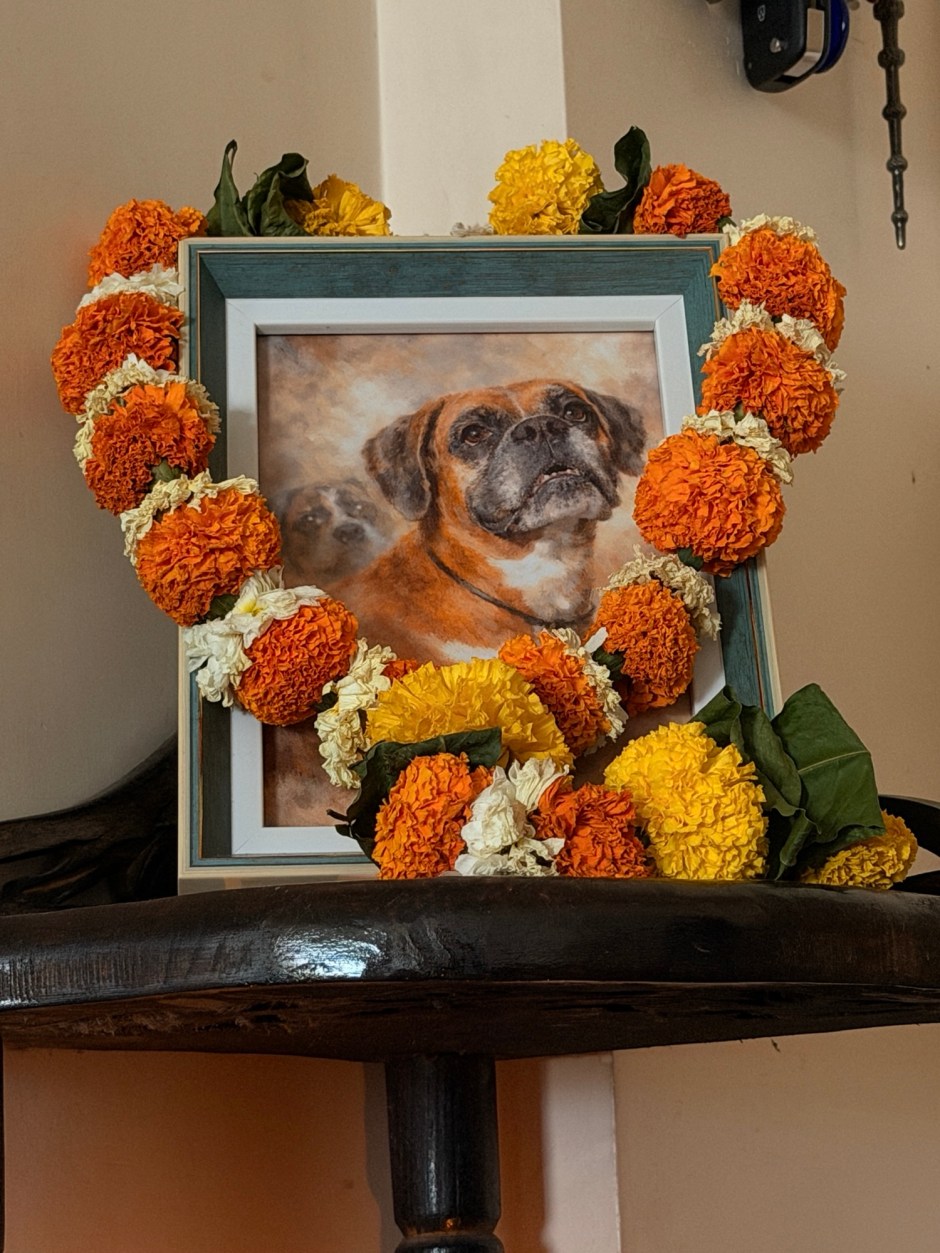
The house feels hollow now. Zach was a large presence — lumbering, filling up rooms, claiming corners, leaning his weight into life. The gentlest boxer dog. The sweetest. And according to everyone in the family, one of the most handsome dogs they had ever seen.

He knew my aunts.

He lived through Covid with me.

He witnessed deaths.

He stood beside me through grief before becoming its centre.

He was my baby.

My baby boy.

And he has taken a piece of my heart with him.

People often talk about grief as something that arrives suddenly, but this grief has been rehearsed for months. Living with two terminally ill dogs teaches you anticipatory mourning — the long, slow exhaustion of loving while preparing to lose. And yet, when the moment finally comes, it still catches you unprepared.

Condolences arrive. Kind words follow death easily. But the real work of grief happens afterwards — when no one is watching, when the house is quiet, when memory ambushes you in ordinary moments.

These memories will keep jolting me as the days go on. I know this. I have seen enough death to know that time dulls the sharpest edges. Pain becomes a low ache. Survivable. Livable.

But not yet.

Right now, I am grief-stricken.

Right now, I am wracked with pain.

Right now, love has nowhere to go.

And so it lingers — in empty bowls, unused leashes, dried drool, midnight walks, and a father that remembers him even when the world moves on.

Pain

At this turn of fifty,
the pain isn’t figurative —
it is literal.
It’s a corporeal manifestation
of what used to be
poetic and tragic.

Youth broke hearts,
and feelings tore innards.
The joke is that the heart
still breaks —
and now it’s not just that pain:
the shoulder, the knee, the heel.

The validation of abstractions
into the concrete.
What divine irony.

Mary Carson said it best
all those years ago:
Nature is cruel.
Man, vindictive.

Age gives you wisdom —
and the price was always
pain.