The Complexity of Lies

Today, I came across a quote that struck a chord: “I was never asking for too much. I was just asking the wrong person.” It made me pause. Lately, I’ve been feeling disillusioned by the people I love, grappling with the simple yet profound expectation of love and honesty. I don’t think I ask for much—just truth, just sincerity. After all, if you truly love someone, wouldn’t honesty be a natural part of that love?

But love and honesty don’t always go hand in hand. We like to believe they do, that love is built on trust and truth, yet relationships often prove otherwise. People lie. And while some lies may stem from fear, self-preservation, or misguided intentions, the fact remains—lies hurt.

I’ve been trying to understand why people lie, particularly to those they claim to love. One could argue that lying is often a reaction to anticipated consequences. The person who lies knows the truth will likely cause disappointment, anger, or pain. But that’s precisely where the contradiction lies—if you know the truth will hurt someone, and you love that person, why lie in the first place? Isn’t deception, in itself, an act of disregard for the person’s feelings?

This brings me to a difficult realisation: lying is not about the character of the person being lied to, but rather about the one doing the lying. A liar weighs the truth, measures the possible reactions, and makes a calculated choice to conceal it. And in making that choice, they assume control over how another person experiences reality. That’s what makes dishonesty so cruel—it robs the other person of the right to respond to life with full knowledge.

Yet, the irony is that truth, no matter how deeply buried, always finds its way out. Lies are never simple; they are layered, tangled, and exhausting to maintain. The truth, on the other hand, is straightforward. It may not always be easy, but it is never as complicated as the web of deceit spun to hide it.

So, if love is real, if it holds any meaning beyond sentiment, then honesty must be part of it. Because love without truth is merely an illusion—fragile, fleeting, and destined to shatter.

The Favourite

Growing up, I was incredibly close to my grandmother. I called her Dadan, an affectionate term for Daadi, which means grandmother in Hindi/Punjabi. She was my rock, my constant source of warmth and love. I was also the favourite of both my paternal aunts. The eldest, who had stepchildren, and the youngest, who had no children of her own, poured their affection into me. My youngest aunt, during her courtship days, often took me along on her dates. Together, we visited beautiful hotels and places, and those moments felt magical in my childhood. When she married, I was only six years old, and her absence created a void. I felt as though I had lost a cherished friend.

[l-r]Munni Pua, Dadan, Goodie Pua and me (in the corner)

But my grandmother, my Dadan, made up for that loss in every possible way. She loved me fiercely, making me feel like the sun and the moon in her eyes. I felt it too, deep in my soul. My cousins and sibling often claim, to this day, I was spoiled by her and my aunts. Perhaps I was, but their love shielded me from a harsher reality. My parents were far from ideal. My father was abusive, an alcoholic, and, from the age of 13 to 19, his physical violence escalated, fuelled by his hatred for my sexuality. My mother, meanwhile, was preoccupied with earning a living and running a household. She was emotionally distant, perhaps sensing that I was different and not the son she had envisioned. She redirected her energy towards my younger sister, Geetanjali, who, being four years younger, became the focus of her affection and aspirations.

[l-r] Me, Dadan, Geeta

When my mother left the joint family, taking me away from my grandmother, I was about to turn 13. My sister was barely eight or nine, giving my mother ample opportunity to mould her into the perfect daughter. I, however, remained the imperfect son—a reminder of the family my mother was trying to leave behind. I was the unique link between her new life and the one she had given up, while my sister became her connection to her own family. This duality shaped our relationships, and as the years passed, I felt punished for the love I had received from my paternal grandmother and aunts.

[l-r] Me, mom, Geeta.

At the time, I couldn’t understand any of this. All I knew was that I wanted to maintain my bond with my grandmother and aunts, but distance creates rifts in even the strongest relationships. Back then, mobile phones weren’t available, and my home life became a nightmare of abuse and violence. After a particularly horrific incident, where my father nearly strangled me, my mother finally decided to pursue divorce. This further deepened the distance between me and my paternal family.

Dadan

In my twenties, I reconnected with my eldest aunt. By then, I was navigating the aftermath of a failed relationship and battling severe depression. Our bond took on a deeper, more complex meaning, rooted in shared pain and an understanding that transcended words. But by the time my grandmother passed away when I was 25, I felt as though a part of my heart had been burned away, leaving a scar that would never heal. She had been more of a mother to me in those formative years than my own mother, and her absence left an aching void.

[l-r] Goodie Pua, Me, Munni Pua

Now, as I look back, I realise that my grandmother’s love was the anchor that held me steady. With her gone, and both my aunts having also passed away, I feel as though I have lost the last remnants of unconditional love in my family. Today, it often feels like my mother and sister are united against me. While this may not be entirely true, the feeling of alienation is overwhelming. It’s as if the familial bonds that once nurtured me have unravelled, leaving me adrift.

I wish I could remember more vividly the years between one and twelve when love and warmth surrounded me. Perhaps those memories would balance out the lack of affection I feel now. But dwelling on the past serves little purpose, except to remind me that, for a time, I was truly loved, cherished, and cared for. That knowledge is both a comfort and a sorrow, a bittersweet reminder of what I have lost.

Love Means Always Having to Say When You’re Sorry

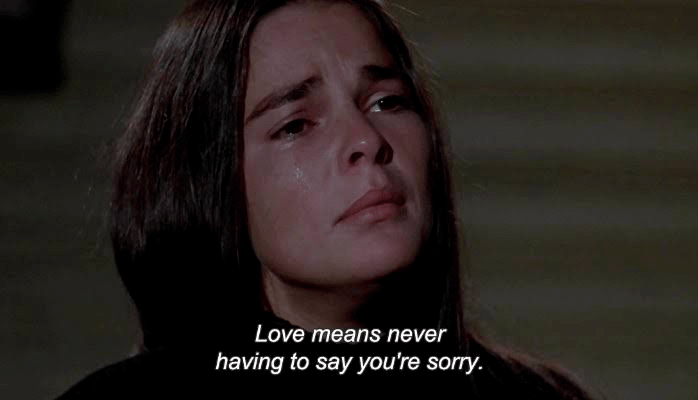
In Love Story, when Ali McGraw says, “Love means never having to say you’re sorry,” she offers a sentiment that I find deeply flawed. For me, love does mean saying you’re sorry – and often. When you care about someone, and your actions cause them pain, that pain becomes even more significant because of the love between you. It’s precisely why acknowledging that hurt and apologising is so crucial.

Consider a situation where you’ve made plans with someone. You’re delayed for reasons beyond your control, and by the time you arrive, they’ve been waiting for you – possibly having made all the necessary preparations and feeling excited to see you. When you finally get there, instead of offering an apology, you brush off the delay because it wasn’t your fault. You expect the other person to simply understand that external factors were to blame. However, this kind of thinking overlooks the other person’s feelings. Even though the delay wasn’t deliberate, the other person has still been affected by it.

This is the key issue: it’s not always about fault or blame. When we love someone, we need to consider how our actions, even if unintended, impact them. Love isn’t just about being right; it’s about understanding and acknowledging the other person’s emotional experience. Skipping the apology sends a message that their feelings don’t matter – that their hurt is irrelevant. It builds quiet resentment, and over time, this neglect can lead to the erosion of a relationship.

Add to this the fact that even when we know each other very well, there are always moments when we unintentionally hurt those we love. It might be something as simple as not being able to be quiet when your partner needs rest. If one person is disturbed and unable to sleep, it may be because the other finds it hard to stay quiet. Now, the person who has been disturbed could easily think, “Why can’t you just be quieter when I need it?” But instead of expecting that understanding, love should prompt the person who caused the disturbance to acknowledge it and apologise. That’s what love is about: trying your best to ensure the other person’s comfort. And if you can’t meet their needs in that moment, then at least show you recognise that by saying sorry.

The failure to apologise, to simply assume the other person should understand, misses the point of love’s emotional exchange. In fact, I believe this is why many relationships struggle. We often excuse ourselves, thinking that external circumstances, or aspects of our personality, excuse the hurt we’ve caused. But we forget that the hurt is real, regardless of fault. The key is to acknowledge it – to take responsibility for the emotional consequences of our actions, even if those actions were beyond our control.

Returning to Love Story, it’s worth noting that the idea of “never having to say you’re sorry” can also be seen as a reflection of patriarchy. When Ali McGraw’s character says this to Ryan O’Neal, she’s essentially excusing him from taking responsibility for her feelings, giving him a pass simply because they’re in love. But that’s not how love should work. When you love someone, you should be even more motivated to show that you never want to hurt them – and that if you do, you’re sorry for it, even if you didn’t mean to cause the pain.

At its core, love is about effort – about trying your best to make the other person comfortable, happy, and valued. When you can’t achieve that, an apology is the least you can offer. It’s not just about taking blame; it’s about showing empathy, understanding, and a desire to make things right.

Ultimately, love means always being willing to say you’re sorry when your actions, however unintentional, hurt the person you care about. An apology is not about blame or fault. It’s about recognising the emotional weight that love carries and showing that the other person’s feelings matter. After all, love is what makes those apologies – those simple acknowledgments of shared vulnerability – so necessary.