I have always been a fan of fantasy. Before I began my journey with the books of Tolkien, Rowling, Paolini, Guin, Pullman, I devoured Enid Blyton, Tintin, Asterix and then historical romances. Yep, I am a sucker for a happy ending and knights in shining armour. Then you have Strider, blazing through the North and rescuing Frodo. Gandalf the Grey standing at the bridge of Khazad-dum and yelling, well, you know. And then when I turned 23, at the pinnacle of heart break, a friend gifts me my first Harry Potter. In it, he inscribes, “to magic your pessimism away.”
I will never forget that. Twenty-two years later we still reminisce on that moment. But twenty-two years later, Rowling tweets, “Dress however you please. Call yourself whatever you like. Sleep with any consenting adult who’ll have you. Live your best life in peace and security. But force women out of their jobs for stating that sex is real?” With this she declared herself firmly on the side of a transphobe who refuses to acknowledge that people born as men can transition into women and vice versa.
There are so many things wrong with the world today. Too many to count. I have been disillusioned and crestfallen at the plight of humanity. Through the years, though I have been allowed to build certain notions about certain people. People who otherwise seem woke. I mention this because I have people whom I love and cherish, who love me in return, but who have blinded themselves to certain political stances that abuse basic human rights. These are people I live with and break bread with.
So, I understand that everyone has a right to their own opinion. But some opinions are just – so against open-minded thought. How can I not say that the opinion is wrong? One of my friends, who is well-versed in mythic structures, tells me how the west, rooted in Abrahamic thought, sees things as absolutes. These are black and white pillars, with not a shred of grey in between. And I would argue with him about Tolkien and Rowling…
Irrespective of the fact that Sauron is all evil, I point out that Gollum is an amalgamation of grey. Irrespective of the fact that Voldemort is purely black, I point out how Harry and Ron both show tendencies of the negative. For the sake of what I am feeling, I will restrict this piece to Rowling. She helped me leave the world that seemed so bleak, at a time when my heart broke by the shattering of a first love. She took me into a flight of fantasy that I had not felt since I understood Tolkien. I loved Hedwig and I loved Hermione and I loved Dumbledore.
I have been effeminate growing up. I have been ridiculed and harassed and bullied. I have been beaten and terrorised by my own father, for being a boy who was understanding a different sexuality. I learnt to behave in a certain way through fear and conditioning by my peers. I never thought that I needed to transition. I was asked this once by a very dear aunt. I knew I liked boys then, I knew I was gay and I did not want to transition into a woman. But I followed all stories of any alternate sexuality and I felt a bond with them, like most of us who are searching for camaraderie and similarity, in a world that doesn’t make sense and that is bent on rejection, instead of acceptance. I learnt that the world is built from many, many colours and mine could be my own and I could allow it to be different, at different times.
Life is fluid.
When I read Harry Potter and the Sorceror’s Stone, I wondered why this stark differentiation between Slytherin and the rest of the houses? Would all Slytherins prove to be negative? When I read Harry Potter and the Prisoner of Azkaban, I identified with Remus Lupin. But Rowling had other plans for him with Tonks. Then I realised something unexpected was afoot, when Dumbledore takes Fawkes and disappears from his office in Harry Potter and the Order of the Phoenix. “He’s got style” could be said of so many queer people, after all. The hints of his relationship with Grindelwald made me squirm with joy. But nothing was ever – ever – overtly mentioned. I made arguments on the reason for this. I stood up for her writing.
As I read Harry Potter and the Half-Blood Prince, I was so consumed by the brilliance of Snape, I avoided the horror that was the portrayal of Voldemort. The dark in the villain let in not a shred of light. He became Palpatine, he became Sauron. There was nothing fluid there. It was just a void. That was the only book of the series that I read only once.
After the series ended, after the Deathly Hallows broke its records, after the hoopla died down, she calmly mentioned that Dumbledore was gay, in 2007. When I heard the news, I was over the moon. Gradually, I heard the arguments of how she had kept Dumbledore in a closet according to convenience and how she outed him as per similar suitability… of course, I once again had my arguments ready. She didn’t need to explain his sexuality when she had hardly mentioned anything much about his past in the first place. And Dumbledore was hardly a happy character, he was manipulative, a recovering fascist, a person who believed in ultimate sacrifices from those who could only be conceived as ‘casualties of war’. Although there was one question, I never really asked –
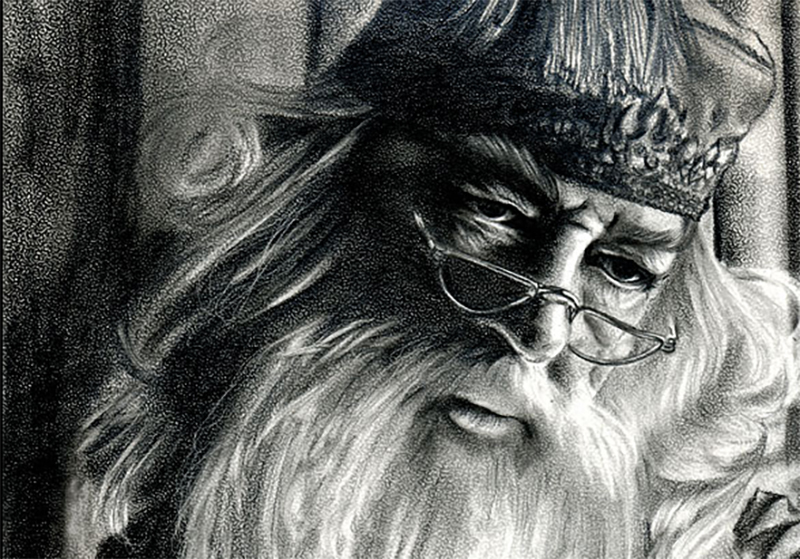
Would it have made a difference to me, as an out, proud, gay man? All those years ago, while getting over a heart break, and worrying about society, and coming out and father figures letting me down… would it have made any difference to read if someone I admired in a fictional work, that was breaking records all over the world, that was bringing children back to the written word? Would it have? Would it have made a difference knowing that the Dumbledore, I grew with in the course of a decade, was gay? That Dumbledore who had a twinkle in his eyes, who wore outlandish clothes and said the most bizarre and beautiful things, who helped the main three at every turn, who so, so many looked up to, was gay?
Simply put, yes.
On a blog, a writer stated, Rowling “has fetishized Dumbledore’s gay pain so much that she is unwilling to write any healing for him.” Which is a complete fact. Both the homosexuals, in the series, suffer and probably, justifiably, but there you have it – crime and punishment. Where is the rising above? Where is the buoyancy of spirit? Where is the resurrection? Where is the coming out – if not of sexuality, of love? Queer identity, by its history, finds momentum by acts of bravery and expression. But I forget, that happens in the real world, in my world.
On 19th December, 2019, I read Rowling’s tweet. At first, I thought I mistook the meaning behind what was written. Then I searched for context. I found it. I understood it. Then read the tweet again. I was shaken. At that point in time, I understood that she did not understand. She, like so many others in life, did not comprehend the beauty of difference, of diversity and the spectrum of existence. None of us can know it all. Most of us try. She was not one of those. Hermione Granger would probably look at her creator and cringe … because irrespective of the fact that Harry Potter and J K Rowling share the same birthday, to my chagrin, I find that Rowling has more in common with James Potter.
That being said, a writer I value a lot, a mentor, realised how I was feeling. He appreciated my perspective and tried to help me align world views. He quietly sent me a WhatsApp message: “Someone who hates Nazis can be awkward with homosexuals. We don’t have to punish her. Why does she have to carry a flag for gay people, when it’s not her lived experience. She did her best. We can’t love people when they do ‘approved’ behaviour.” He ended, “The jackfruit does not bear grapes.” And I felt as though I was Harry, at the end of one book, in the series, and he was Dumbledore, (a confident, wise, out gay man) talking to me of the lessons I needed to learn after experience.
I have wondered what the ones with alternate sexuality who are also fans of the series are feeling. When someone with a voice as big as Rowling’s speaks out against one’s identity, how does one consign to the fact that hers is just one voice? But that is just what we have to remember! No matter how big or dynamic it is, another voice should have no impact on who you are or who you wish to become. It is a voice, with great power, but we have to understand, it speaks from its own limitations and experiences. Every human being is flawed. Dumbledore is flawed. Rowling is flawed. And so, ultimately, the voice that you have to listen to must always come from within you and based on your own experiences.
Edited: 29 November, 2024
 Hearts Still Care
You must be logged in to post a comment.