⚠️ Warning: This review contains major spoilers. If you haven’t watched the film yet, I’d recommend coming back after you have. It’s a journey worth taking with fresh eyes.
There are films you watch.
And then there are films you experience.
Last night I travelled all the way from my home to Thane because the film came highly recommended by someone whose opinion on mythology I respect immensely. I couldn’t find tickets anywhere in my area or rather on this side of the city. Honestly it completely slipped my mind that the movie was releasing today. I remembered Spider-Man was because of all the trailers that kept showing up everywhere. Yet something told me I had to watch this one this weekend.
I’m glad I listened.
For someone who has studied Homer’s Iliad and Odyssey, I walked in wondering what Christopher Nolan would discard, what he would compress and what he would reinvent. I walked out surprisingly satisfied. I genuinely cannot think of a single major episode from the epic that I desperately missed. That, in itself, is remarkable.
Matt Damon is magnificent. He never plays Odysseus as an untouchable hero. He gives us a man worn down by war, by pride, by guilt and by the unbearable weight of survival. His Odysseus is at once cunning, vulnerable and quietly broken.
Tom Holland, unfortunately, never quite convinced me. He isn’t bad at all, but he felt miscast. Telemachus should still carry the uncertainty of youth, someone only just becoming a man. Holland, for me, looked and felt a little too mature for the role, making that coming-of-age journey less affecting than it should have been.
Anne Hathaway’s finest moment comes when Telemachus, exhausted by two decades of uncertainty, asks his mother to stop waiting and finally choose one of the suitors. It is an impossible conversation between a son desperate to save his kingdom and a mother whose hope has become an act of defiance. Hathaway plays the scene with astonishing restraint. She is bereft, and every glance carries twenty years of longing, loneliness and unwavering faith. It is one of the finest performances in the film.
John Leguizamo’s Eumaeus was another revelation. His loyalty hurt to watch. Here is a servant who never stopped believing. Twenty years of waiting. Twenty years of tending the estate. Twenty years of caring for the hunting hounds because someone had to believe Odysseus would eventually return. He was the personification of a dog’s loyalty.
One scene has remained with me ever since I left the cinema. Eumaeus is killing puppies that are unlikely to grow into good hunting dogs. It is harsh, but entirely in keeping with the brutal realities of the ancient world. Then Odysseus quietly intervenes and saves one of those doomed pups.
That puppy is Argos.
Which makes their reunion twenty years later almost unbearable. Argos wasn’t simply an old dog recognising his master. He was a life Odysseus himself had once saved. The loyalty had come full circle. I knew exactly what was coming, and it still broke me. Homer wrote one of literature’s greatest scenes, and Nolan honours it beautifully by giving it an even deeper emotional foundation.
The Cyclops sequence is spectacular. Polyphemus feels ancient, terrifying and utterly believable. The scale is immense without becoming cartoonish. Yet what stayed with me even more than the monster was what followed.
Odysseus cannot resist engaging in revenge. His pride—his fatal hubris—demands recognition. That single moment condemns him and every man sailing beside him. The grey area of who truly is a monster is riveting.
By the end of the story he has learnt the hardest lesson of all: sometimes survival belongs not to the greatest hero, but to the man willing to hide his own greatness. Had he not finally buried his ego beneath the disguise of a beggar, he would never have reclaimed Ithaca. The arrogance that doomed him before ultimately gives way to humility, and that is the true victory of his journey.
That is perhaps why The Odyssey remains painfully relevant today.
It is not really about monsters.
It is about war.
About men intoxicated by vengeance.
About the destruction pride leaves behind long after the battlefield has emptied.
One of Nolan’s smartest choices is how he treats the gods.
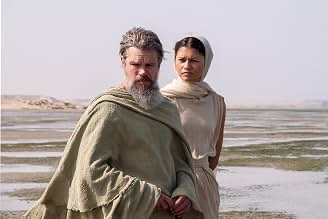
Zendaya is unmistakably Athena, but she rarely feels like a goddess striding down from Olympus. Instead, she seems to embody Odysseus’ wisdom, conscience and instinct. She appears whenever he is in danger of losing himself, almost as though Athena exists both as a goddess and as the voice that guides him from within. That makes her the only Olympian with a sustained human presence.
The male gods, by contrast, become elemental forces. Poseidon is the sea itself. Divine anger arrives through storms, waves and nature rather than men descending from the heavens. It is an elegant way of preserving the mythology while keeping the story rooted in human experience.
Interestingly, Nolan ensures that the women of the epic retain their full presence.
Penelope.
Athena.
Circe.
Calypso.
The Sirens.
Helen.
Clytemnestra.
The women shape the narrative, while the male gods are largely transformed into the world around them.
Circe, in particular, is magnificent. Of all the women in The Odyssey, Samantha Morton’s Circe left the deepest impression on me. Despite her relatively brief screen time, she completely stole the film. Her performance is visceral, vibrant and seething with barely contained rage, yet alive with an intoxicating zest and verve. She embodies the witch with terrifying authority, commanding every frame she inhabits, while never losing sight of the loneliness and aching pathos beneath the power. It is a breathtaking balancing act that makes Circe feel both mythic and profoundly human. Perhaps the highest compliment came from Christopher Nolan and producer Emma Thomas, who revealed that Morton’s scene earned a spontaneous standing ovation from the cast and crew—“the first such reaction on a Nolan set since Heath Ledger’s performance in The Dark Knight. Watching her, it’s easy to understand why.”
Her speech exposing the true nature of men may be my favourite dialogue in the entire film.
“Turn back into your disguise as men.”
What a devastating line.
But it is everything surrounding that scene that stayed with me.
Circe has lived alone for years. Suddenly, a ship full of armed strangers lands on her island. We, the audience, know they are Odysseus’ men. She doesn’t. From her perspective, every ship could bring men who want to conquer, plunder, rape or kill. It reminded me of the conversations we still have today whenever someone says, “Not all men.” Of course “not all men”. But women like Circe have never had the luxury of knowing which men are safe until it is too late. Like all women.
Then she strips away every heroic illusion. Men, she says in essence, all want the same things. They want to eat. They want to be fed. They want someone to keep house for them. They want sex. The transformation into swine is brilliant because it isn’t really about magic at all. It is about exposing appetites we spend our lives pretending are more sophisticated than they really are.
Ironically, that was the very first scene that came back to me when I got home after the film.
I’d made the long journey back from Thane. I walked through my front door absolutely starving. All I wanted was food and the comfort of home. I actually laughed to myself because Circe’s words echoed in my head. Strip away our ambitions, our careers, our philosophies, and perhaps she was right. Sometimes we really are just creatures longing to be fed and to find our way home.
I was less convinced by the Laestrygonians.
Turning them into towering medieval armoured giants certainly creates memorable imagery, but I missed Homer’s original vision of colossal beings hurling boulders upon the Greek fleet. Sometimes the ancient imagination is already cinematic enough.
Likewise, merging Calypso with the Lotus-Eaters is a liberty I understand, even if I didn’t entirely like it. For cinema it streamlines the narrative. For readers of Homer, however, the two represent entirely different temptations. The Lotus-Eaters offer forgetfulness. Calypso offers immortality and eternal comfort. They serve different purposes, and I missed that distinction.
The climax, thankfully, is never rushed.
Too many adaptations hurry once the hero reaches home.
Nolan does the opposite.
The rescue of Telemachus.
The reunion with Argos.
The reclaiming of the palace.
The death of the loathsome Antinous.
Every moment is allowed to breathe. Yes, Homer has Antinous as the very first suitor to die, but changing the order serves the rhythm of the film without diminishing the satisfaction of justice finally arriving.
The film also handles Agamemnon with remarkable presence.
His aura is so commanding that, for a moment, I almost mistook him for Ares—or even Achilles returned from the dead. Yet what fascinated me more was the tragedy surrounding his family. Agamemnon sacrifices his daughter for victory. His presence on the battlefield signifies complete ego. He overshadows everyone there. Anticlimactically, Clytemnestra murders him in his own home in revenge.
Orestes then kills his own mother to avenge his father. Three thousand years later, that story still resonates because it asks who ultimately pays the price for men’s wars. More often than not, it is women.
Which is why one liberty genuinely bothered me: Helen and Clytemnestra are presented as identical. They were not. They were half-sisters.
That distinction matters. Helen’s legendary beauty was singular. It launched a thousand ships and became the spark for the greatest war of the ancient world. Making her visually identical to Clytemnestra may simplify casting, but it diminishes something essential about the mythology. Some liberties are worth taking. This wasn’t one of them.
The music deserves special praise. It is extraordinary. Not conventionally beautiful, but elemental. It feels less like a score and more like something unearthed from the Bronze Age itself. During the Sack of Troy it pounds with the relentless machinery of war. During Circe’s transformation of men into swine it abandons melody for something ritualistic and deeply unsettling. It doesn’t merely accompany the story; it feels like the pulse of myth itself.
One aspect that deserves special mention is Nolan’s decision to shoot The Odyssey entirely on analogue IMAX 70mm film, making it the first feature in history to do so. In an era dominated by pristine digital cinematography, the image possesses a warmth, softness and organic texture that feels almost otherworldly. The grain breathes, the light glows and every frame carries the tactile beauty of something physical rather than manufactured. It lends the film an ancient, timeless quality—as though we are witnessing a myth remembered rather than a story recreated. It is deeply unfortunate that only a handful of IMAX 70mm cinemas worldwide can present the film in its full 1.43:1 glory, because this is not merely a technical achievement; it is an artistic one.
I absolutely revelled in this film. Christopher Nolan has not merely adapted Homer. He has understood him. He understands that The Odyssey is not ultimately about monsters, magic or even gods.
It is about what war does to people.
About the terrible cost of pride.
About vengeance consuming generations.
About the wisdom that only suffering can teach.
Odysseus begins the story desperate to be remembered as the greatest hero alive. He ends it willing to hide his name, bury his pride and walk home as a beggar if that is what it takes to reclaim his family and his kingdom.
That is the journey.
That is why Homer’s epic has survived for nearly three thousand years.
And that is why Nolan’s film feels so profoundly relevant today.
In an age still consumed by wars, wounded egos and men who mistake pride for strength, The Odyssey reminds us that the greatest victories are not won on battlefields.
They are won over ourselves.


 Hearts Still Care
You must be logged in to post a comment.