After Everyone Leaves

When the funeral is over, and the house finally empties of people, grief does something cruel and ordinary at the same time. Life resumes. Chores return. The day demands to be lived — and that is when the absence announces itself.

Not in grand ways. In small, brutal details.

The food bowls are the first thing I notice. I used to juggle three every day. Now I carry two, one in each hand, and my body still prepares for the weight of the third. Muscle memory has not yet learnt loss.

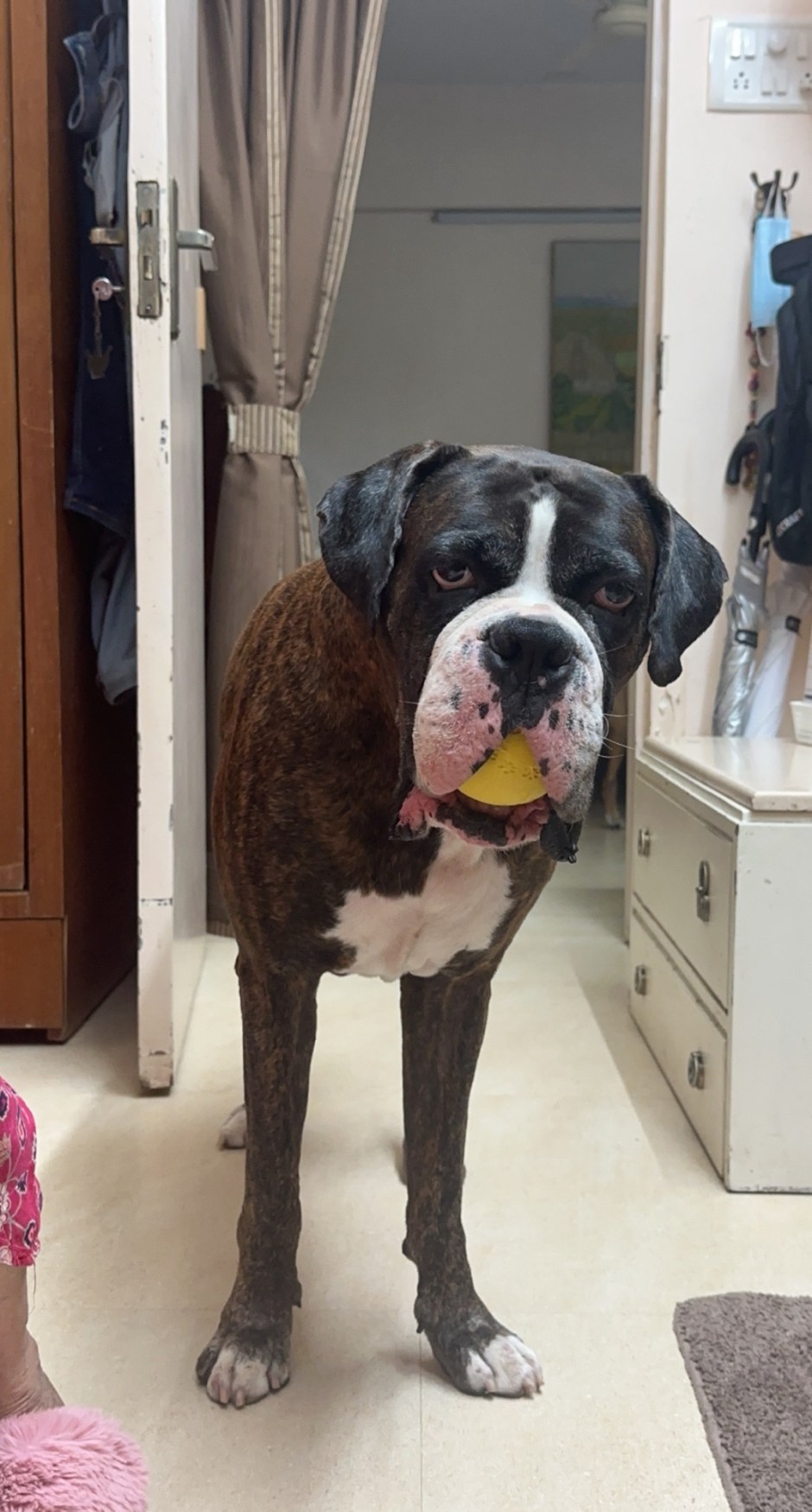
In the corner of the room, his mattress sits unused. The edges are stiff with dried drool — the very drool everyone used to shy away from. Zach was intensely affectionate. He loved with his whole body. And yet, visitors would dodge him, hold their clothes away, laugh nervously.

“Zach, sit down.”

“Zach, go away.”

He never understood why love had conditions.

The medicine chart still hangs on the fridge — morning, afternoon, night — followed meticulously, desperately, faithfully. A quiet record of how hard we tried. His leash hangs with the others, but his remains vacant. I notice the name tag first. Zachary. Still there. Waiting.

Then comes the first midnight walk without him.

We step out as a family, no one leaving anyone alone. The girls walk beside me, steady and present, as if they instinctively know that this is not a walk — it is an endurance test. I see the spot where Zach always stopped to pee. He took his time. He ambled. He was a big boy. He occupied space without apology.

And now that space is painfully, offensively empty.

I don’t have many grand things to say about our relationship, except this: I loved him. Fiercely. Quietly. In the way fathers often do with sons. It wasn’t demonstrative. It wasn’t dramatic. But it was solid.

Nothing like my relationship with my own father — because Zach always looked to me for help, for reassurance, for safety. And I always told him the same thing: I’ve got your back.

I used to sing to him —

You’re my honey bunch, sugar plum, pimply imply umpkin —

and he would come charging towards me, tail wagging wildly, a weapon that bruised shins and toppled objects. Love, again, without restraint.

The house feels hollow now. Zach was a large presence — lumbering, filling up rooms, claiming corners, leaning his weight into life. The gentlest boxer dog. The sweetest. And according to everyone in the family, one of the most handsome dogs they had ever seen.

He knew my aunts.

He lived through Covid with me.

He witnessed deaths.

He stood beside me through grief before becoming its centre.

He was my baby.

My baby boy.

And he has taken a piece of my heart with him.

People often talk about grief as something that arrives suddenly, but this grief has been rehearsed for months. Living with two terminally ill dogs teaches you anticipatory mourning — the long, slow exhaustion of loving while preparing to lose. And yet, when the moment finally comes, it still catches you unprepared.

Condolences arrive. Kind words follow death easily. But the real work of grief happens afterwards — when no one is watching, when the house is quiet, when memory ambushes you in ordinary moments.

These memories will keep jolting me as the days go on. I know this. I have seen enough death to know that time dulls the sharpest edges. Pain becomes a low ache. Survivable. Livable.

But not yet.

Right now, I am grief-stricken.

Right now, I am wracked with pain.

Right now, love has nowhere to go.

And so it lingers — in empty bowls, unused leashes, dried drool, midnight walks, and a father that remembers him even when the world moves on.
Xena

You look behind to see if I am coming.

You would take your toy and come to me running.

You are a grumpy little thing with bat-like ears.

You came to me at a time that was filled with tears.

You journeyed through miles, quite a valiant feat.

When I held you, you made my family complete.

I named you a warrior princess, not a guest.

You have more than passed the strongest of tests.

Life has a few more in store for you, I’m afraid,

but I can count on all the victories you’ve made.

So tomorrow may frighten the hell out of me,

but the warrior in you shall fight valiantly.

I love you the most, my daughter, and that you know,

for every glance you give me tells me so.

Know I’ll be there if, on the table, you feel alone,

waiting outside the doors to take you right back home.

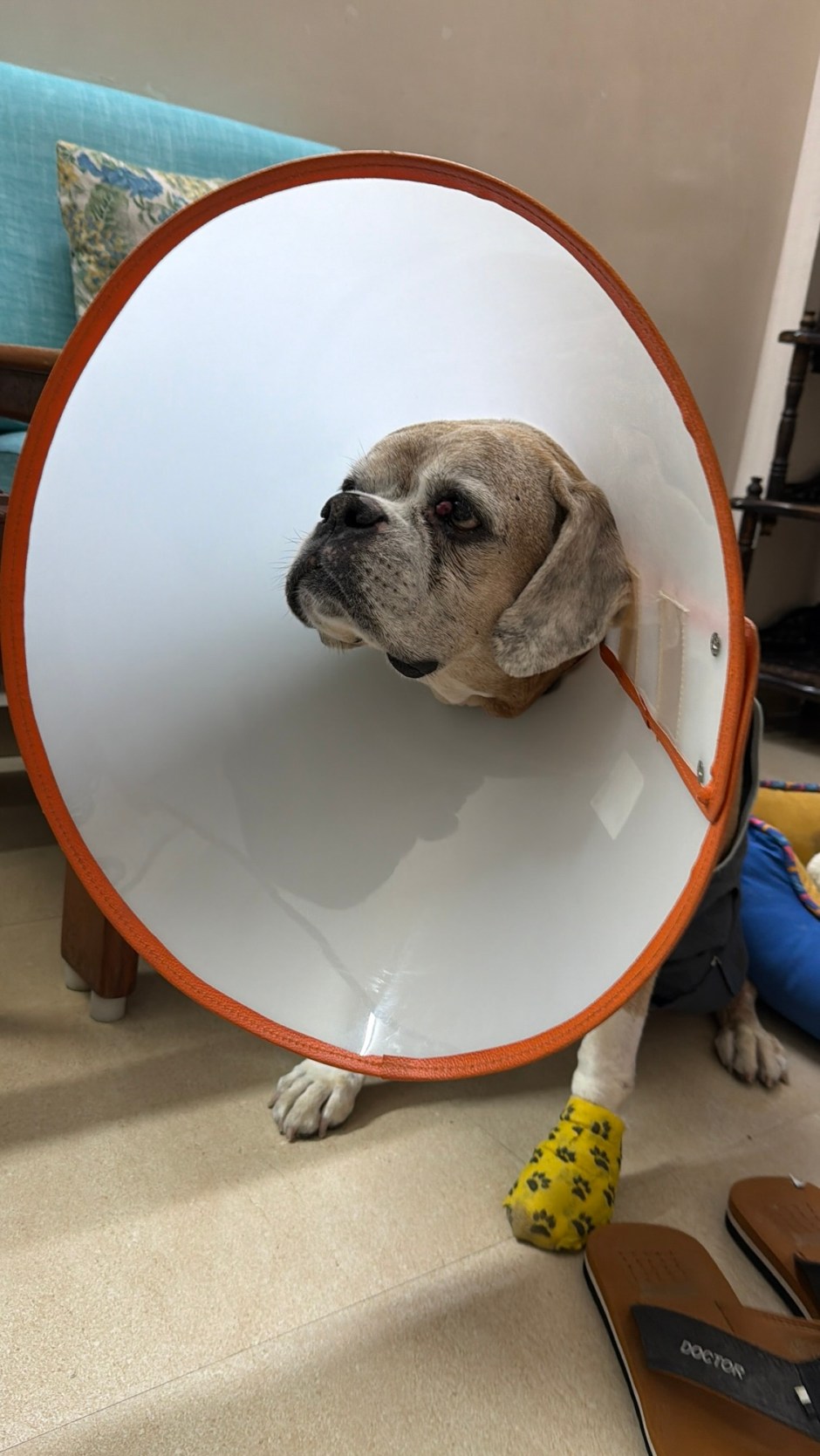
So keep your strength and let them cut the cancer out.

Fight and be strong, and you’ll win — I have no doubt.

My heart aches for all the battles you must fight,

but being your dad, that falls as my right.

Just know, as I see you stick your head out of the cone,

the moment I held you, you stopped being on your own.

Zach’s Galaxy

We all knew Zachary had mast cell tumours on his back. I know the signs — the tiny swellings, the quiet signs that the body gives when it’s fighting something deeper. I also knew I didn’t want to put him through invasive surgeries or chemotherapy. He’s twelve now — he crossed that milestone on the 21st of September — and at this age, peace matters more than intervention.

Recently, we found two new lumps on his throat and another big one on his shoulder. The biopsy was done — it could be a goitre from the thyroid gland, or it could be metastasis. We don’t know yet. I’ve taken it in my stride, because Zach has already defied time. He’s the first boxer who’s lived this long with me.

I lost Rolfe at six. Diana at ten. Zoe at eleven. But Zachary — my Zacho Whacko — has crossed twelve. He still eats well, plays with his ball, and his eyes still light up when we go down together.

This morning felt ordinary. I went hunting for tiles and granite for the new home — the kind of simple domestic errands that keep life moving. When I returned, Anand casually mentioned he’d cancelled his trip to Delhi. A small thing, really — but it hit me with unexpected force. Because somehow, it made everything suddenly real.

I went to take a bath and ended up crying — the kind of quiet, unstoppable crying that comes from a place deeper than thought. Because loss is loss. It doesn’t matter how many times you experience it; it never gets easier.

I don’t even have the biopsy results yet, but I know. He’s old. And I’ve always prepared myself for the worst — I’ve always been that kind of person. Still, it hurts. Zach and Xena are the last of my dogs who ever met my aunts — Munni pua, Goodie pua, Cecilia. They’re the only ones who’ve seen that part of my life, that chapter when everything was still whole.

Zoe belonged to the Amruttara years.

Zach and Xena belong to Raj Mahal — the home where I was truly happy.

And now, as time shifts again, I feel that ache of knowing that endings are near, even when love continues.

I’m fifty now. My body reminds me of it — the aches, the stiffness, the quiet hum of age that settles into the bones. And yet, I carry all of it with me — not just the years, but the memories.

Most of those I’ve loved have gone — except for my mother, my sister, Anand, and Atif. But I’ve lost so many others — people and dogs alike. Now I have Zuri, the youngest in our home, but she’s never known my aunts. And it reminds me that everything comes with a time limit — even memory.

Because memory lives only as long as those who share it do. And when they’re gone, even the memory begins to fade. I like to think it doesn’t die, though. Maybe it goes somewhere — into a kind of galaxy of memories, where all our shared moments turn into light. Coiling and floating together — brilliant stars in a quiet Milky Way of remembrance.

When I look at Zachary now — slower, softer, but still full of heart — I realise that grief is just love with nowhere to go. Every wag of his tail, every breath he takes, feels like a reminder that life isn’t measured in years but in moments of trust and togetherness. One day, when he’s no longer beside me, I’ll still feel him — in the walk in the evening, in the sound of glomping that he brought in quiet places, in the stains of his saliva that dab all our walls and all of the memory that becomes love. And maybe that’s what love really is — the part of us that refuses to die, even when everything else must.