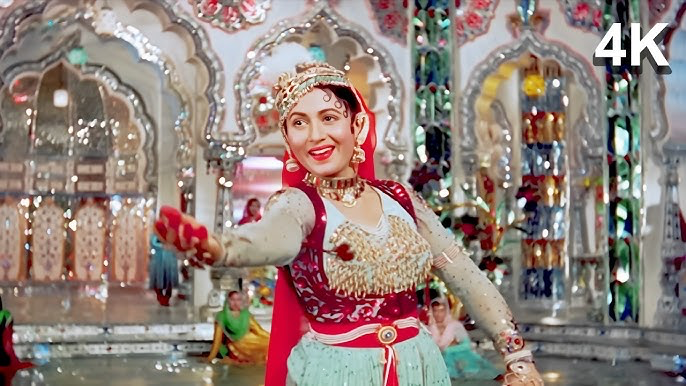
A friend of mine is doing a show, and he has asked me to perform to two songs. One, of course, is a Sit Down qawwali — but the second song is a dance number. Basically, it’s a courtesan’s number, it comes from one of my favourite movies. You guessed it. It is picturised on one of my favourite actresses, Madhubala. It is sung by one of my favourite singers, Lata Mageshkar. It is composed by one of my favourite composers — Naushad Sahab.
When I see it on screen, it reminds me of a revolution. It reminds me of how love conquers all. It is the song that led me into the revolution of being proud of who I am, being proud of the men that I fall in love with.
It’s basically been an anthem since — I can remember — in terms of identity, in terms of a reaction against hatred, a reaction against bullying, against prejudice and against my own dad at times. I used to dance to this when I was young, wearing a ghagra, and thinking that I was Madhubala, standing up for my lover and my own love.
As I grew up, I realised that it’s a feminist song. It is a song where a woman reclaims her own agency, and says that I don’t care what the world says to me, I have to live by my own beliefs and by the virtue of my love. As I grew, and I grew into my own homosexual identity, I realised that this is the song that empowers. It’s like a gay anthem, obviously. And so it’s like talking about the closet. It says:
प्यार किया तो डरना क्या?
It says:
पर्दा नहीं जब कोई खुदा से, तो बंदों से पर्दा करना क्या?
These words are epic. These lyrics are epic. These lyrics resound in my own head and in my own heart. It brought in its own life lesson on love. Or rather, how it ought to be. It taught me about the Self. How one should see one’s self and be true to it.
So when this opportunity came to me, I jumped at it. Then, I thought that I could not do it — because there are so many hitches, actually. There are so many things that keep me second guessing.
I used to be a Kathak dancer. But I stopped dancing because my left knee just gave out in 2010. And now, of course, I can’t dance on it. My orthopaedic surgeon has told me — when I went for a check-up — that I shouldn’t be dancing at all. I also have a rotator cuff injury in my right shoulder, since months which is excruciatingly painful.
I have mentioned all of this to my friend who is hosting the show — who’s doing the show. He gave me an option to drop out but he also believes in me. And I mean, there are those who love me — who said that I shouldn’t be doing it, because of the pain, because of what I may be going through, and because of what I may go through after the show.
There could be further knee damage. There could be further damage to my shoulder. But I seriously feel that I need to jump at this chance — in the sense of this particular song — because it’s something that I lived by, you see. It was something that brought meaning to my formative years.
And I’ve seen the show on stage — Feroz Khan’s Mughal-e-Azam — that tours the world. And I’ve always loved the way the song has been choreographed. I’ve seen it twice now. And it’s epic — the way they do this song. It’s such a spectacle to love up to in entirety.
Of course, I could never match up to the choreography. So I did the choreography myself. I’ve been practising for the last three weeks. And I told my friend that I may not do it — give me a few days. He’d given me about a fortnight to think about it and rehearse and see if I can choreograph it. And I have done so.
Initially, I thought that I would ask somebody else to dance the pure dance part before the number starts. But then I decided that that would be cheating. I had to do it myself. And I really have put in my time, my effort, my entire heart into this.
And I don’t know how it’s going to be — the show is in ten days — but I am preparing a costume, and I’m preparing the choreography. Even today, I rehearsed and I tweaked a little bit of the dance movements — to suit the fact that I can’t do 27 chakras in one go. But I managed to pull in about nine of them in the piece within the piece.
And my body doth protest. Right now, my neck is hurting, my knee is hurting, and my shoulder is hurting. So I’m in pain. I’m also very anxious — wondering whether I’ll be able to pull it off on stage, and wondering whether I’ll be able to, you know, live up to the beauty, the sheer magnificence of the song.
I’m going to try my best. And then, of course, let the chips fall as they may. But I just wanted to put this out there — as to why I want to do it, and what drives me to do it despite the problems that I’m facing. And I think it’s a chance for me to be beautiful, and proud, and magnificent — through the pain.
That’s why I’m doing it.




You must be logged in to post a comment.