Parents

I was just scrolling though instagram and I read a post where someone was exuberantly praising their mother. I am going to say something real here. We all have parents. According to society and many religions we are suppose to love them. But it’s not always possible.

Firstly, I do not come from the mind set where being brought into this world is something to be lauded. The world is a crazy place. It’s filled with angst of living right from the get-go. Sure, it has love and beauty, but the hate and the ugliness over powers the former most times. I understand all the copious ideologies that talk of light overcoming dark. Pick up movies, books, education, theology, and they will talk about the reason-to-be and why light is better than the dark. I don’t think either is better. They’re the same. Birth isn’t better than death. And being isn’t better than non-being. The best questions Shakespeare asked were in Hamlet’s famous soliloquy.

Parents then aren’t meant to commemorated. Loved surely. All living beings need love and should be. That’s the point of life actually. But loved blindly just because of blood ties. Na. Any woman who works hard and gives her children the best life she can give them should be loved. But not celebrated, the choice of being a parent was hers. So the duty of being a good one isn’t anyone else’s but hers. Therefore, the duty she has taken on becomes the judge of her parenthood. Not the children. The children haven’t chosen her to be their mother. So they aren’t in any way responsible for her as adults. It’s love that makes them responsible. Not duty.

I speak from personal experience and so I shall also talk about things when they go wrong. When you have a father who isn’t capable of love or parenthood but capable of reproduction and does, you’re also in some deep shit. The idea of respecting a person who falls in his duty is preposterous. Krishna himself said this to Arjun at the brink of a war. When the people who create culture fail to uphold it there is a collapse of society. We do not live in the wild, where animals stay with their parents up to a point and then don’t bother if the parents are old enough to care for themselves or not. We live in a culture that has created these rules. If an animal is a bad parent, the child dies, here society prevents that from happening. And thus, pathologies develop. Serial killers go on rampages. The idea of duty becomes the benchmark for everyone.

I live with anxiety and depression created by an abusive father and fear of the world created by an over protective mother. Yet, I function in society because that is my duty- which I never asked for. Essentially, I should love being who I am. But I do not. I have made my peace with it. As such, I have made peace with the fact that parents are human beings who are capable of disastrous mistakes. They are to be loved, yes, but worshipped, no.

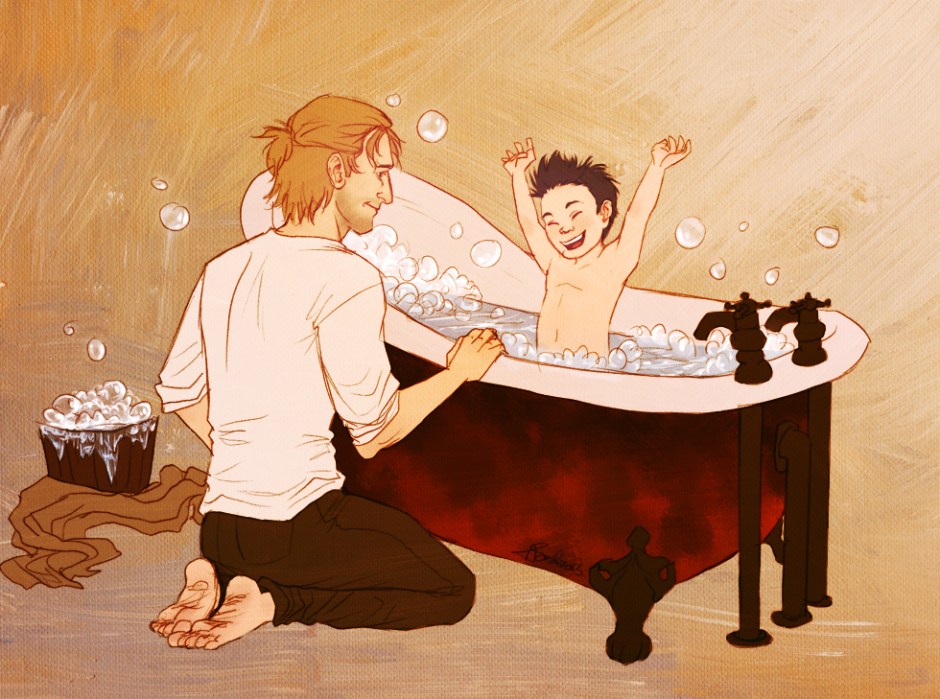
I had aunts who cared for me like they were my parents. One of them filled the place of my father. Strong, supportive and loving. She did more for me than my father ever did. It was not her duty to do so. She had not given birth to me. But she loved me like I was her own. Some say, that was because she did not have children of her own, but that doesn’t mean she did not love me. That only meant that her duty would have been to her own children first. And I would not expect any less of that. But would she have loved me less? I do not think so. Irrespective, of that digression, I will just reinstate that motherhood or fatherhood or parenthood, itself, is created by love. If it is a hallmark of duty, it needs not be respected but taken as a matter of life. If it is an act of pure love, it won’t need reciprocation.

No one asks to be born. And as such the one who procreates has a moral obligation towards culture itself to make sure that the offspring contributes to the love needed in the world. Nurture is always more important than nature and that is a parent’s job. Not the child’s. As you grow you can appreciate what your parent has done – but in the sense, of how well they did their duty. Love is a necessary by-product of that duty. And one need never be grateful to be loved.
Animal

It’s not a great movie like everyone is making it out to be and it is not a terrible movie as the others are saying it to be. It’s like the same alpha male movies everyone is making these days. All the bearded heroes step forth please. Pushpa, KGF, RRR – they all seem to sport a similar feel. No? Ok.

The story line is simple, the quest is hot-headed and personal. Women are treated like… the way most women in the country are actually treated. I will say one thing that won’t sit well with most people, women don’t go for the poets, they do go for the alpha male. In fact, rocky aur rani said the same thing in a funny, more stylised way. Many women I know were okay with the movie – so there you have it.

I’ll make one more reference that keeps coming to my mind…Kill Bill. The woman was the protagonist, but she was decidedly alpha. And I must say Tarantino made the movie a spectacle. Reddy doesn’t have that finesse, but he is certainly aiming for it with his big gun.

But a woman doing that here? Will it work? The days of Khoon Bhari Maang are over. They don’t seem to be returning… For instance, Tripti Dimri is lovely. She is brilliant. She played Qala. The Mother/Daughter equation didn’t work as well as the Father/Animal equation. But her character’s arc, particularly being told to “lick shoes to get famous,” highlights the film’s flawed handling of women. The mother-daughter dynamic pales in comparison to the father-son (animal) relationship. I also see other flaws like the overt misogyny, religious politics, and sexual innuendos, hinting at themes like the Oedipal complex without fully exploring them.

I would never make the mistake of thinking that Ranbir Kapoor’s character, Ranvijay, displays a protective attitude towards his sisters, interpreting it as familial care rather than misogyny. This portrayal can indeed be seen as deeply rooted in patriarchal notions. His aggressive protectiveness and dominance over his sisters’ lives, decisions, and autonomy reflect an ownership-based attitude rather than genuine respect for their individuality.

This type of ‘protection’ reinforces the idea that women need male guardianship, subtly stripping away their agency. By controlling his sisters’ actions under the guise of protection, Ranvijay’s behaviour perpetuates the idea that women are fragile and need to be policed by men, which is a form of subtle but pervasive misogyny.

Thus, while some may claim that his actions are well-intended, they stem from an ingrained belief system where men hold authority over the women in their families, making his attitude clearly misogynistic in nature.

So Reddy was making the movie to angst out feminist critics? but why? Make three movies to make some women look bad? I mean, could that really be true? If it is, well, it’s not alpha behaviour. And if it isn’t, then he’s investing three parts to tell one revenge saga that had no real provocation… I mean, bobby Deol seemed to have more in terms of provocation than Ranvijay… but I am not going to delve deeper – I mean it’s not possible to delve deep into that at all. Because Sandeep Reddy doesn’t want to waste his time in doing that either. Bobby’s is just another daddy issue – but in this case, the father actually died a ghastly death.

So technically, if you see it through a very literary sense (cough) the eponymous Animal is Abrar. Not Ranvijay. He fornicates with his new bride in the women’s quarters. He slaps his wife in a foursome to shut her up. It’s quite what Vanga probably wanted Ranbir to be, but showed some restraint?

(That scene with the psychiatrist though. What is the thought process of representing psychology as being rooted in sex – wait, was the hint towards an Oedipal/electra complex there? Nah. That was my major irk and probably the only one I had while watching the movie… wait, no… I had several.

Dialogues related to big hips, wine, tops doing all the work, cheating not as hurtful as murder, murder the only answer to everything, the villains being Muslim, the heavy attempt to show all religions as silly, but clearly politicising one particular one and several other current totalitarian ideologies… er, I could go on. But I’ll stop.)

I didn’t get bored in the movie. The punjabi men were all good looking, and Bobby Deol was a great villain. I was like Anil Kapoor, not interested but invested and wondering what the hell is wrong with Ranvijay. I mean, wtf. I have daddy issues but I guess I took the opposite route and turned out to be a poet.

I saw it because of all the hoopla. Also, because every artist must have the right to create his – piece. Yep, it kept me entertained for a few hours, but I am not interested in the sequel. I was intrigued by the negative/positive publicity tug-of-war and I saw it.

Now I wait for The Archie’s on Netflix.

P.s. Davy Grewal was really good to look at. Did I mention Tripti? Oh, yea. I did.

P.P.S. People who liked the movie think this is a positive review. I just like to think it’s an unbiased one.

Rocky Aur Rani Ki Prem Kahani

I knew I’d like the movie. Because I am an Alia fan. Because I love family dramas. Because I enjoy Karan Johar’s direction and vision. I loved Ae Dil Hai Mushkil. And I wasn’t surprised that I ended up loving this movie, too.

Rocky Aur Rani Ki Prem Kahani has all the masala and the twists for a Bollywood movie. And it feels like a hit without a single macho punch being pulled anywhere on screen. It also hit close to home for very personal reasons. There are simply too many similarities right now between my life and various episodes in the film. I think that’s important for a good movie. And that’s why I loved it – because I connected with it.

The story is simple. An intelligent, self-made, independent, educated woman falls in love with a rich, loud, narcissistic, lovable, carefree man. Families realise the disparity and the lovers decide to test themselves in each other’s spaces for a few months.

Spoiler alert.

In the midst of it all, you throw in a septuagenarian romance that actually brings the couple together in the first place and then links them further. Then there is the antagonist: a matriarch who governs with an iron hand (already done in Ram Leela with far greater flair) but this doesn’t include physical but emotional and mental violence. There is a house governed by ambition and a quest for material prosperity. The other house is governed by emancipation and a quest for intellectual betterment and acceptance.

The movie doesn’t just tackle the romance and the odds of the hero and heroine. But interlinked within the families, each character struggles to find a voice or realises that the voice they were using could be biased at best and cruel at worst, as well.

The film has both Pride and Prejudice. It’s a subtle encapsulation of how people look down upon people, how we form prejudices based on past experiences and why it is important to realise our own trauma and make peace with due apologies. Every person in the movie is flawed. And growth happens with the realisation of these flaws and seeking to better one’s self through mature, self-affirming decisions.

The only abrupt change that seemed jarring was the write-off they gave Dhanlakshmi, Jaya’s character. But in a way, it was for the best, because it was in keeping with her character that the change wasn’t radical or real, but implied off-screen.

Dharmendra and Jaya Bachchan are brilliantly cast in characters just made for them. Shabana Azmi steals the screen when she is on it, as the woman who experienced true love for a few days that lasted a lifetime. She battled abuse and raises a son who is different from the typical idea of what a man should be and do, in India. This is brave (uncannily) and well-handled by Karan. The scene where Alia’s father is ridiculed speaks to every boy who grows up being different, in a patriarchal society. To exemplify this, Ranveer’s Rocky wears an outfit that’s vomit green as he laughs with the crowd. I noticed it, Karan.

The monologue Rocky gives addressing the ridicule Rani’s father faced, after a Kathak performance, is worth an honourable mention. It speaks of the need to understand not just what is considered woke in the modern day world but also the dangers of cancel culture that circles around it. For those who say that never happens to men who are into classical dance, you truly either live in a different world or choose to ignore the problems that are very much around in this world.

Rani’s character excels in her confrontation with Rocky’s father. It reminded me of the confrontation Reena Roy has with Lalita Pawar, in Sau Din Saas Ke. But there, there is the confrontation between two women. That happens with Jaya Bachchan and Alia, too. But what is actually different is Rani, a woman, standing in all her glory, dressed in Red at a Durga Puja and confronting a patriarch. The scene resonates because she stands there with no trace of fear. It is a juxtaposition to the scene where Rocky laughs at her father for being who he is. She stands with the frustration of all liberal mentality that reaches a crescendo at that point. It teeters on violence. The dangers of that happening is almost as bad as the despotic power that Dhanlakshmi holds over her entire family. Almost. But not quite.

The costumes were extensions of the characters. Rani was mostly dressed in the most beautiful sarees, since Sridevi’s performance in English Vinglish. Red being her colour and the implication of red being the colour of true love and passion, given it being the colour of the most sensitive character, of Rocky’s grandfather, essayed by Dharmendra. It is perhaps the colour that flares out when poetry is ousted by industry. Rocky thus wears a riot of colours, because he has it all in him and Ranveer can carry off all of them because he knows he can. He tends to wear black and white, when he is with his family. Do notice that.

I don’t know if I am the only one who felt so, but Alia looked a tad uncomfortable in the love scenes with Ranveer. If she is in love with the man, there can’t be a discomfort in the intimacy. In some shots, she just seems to be pulling away rather than pulling in. For the character of Rani to fall in love with the character of Rocky, there can be no chance of a lack of physical chemistry. And by the interval, the love has to have cemented enough to be there in their eyes. Ranveer has it, Alia loses out here. The character of Jaya Bachchan too for all her superiority complex just allows her husband and his lover to meet up? For a woman who walks out of a Durga Aarti, how does she sit by in discomfort when her husband obviously is being intimate with another woman? I found this a bit jarring.

There are a multitude of old song covers. Mostly from a favourite film of mine, Hum Dono. And the songs set to the OST of the movie are not particularly engaging but they work for the tempo of the movie. My favourite is actually not the title song but Ve Kamleya. (Must throw in an aside here: the movie begins with a dance number, which I quite liked, but it’s not the song that is worth a mention – I grinned when I saw all the nepo-babies make cameo appearances in the song. Tongue-in-cheek there, Mr Johar.)

All in all, I end with my personal opinion that Karan Johar has created a wonderful movie. He has applied himself once again to creating a family drama for the modern world and he has succeeded. Rocky Aur Rani Ki Prem Kahani is exemplary for the fact that it speaks of breaking away from issues that do not truly matter and finds shaky ground in a world that is itself trying to find a place for each person’s uniqueness.