The Power of Cinema: How The Black Stallion Has Carried Me Through Life

The power of cinema lies in its ability to transport us—to take us back to moments of pure joy, to remind us of who we once were, and sometimes, to lift us from the depths of despair. For me, that film has always been The Black Stallion.

I first saw it when I was five years old, in a cinema called New Talkies in Bandra. My grandmother took me to watch it, and then my mother took me again. I watched it several times over the years, and in the 1980s, without access to OTT platforms, DVDs, or even regular TV broadcasts, we had to rely on someone with a VCR and a VHS cassette to revisit a beloved film. And revisit it I did—again and again, probably thousands of times.

There’s something about The Black Stallion that speaks to me on a level no other film does. It’s a simple story—a boy and a horse, forming a bond that goes beyond words, beyond logic, beyond any relationship I’ve seen depicted in film before or since. They meet in isolation, stranded on a deserted island, both alone in the world. And in that loneliness, something unbreakable is forged. The purity, the energy, the synergy between them—boy, animal, landscape—it all fills me with a deep, complete contentment.

Lately, I’ve been particularly low. Depression has a way of creeping in, weighing me down, making even the simplest things feel exhausting. And when that happens, I go back to The Black Stallion. I put it on, and I watch the first half—just the boy and the horse, with no dialogue, no human noise, just the sound of the waves, the wind, the hooves against the sand. The barren landscape, the golden light of the setting sun, the ocean stretching endlessly—it all carries me away. There are so many metaphors at play, but to a child watching in the cinema all those years ago, it was simply magic. A connection to aspire to.

And that’s still what I aspire to. Beautiful connections. Connections where words aren’t necessary—where love, need, and the desire to run free are enough.

Carroll Ballard’s direction is nothing short of breathtaking. There’s one shot, in particular, that I always come back to—the one where Alec, played by Kelly Reno, offers the horse a piece of seaweed as the sun sets behind them. The way the camera lingers on that moment, the hesitation, the trust, the silent understanding—it always makes me smile, no matter how heavy my heart feels. In those moments, I forget everything else.

That’s the true power of cinema. It lets you go back. It takes you to the moment when you first experienced it—before life got complicated, before the losses, before the weight of the world settled on your shoulders. When Alec Ramsey climbs onto the horse in the sea and they gallop together for the first time, the music swells, and I feel it in my bones. I feel that rush of freedom, that joy, that dream of running wild and untamed.

Very few movies can do that. The Black Stallion does. The only other film that comes close, for me, is Anne of Green Gables—another story that exists in a world untainted by cynicism, by corrupt logic, by the exhausting battles between overbearing liberalism and catatonic conservatism. A story where beauty is simply beauty.

And even now, as I write this, I feel lighter. I think about the music, about Alec, about the horse, about the island. I think about the sun, the waves, the wind, the freedom. And I smile.

That is the power of cinema.

A Few Facts About The Black Stallion:

• The film was directed by Carroll Ballard, known for his ability to capture the raw beauty of nature and animals on screen. His work in The Black Stallion is widely praised for its poetic visual storytelling.

• The cinematography was done by Caleb Deschanel, whose stunning compositions turned the film into a visual masterpiece. The way he shot the island sequences made them feel almost dreamlike.

• The film’s score was composed by Carmine Coppola, father of Francis Ford Coppola, who also produced the movie. The music is hauntingly beautiful, especially in the moment when Alec first rides the stallion in the water.

• The titular Black Stallion, Cass Ole, was an Arabian horse known for his beauty and grace.

• Sadly, none of the main cast members are alive today. Teri Garr recently passed away, Mickey Rooney before her, and Kelly Reno, who played Alec, stepped away from acting long ago. Even Cass Ole is gone. But the film remains—a legacy left behind, a piece of art that still touches the heart of someone who first watched it 45 years ago.

And that, more than anything, is proof of cinema’s power.

The Black Stallion

The Black Stallion is a film that has stayed with me ever since I first saw it as a five-year-old in the theatre. Released in 1979, it wasn’t until a year later that I watched it—first with my mother and later with my grandmother, in the theatre. Those memories of sharing this film with them have made it all the more precious to me, especially since many of those who shared that experience are no longer with me. The movie itself captured my young imagination with its stunning depiction of bonding between a boy and his horse, a fascination that had already been kindled by hours spent watching David Attenborough narrate the wonders of our planet.

Directed by Carroll Ballard, The Black Stallion tells the story of Alec Ramsey, a young boy marooned on a deserted island with a wild, black, Arabian horse. What makes the movie so unforgettable is the wordless bond that forms between Alec and the Black. The first half of the film has minimal dialogue, allowing the majestic visuals to take centre stage. Ballard’s direction in these moments is magical—especially the scene where Alec and the Black connect for the first time against the backdrop of a glowing sunset. The beauty and stillness of those scenes are seared into my mind as vividly as though I were watching them unfold in front of me even now.

Kelly Reno, who played Alec, was just 11 years old when he took on the role, and his natural performance helped make the relationship between the boy and the horse feel completely believable. But of course, the real star of the film was Cass-Olé, the Arabian stallion who played the Black. His grace, power, and beauty were breathtaking to watch on screen, and the bond between horse and boy felt as though it transcended the screen. The other horses used for racing scenes were just as magnificent, but none captured my imagination quite like Cass-Olé.

Mickey Rooney’s performance as Henry Dailey, the retired jockey who trains Alec and the Black for the climactic race, added warmth and depth to the second half of the film. The race itself remains one of the most thrilling and beautifully shot sequences in cinema. Even now, I haven’t seen another horse race in film that matches the raw intensity and realism of The Black Stallion’s final race—except, perhaps, Seabiscuit, another favourite of mine. Yet, for all the greatness of the narrative of Seabiscuit, The Black Stallion will always hold a special place as my personal, all-time favourite.

The music in the film, composed by Carmine Coppola, is hauntingly beautiful. Every note lingers, creating a dream-like atmosphere that draws you back into that misty world of ocean air, dewy mornings, and the wild freedom of a horse’s mane flowing in the wind. I can still hum the title music and recall the melodies that accompanied the final credits.

What makes The Black Stallion so poignant to me personally is that it holds memories of every member of my family who once watched it with me. Watching the film was a shared experience that transcended the screen, making it a cherished part of my life. Today, when I think of this film, it’s not just the beauty of the story or the visuals that come to mind, but the deep, emotional connections I had with my mother, my grandmother, my aunts, and others who sat beside me in the theatre all those years ago. It’s more than a movie—it’s a piece of my past, and that’s why it will always be so dear to me.

Watch the End Credits and hear the music in this video: it begins from 1:06 minutes…

End Credits – The Black Stallion

The Fellowship of Fantasy

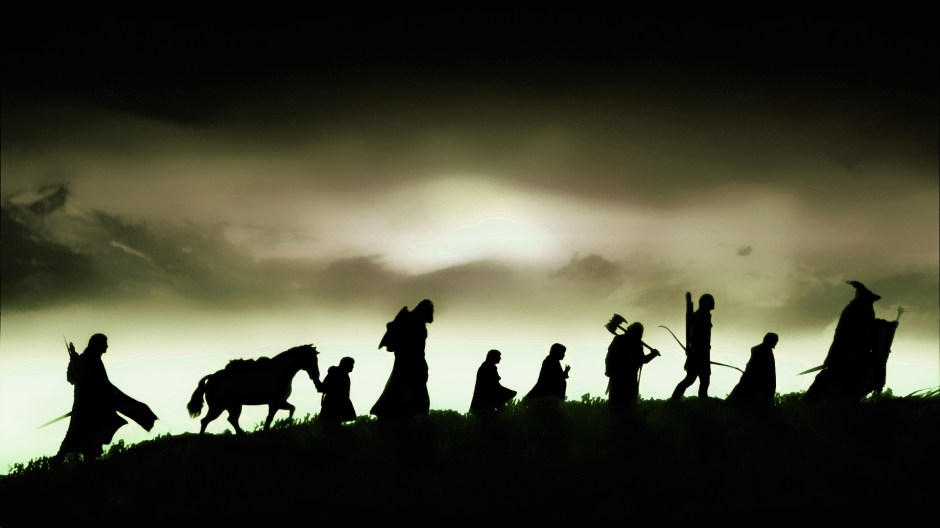
Today, I was made to feel bad about the fact that I wasn’t adult enough, by a dear, old friend, who is a mentor to me, as well. On the whole, it began with his trip to New Zealand and how he visited all those places that I would love to have seen: Hobbiton, Matamata, the Old Mill, Bag End, SamWise Gamgee’s hobbit home, with the yellow door, Weta Works, etc. Of course, he visited all those places and I didn’t, even though I would have enjoyed them far more than he ever could, for the simple reason that he isn’t a Tolkien book or movie fan, whereas I am all things nerdy, when it comes to Middle-earth.

He gifted me the vinyl figures of Gandalf and Saruman and I loved them so much that I thought of getting the Fellowship. My aunt who was sitting beside me offered to get them for me as gifts and so I went ahead and ordered them online. My partner mentioned this to my friend who wrote to me, later on, during the evening, and chastised me for not saving money and splurging it on unnecessary things.

I understand where he is coming from, of course. I am 44 years old and I save only as much as is required with no great thought about the future and the terrors it could bring. Unbeknownst to him though, I have tackled worst case scenarios in my lifetime and I don’t believe they hardened me enough to let go of the child in me. I have faced the impact of great diseases, taken care of loved ones who have survived them, have also cared for and lost to death those who couldn’t. Childhood was kind and I was loved but my teen years impacted me with the abuse of a father and the torment of being ridiculed for my sexuality. Irrespective, I did well for myself academically and I fixated on happy endings in the books I read and in the movies I watched.

I became a people person, when I grew seemingly confident about myself. I was betrayed in love, I was cast away, I was lost. I lose myself often, when reality strikes with a bludgeoning. But I always find myself, though I was chipped and have lost faith in the existence of gods. I take heart in what they stand for as I battled to see the good in life. Irrespective of the fact that I saw very little of it, I tried to be the good I wanted to see in others. I retained the honest streak I grew up with and still clung to happy endings. As the real got difficult, I clung to the fantastical and saw this as a means to deal with existential truths.

When I see Frodo losing his sanity at the edge of Mount Doom, I revel in the tenacity of SamWise as he rallies forth. I cry when I share Harry’s despair as he realizes he must be sacrificed to shatter a Horcrux – I walked the walk to the Forbidden Forest right alongside him. When Superman flies, I do not see just his indomitable strength of muscle, I take heart in the idea of all that he stands for. At the age of five, Clark Kent taught me to love, to be kind to animals, to take heart in the fact that negativity cannot survive in the end. And apart from the fantastical, a shipwrecked boy finds hope and solace in an Arabian Stallion, he calls Black … it could sustain me a lifetime of memory and faith. Anne of Green Gables assures me that tomorrow has no mistakes in it – yet.

So, I cling to this notion – and if one chooses to call it a fantasy, so be it. I am not sad for being called a child, or of that I am assured of the probability that the future is a bleak prospect. I am crestfallen because growing up is equated with becoming wiser, and that turning a certain age implies that all of childhood is negated. All the lessons I learned from childhood weren’t centered around life being grim and bleak… most of the lessons came from a place where Sith lords ruled the world and then through sheer dent of will and determination, the Jedis cast them down. I go back to the thought of another real life super hero when he enunciates, “When I despair, I remember that all through history the way of truth and love have always won. There have been tyrants and murderers, and for a time, they can seem invincible, but in the end, they always fall. Think of it – always.”

So, I order the vinyl figures of Gandalf, Frodo, Sam, Aragorn, Merry, Pippin, Boromir, Legolas and Gimli, to remind me that matters of personal strife, prejudice, envy, greed, error can be overcome with hope, love, faith and determination. As I see them, I will think of the fact that there are people who care about me, who lift me up in my sorrow and guide me towards a future that no one can truly comprehend. Like Gandalf, one can fall and rise; like Gimli and Legolas, one can overcome prejudice; like Sam, one can be steadfast and honourable; like Merry and Pippin, one can relish the child and still be an adult; like Boromir, one can overcome insecurity and fear; and, like Frodo, deal with immeasurable burdens of the heart and soul and eventually be uplifted.