Rocky Aur Rani Ki Prem Kahani

I knew I’d like the movie. Because I am an Alia fan. Because I love family dramas. Because I enjoy Karan Johar’s direction and vision. I loved Ae Dil Hai Mushkil. And I wasn’t surprised that I ended up loving this movie, too.

Rocky Aur Rani Ki Prem Kahani has all the masala and the twists for a Bollywood movie. And it feels like a hit without a single macho punch being pulled anywhere on screen. It also hit close to home for very personal reasons. There are simply too many similarities right now between my life and various episodes in the film. I think that’s important for a good movie. And that’s why I loved it – because I connected with it.

The story is simple. An intelligent, self-made, independent, educated woman falls in love with a rich, loud, narcissistic, lovable, carefree man. Families realise the disparity and the lovers decide to test themselves in each other’s spaces for a few months.

Spoiler alert.

In the midst of it all, you throw in a septuagenarian romance that actually brings the couple together in the first place and then links them further. Then there is the antagonist: a matriarch who governs with an iron hand (already done in Ram Leela with far greater flair) but this doesn’t include physical but emotional and mental violence. There is a house governed by ambition and a quest for material prosperity. The other house is governed by emancipation and a quest for intellectual betterment and acceptance.

The movie doesn’t just tackle the romance and the odds of the hero and heroine. But interlinked within the families, each character struggles to find a voice or realises that the voice they were using could be biased at best and cruel at worst, as well.

The film has both Pride and Prejudice. It’s a subtle encapsulation of how people look down upon people, how we form prejudices based on past experiences and why it is important to realise our own trauma and make peace with due apologies. Every person in the movie is flawed. And growth happens with the realisation of these flaws and seeking to better one’s self through mature, self-affirming decisions.

The only abrupt change that seemed jarring was the write-off they gave Dhanlakshmi, Jaya’s character. But in a way, it was for the best, because it was in keeping with her character that the change wasn’t radical or real, but implied off-screen.

Dharmendra and Jaya Bachchan are brilliantly cast in characters just made for them. Shabana Azmi steals the screen when she is on it, as the woman who experienced true love for a few days that lasted a lifetime. She battled abuse and raises a son who is different from the typical idea of what a man should be and do, in India. This is brave (uncannily) and well-handled by Karan. The scene where Alia’s father is ridiculed speaks to every boy who grows up being different, in a patriarchal society. To exemplify this, Ranveer’s Rocky wears an outfit that’s vomit green as he laughs with the crowd. I noticed it, Karan.

The monologue Rocky gives addressing the ridicule Rani’s father faced, after a Kathak performance, is worth an honourable mention. It speaks of the need to understand not just what is considered woke in the modern day world but also the dangers of cancel culture that circles around it. For those who say that never happens to men who are into classical dance, you truly either live in a different world or choose to ignore the problems that are very much around in this world.

Rani’s character excels in her confrontation with Rocky’s father. It reminded me of the confrontation Reena Roy has with Lalita Pawar, in Sau Din Saas Ke. But there, there is the confrontation between two women. That happens with Jaya Bachchan and Alia, too. But what is actually different is Rani, a woman, standing in all her glory, dressed in Red at a Durga Puja and confronting a patriarch. The scene resonates because she stands there with no trace of fear. It is a juxtaposition to the scene where Rocky laughs at her father for being who he is. She stands with the frustration of all liberal mentality that reaches a crescendo at that point. It teeters on violence. The dangers of that happening is almost as bad as the despotic power that Dhanlakshmi holds over her entire family. Almost. But not quite.

The costumes were extensions of the characters. Rani was mostly dressed in the most beautiful sarees, since Sridevi’s performance in English Vinglish. Red being her colour and the implication of red being the colour of true love and passion, given it being the colour of the most sensitive character, of Rocky’s grandfather, essayed by Dharmendra. It is perhaps the colour that flares out when poetry is ousted by industry. Rocky thus wears a riot of colours, because he has it all in him and Ranveer can carry off all of them because he knows he can. He tends to wear black and white, when he is with his family. Do notice that.

I don’t know if I am the only one who felt so, but Alia looked a tad uncomfortable in the love scenes with Ranveer. If she is in love with the man, there can’t be a discomfort in the intimacy. In some shots, she just seems to be pulling away rather than pulling in. For the character of Rani to fall in love with the character of Rocky, there can be no chance of a lack of physical chemistry. And by the interval, the love has to have cemented enough to be there in their eyes. Ranveer has it, Alia loses out here. The character of Jaya Bachchan too for all her superiority complex just allows her husband and his lover to meet up? For a woman who walks out of a Durga Aarti, how does she sit by in discomfort when her husband obviously is being intimate with another woman? I found this a bit jarring.

There are a multitude of old song covers. Mostly from a favourite film of mine, Hum Dono. And the songs set to the OST of the movie are not particularly engaging but they work for the tempo of the movie. My favourite is actually not the title song but Ve Kamleya. (Must throw in an aside here: the movie begins with a dance number, which I quite liked, but it’s not the song that is worth a mention – I grinned when I saw all the nepo-babies make cameo appearances in the song. Tongue-in-cheek there, Mr Johar.)

All in all, I end with my personal opinion that Karan Johar has created a wonderful movie. He has applied himself once again to creating a family drama for the modern world and he has succeeded. Rocky Aur Rani Ki Prem Kahani is exemplary for the fact that it speaks of breaking away from issues that do not truly matter and finds shaky ground in a world that is itself trying to find a place for each person’s uniqueness.

Tu Jhoothi, Main Makkar

Yesterday I saw TJMM, despite all the reservations I had against what I had hear about the plot of the movie. I have seen the earlier movies directed by Luv Ranjan. I have not appreciated the context in which women are placed and the way their wants and desires are not taken into account whatsoever.

As such, this movie does not deviate much from this formula. But it gives the heroine a brighter mind and a more valuable heart than the hero. The heroine is a strong-minded, independent woman. Pursued by a man who is linked to his family and is entitled by the worth of his own masculinity. The masculinity becomes toxic, eventually, because as an Indian man he is not willing to give up his comfort for the woman he professes to love, above all.

In the case of all love relationships, the couple fall in love with each other, and in the throes of any romantic endeavour they focus on just themselves. Eventually, though, the world steps in. When one has a relationship with someone, one is initially completely focused on the partner. The partners live and love in a cocoon, untouched by the outside world. The moment they make their promises to each other, in the vacuum of this protected space, they feel confident enough to step out of it. But once the world begins its interaction with them again, it is then that the promises come to be tested. And more often than not, the world is heavier than the couple. The promises falter and finally, shatter.

This is what happens with the couple in TJMM. Rohan pursues Nisha. He professes his undying love and makes his promises. She falls in love after this courtship. He introduces her to his family. They take over the relationship. As is the wont of most Indian families, the family becomes overwhelming with its superciliousness and entitlement.

When Rohan and Nisha’s families meet, we understand her desires. Her aunt asks her how she fell in love with a man who is from a “business family” when she wanted a man with a salaried job. Because as most Indians know, children that are brought up to take care of their own family businesses are bound to the infrastructure of that dynamic. There is never any independence. It is like Princess Margaret who wanted to love a commoner but did not wish to stop being a Royal. It’s a nepotism that must be agreeable to all.

In the wake of their overzealousness and their taking over her life, Nisha decides to call it quits. Because she doesn’t want to be in the space where she wants to make Rohan choose between his family and her. The director – intentionally or unintentionally – gives her character a human conflict. She realizes that she will never be a priority in his life – no matter how much she wants him to make her one. So she decides to break it off.

The subplot of his being a “match-breaker” is relevant only to create comic interludes. Without Ranbir Kapoor’s acting prowess, the character of Rohan would have been terribly insipid. But he, as always, pulls the character forward effortlessly. He is always brilliant to watch. Shraddha gives no surprises, she has done a good enough job, but I cannot help but question how Alia would have fared in this role. Dimple gives good slaps, Boney Kapoor is irrelevant. The best side character was Nisha’s mother. Ayesha Mishra has always been brilliant. She has about five minutes of screen time. But the burden of having no agency in her family is depicted beautifully, as she speaks to her daughter about her decision. Her mother’s unfulfilled life is the reason why Nisha wants to branch away from another joint family.

The end is bittersweet for Nisha. But most viewers won’t understand this. It becomes Nisha’s movie, because she is the one who actually loves – because true love is always tested by sacrifice. One party always gives up more than the other. In this case, in the climax, she tells Rohan the reason why she didn’t want to be with him. She did not want to give up her own agency to fit into another joint family. She wanted to be his first priority, not his 7th, to which he himself admits. He refuses to do so. He leaves. And she leaves.

But his family intervenes – they decide again what he should do. Again. And he falls in line. Again. He should have let her go. He had actually. But his family says no, you must have the toy that kept you happy. There is a classic airport scene, but with the entire family, instead of just the two lovers. It is directed well, every one discussing their own mistakes. It is a fun watch, mostly because I am a die-hard romantic myself (sucks for me), but the realist in me also reared his head and felt terribly sad for Nisha. She accepts her lover’s family and her lover – who will always place her 7th in his life.

I also know through bitter experience that this placement will never change for Rohan. Even if the ones he places before her die, she will always remain 7th, because death is never a leveller when it comes to matters of love. It outlasts death, and that is the tragedy of this movie and the mentality that gives it validation.

The Lord of the Rings: The Rings of Power

I suppose it is canon when I tell you how I have loved the works of Tolkien since I was a child. The works of Rowling matched that fervour in the late nineties. But then I saw The World This Week with Pranoy Roy, where they gave the world a glimpse of The Fellowship of the Ring. I already was well aware that Gandalf would be played by Sir Ian McKellen. He was one of my earlier icons from theatre, he had come out as gay and was a role model. He became even more of a beacon of light for this boy growing up in the suburbs of Mumbai.

I won’t get into the absolute delight of watching Peter Jackson’s trilogy as they released over the beginning of this century. They will forever be a bench mark in the history of cinema. The Hobbit trilogy that followed a decade later was not lovelier than the first trilogy. I always wondered whether the Silmarillion would be touched.

You see, I believe that The Silmarillion is chock full of brilliant mythology. The stories have a lot of death and destruction, but they also have love and light. I am of the belief that The Silmarillion has more cinematic appeal than the Lord of the Rings and that is indeed saying much. The characters are epic, because they deal directly with a scope that extends into the realms of the gods – literally.

So I will not gloze on how wonderfully happy I was when the rights to the Second Age was bought over by Amazon, in November, 2017. I wondered why they didn’t take in the rights to the First. But I would suppose it is because the Lord of the Rings and the Hobbit will always be the go-to for Tolkien’s work on film. So, the depiction of the Second Age and a known villain like Sauron would have a far greater appeal in terms of quicker understanding for the vox populi.

So, then I waited, almost in the gloom of Gollum’s cave.

The Tolkien Estate sold the rights to the highest bidder who turned out to be Jeff Bezos of Amazon. The rights were sold for USD 250,000,000 and his plan of making an epic series greater than The Game of Thrones began its reality. The budget was supposed to be USD 150,000,000 per season, but the first season is now estimated to exceed USD 1,000,000,000.

The COVID pandemic fucked up a lot of production and I won’t get into what happened to millions of personal lives. But the making of the series always brought me one of the few hopes that I cling onto. You know, how when things get dark and you wonder if there are things to look forward to in life? Well, this series was one of those things. I am a man of small desires – food to eat, clothes to wear, people to love and books and movies to watch.

Director Bayona completed shooting of the first two episodes of season one by December, 2020. 2021 was the year where they brought out the day of release for the series. They were calling it The Lord of the Rings series, itself – and it seemed right, since the main antagonist of the series, after all, would be Sauron. The teasers released, pictures and video. Hope increased.

Then I waited through the entire night for the release at 6:30AM on 1st September, 2022. Let me tell you right at the beginning that I have not been disappointed in the least. Far from it.

It begins with a prologue. Galadriel narrates. The salute to The Lord of the Rings movies is unmistakable. The prologue here doesn’t speak of the Second and Third Age – it speaks of the First. There are some spectacular glimpses of the Two Trees. The Darkening of Valinor and then the sinking of Beleriand. I wondered then if the series would be understood by those who have never read the books or seen the movies – much less read The Silmarillion, Unfinished Tales and the History of Middle-earth.

There could have been more explanations to Morgoth, before showing us the glimpse of Sauron. Hopefully, the people who are not in the know, picked up on the quick segue from fallen Valar to fallen Maiar.

Morfydd Clark as Galadriel does not disappoint. She lacks the charisma of Cate Blanchett. But this is a different Galadriel than the one you see later in the Third Age of the World.

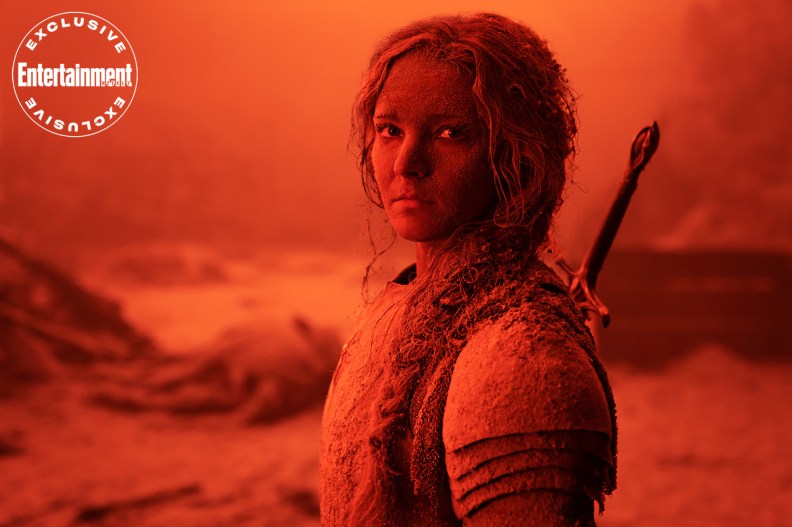
This Galadriel is the forerunner of the show. She is its heroine. Here, you are presented with the Elf who becomes the Dark Queen of Lórien when presented with the ring. This is a younger Galadriel, who is steeped with ideas of ambition and vengeance. She is the Galadriel who has lost her family in the tumult of the First Age. She is the one who wants to hunt down Sauron who she believes is not dead or lost. She is the one who wishes to take the Ring from Frodo, much later, because she has not given up the idea of bringing peace to the realm by any means necessary. This is the Galadriel who gives up Valinor because she believes without her no one will attempt to set things right in Middle-earth. Her character is not Light and it is not Dark. It is grey.

The Lord of the Rings: The Rings of Power Galadriel (Morfydd Clark) on the battlefield. CR: Ben Rothstein / Prime Video

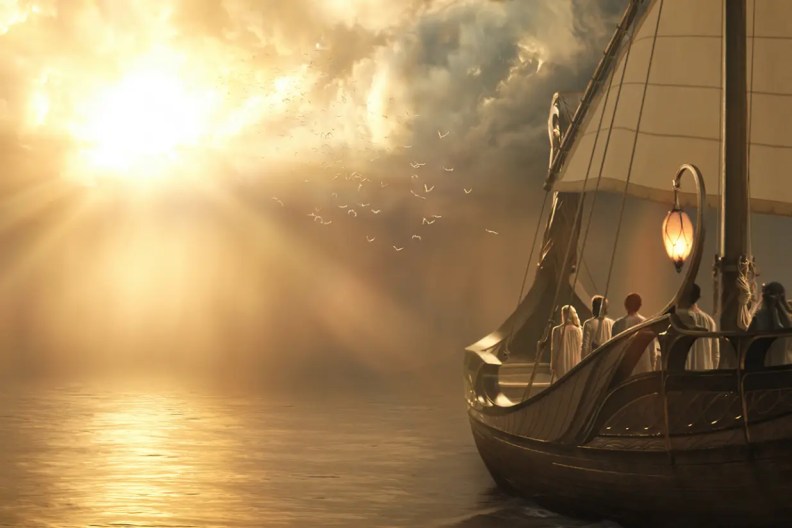
I love the way she is represented. She is the Lady of Light seen in Caras Galadhon in the end of the Third Age. She is here more vocal about her desire. She has not yet become the politician that she accuses Elrond of being. One of the best scenes of the first episode, in my opinion, is when she is on the ship sailing to Valinor. The spectacle of the scene is a culmination of the representation of places we have never seen on screen before.

Lindon, Khazad-dûm, Eregion, the South Lands – utterly beautiful depictions – and the special effects team has just done its job so very well. And Númenor – oh my gosh. It is said that concept artist John Howe (I love his work!) filled 40 sketchbooks with drawings for the project! He stated that the biggest different between the films and the series was that the series visited new locations!

Payne, McKay and Avery, the writers, wanted a lot more focus on the beauty of Númenor, because it had never been conceptualised before on screen. Tolkien had mentioned that the city was like Venice, because of its connection to water. The Elven works have given way to work grounded by the reign of Men… and as with mankind, there are grandiose depictions of stone sculptures – of Men. But I digress.

The crux of Galadriel’s conflict comes within the scene at Valinor’s portal. The rejection of her invite to return home. It is like the rejection of Fëanor, when he is told by the Valar to stay at home and not seek out Morgoth for revenge. But he does, and so does she. She abandons the ship bound for Valinor. She thinks her presence is indispensable. It is her own vanity that makes her dark, as she dives into the sea, instead of looking upward into the stars.

Valinor

The writers of the show have dealt with the minds of the Valar and given them the cognizance of wisdom. As Galadriel reaches Valinor and the portal opens, a comet shoots out from the skies. Her replacement is sent forth. They do not mention who The Stranger is – but I would like to believe it is Gandalf the Grey. He is sent forth as a better replacement to Galadriel. For he is a Maiar – of fire – the follower of Manwë – and he has no intention to gain power. His purpose is only to help and guide. As is clearly shown by the end of the third episode.

Of course, I wouldn’t say that the purpose to help and guide was also shared by both Morgoth and Sauron. The former when he teaches the Vanyar how to build weapons and armour and the latter when he becomes Annatar and comes to Númenor. But those are analogies I won’t speak about further.

The scenes in Lindon are some of my favourite. Everything is so – yellow. But the carvings of the fallen on trees – superb. Has anyone noticed how Gil-Galad, Benjamin Walker, looks so similar to the actor who plays Gil-Galad in the movies, Mark Ferguson?

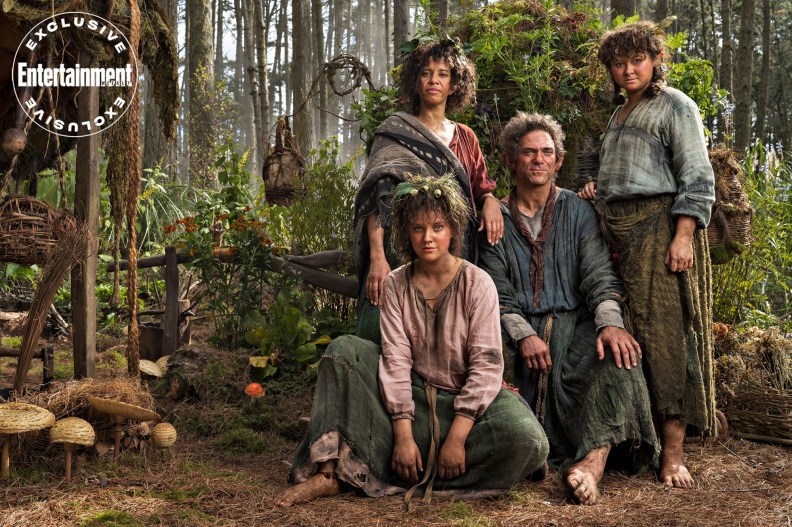
The Lord of the Rings: The Rings of Power Clockwise from top left: Harfoots Marigold Brandyfoot (Sara Zwangobani), Largo Brandyfoot (Dylan Smith), Poppy Proudfellow (Megan Richards), and Elanor “Nori” Brandyfoot (kneeling).

The creation of the Harfoots seems so in sync with the question of how the hobbits come into their own. I always wondered why their history was never mentioned very much. I like the idea of them being nomadic and filled with the idea of family. The character of Nori played by Markella Kavenagh is so – right. She fills easily into the shoes of both Merry and Pippin. The Stranger rockets right into their midst. Another reason why I feel he has to be Gandalf (apart from the fact that he can speak to fireflies like he did with a moth). Does Gandalf the Grey not share an old affinity with hobbits? It’s all so well-structured.

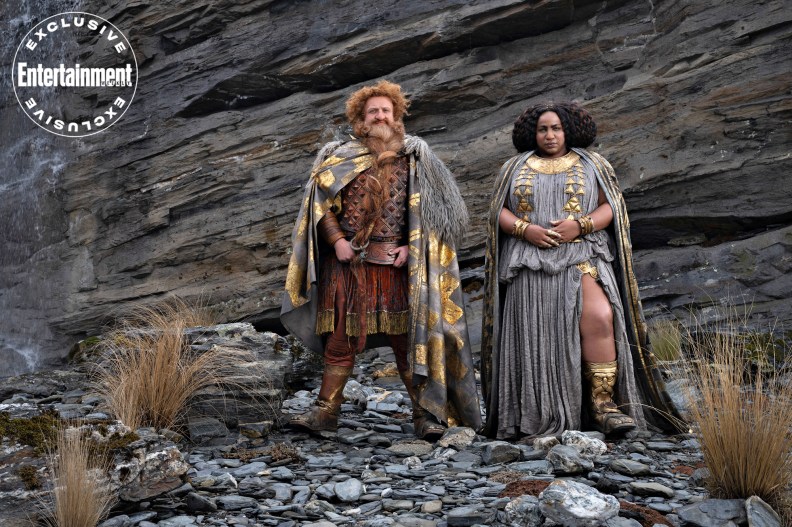
After the Elves and the Hobbits, I must speak of my favourite couple in the series. Prince Durin IV and Princess Disa. Khazad-dûm is a wonder. The way they have picked up the skeletal ruins seen in The Lord of the Rings and filled them with life and beauty is a joy to behold. Just amazing work of the digital team that has mastered about 9,500 visual effects shots within this one season! The acting of Durin and the chemistry between him and Disa is really lovely to behold – you can actually feel their love.

The Lord of the Rings: The Rings of Power Prince Durin IV (Owain Arthur) and Princess Disa (Sophia Nomvete) of Khazad-dûm.

Finally, we come to the depiction of the Southlands. Another area of Middle-earth never before seen. There is a history there that hasn’t been spoken of – and once again there is light even in the darkness, presented as the love of Bronwyn for Arondir.

There were bigots who did not wish people of colour to play roles they thought should be played by white people. They spoke on behalf of Tolkien. What I know is this – Tolkien wrote about the free peoples of Middle-earth – and they all sat on the Council to decide Middle-earth’s fate. As such, I am sure he would be just as pleased with Ismael’s Arondir as most people who admire gravitas do. He is the Elven Aragorn.

Tolkien’s work is for everyone. I was a 12-year-old Indian boy, bullied because he was different, and reading about Frodo then did me a world of good. So I do not believe that I could not play that part just as well as Elijah, just because I am brown. (Pardon my immodesty – I do not beg pardon for my ethnicity!)

We have a lot of similarities between the Third Age and this one. We have a dark weapon that talks and corrupts, we have a dwarf and an elf friendship, we have a lost king of men, many dialogues that seemed to be picked up from the movies (she has passed out of my sight), another weapon forged by the elves that is a representation of an ancient warrior, and so much ambition floating about everywhere.

I have loved the series so far. I like the depiction of the characters. The script has its flaws here and there, but over all the writing is very good. The dialogue has been adapted to suit the difference in the ages of Middle-earth. For example, Elves speak mostly Quenya instead of Sindarin. There are different dialects and even poetic meters for some characters. It’s a lovely affair of sound. The writers have outdone themselves – and I can just imagine what a momentous task it happens to be.

It is necessary, I suppose, to leave cliff-hangers here and there. Like what exactly was in the box that King Durin opens up with his son. I think it could be a silmaril. Some think it could be mithril, upon the finding of which the dwarven kingdom began its downfall. They “delved too deep” – and ultimately released the Balrog.

For me, someone steeped in Tolkien’s mythos, the series has proved to be a sensation of many delights. I love seeing the different locations. Seeing characters that I have read about and always wanted to see on screen. I look forward to every Friday morning. And the wait fills me with pleasure. It is nice to look forward to things like this in life when most things seem to pale and fall away into desolate burdens of daily life. I do hope we get to see all five seasons of this – because I much prefer to see Middle-earth than Westeros. Romanticism over realism and love instead of cruelty.