
Confused, frustrated, angry

It began with a sentence that stayed with me long after it was spoken. When I said it had been a month since we had made love, the partner I most desire looked at me and said, almost casually, that I was angry all the time. It wasn’t the first time. Over time, the language had been shifting. I was controlling. I was a perfectionist. Now, apparently, I was angry.

Maybe I am.

But I have begun to wonder if what he calls anger is actually frustration — the kind that comes from being starved of touch while being told you are difficult for wanting it. The kind that builds when you ask, quietly at first, to be held, to be wanted, to be made love to, and the asking itself becomes evidence against you. When longing is recast as a character flaw, something inside you hardens just enough to survive.

I don’t want constant sex. I want closeness. I want to be held at night. I want to feel a body reach for me without having to negotiate for it. I want desire to feel like an offering, not a concession. When those things don’t happen, when tenderness dries up and erotic attention becomes sporadic or withheld, the ache doesn’t disappear. It finds other outlets. I scroll, I watch porn, I masturbate daily — not because I am insatiable, but because something in me is trying to self-soothe what is not being met. And sometimes, lying there afterwards, I find myself asking the question I’m afraid to say out loud: if there are two men in my life, why do I still feel so alone?

In queer spaces, we are often encouraged to name ourselves early and clearly. To know whether we are tops or bottoms or sides, as if desire can be neatly categorised and remain stable across decades. I have moved between these words for years, trying to see which one fits. When I was a teen, I thought I was a bottom because surrender felt right in theory. Then, after I topped and tied bottoming, I didn’t like either experience. So, I thought I was a side because penetration was never central to my wanting. Then, with my last partner, there were moments when I surprised myself entirely, enjoying things I had once assumed were not for me. None of it followed a straight line. None of it stayed consistent. What I once mistook for confusion, I now recognise as responsiveness — to safety, to trust, to care, to timing.

What we rarely acknowledge is how deeply fear shapes desire. How avoidance can masquerade as preference. How wanting closeness without certain acts doesn’t make you less sexual, only more specific. And yet, there is pressure to present a stable, legible version of ourselves — one that partners can rely on, even if our own bodies are quietly asking for something different.

Alongside this uncertainty about sex lives something even more tender. I love being held. I love sleeping with an arm around me, the reassurance of touch in the dark. And yet, the partner I am most sexually drawn to is not the one who holds me at night. That care comes from my older partner, now, the one who steadies my day-to-day life. I sleep between them. Care on one side. Desire on the other. Somewhere in that arrangement, I began adjusting myself instead of asking to be met fully.

Over time, I taught myself how not to want. I stayed awake until exhaustion took over so I wouldn’t lie there missing what wasn’t coming. It’s a quiet grief, learning to dull a need because it feels inconvenient or unwelcome. From the outside, it might look like composure. On the inside, it feels like erasure.

When I confide in men outside this life, they sometimes say things that sound like promises. That they would never let me go untouched. That they would always hold me. I don’t dismiss them, but I don’t cling either. I’ve lived long enough to know how time works. How novelty softens. How desire changes. How even sincerity is no guarantee. So I accept the recognition, if not the reassurance.

All of this leaves me questioning structures I once took for granted. Whether committed relationships are meant to carry everything forever — desire, care, novelty, safety, touch — or whether that expectation itself is what exhausts us. Whether open relationships should be less of a scandal in queer lives and more of an honest response to how desire actually behaves. Whether love and sex are always meant to live in the same body, or whether insisting that they must is an unnecessary cruelty.

I don’t have answers. What I have is a growing refusal to be reduced — to a role, to a label, to an accusation of anger when what I am really expressing is hunger. Hunger for closeness. For tenderness. For being chosen without having to justify the wanting.

If any of this feels familiar, you are not alone. Many of us are renegotiating love quietly, in the middle of the night, teaching ourselves how to sleep, how to wait, how to endure without hardening. Confusion is not failure. It is what happens when we stop performing certainty and start telling the truth.

Sometimes, that is where living actually begins — not in neat resolutions, but in allowing ourselves to feel the full weight of what we want, and refusing to disappear just because it makes others uncomfortable.
Sabar Bonde

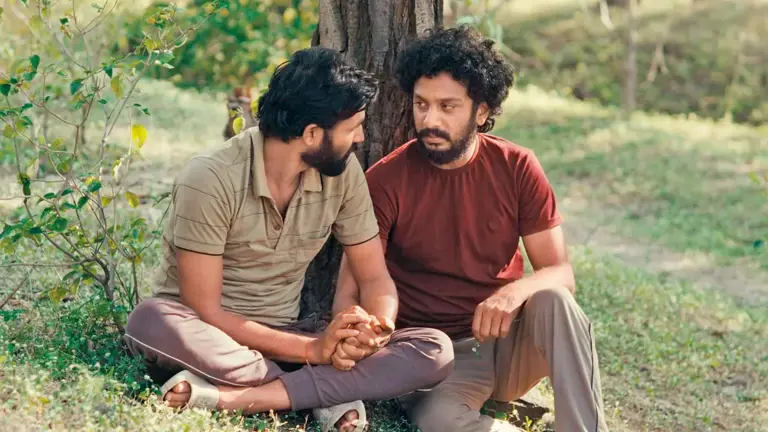
I watched Sabar Bonda at its 4:20 show at PVR Andheri — an experience that turned out to be more than just cinema, but a mirror. What most gay men go through, irrespective of class. A simple thing like a parent being worried about the future of his gay son. 

It began with death. A father passes away, and rituals immediately take over: what to wear, what to eat, how to mourn, what to suppress. That opening sequence pierced me deeply because my bua — whose birthday coincidentally fell on the day of my viewing — was like a father to me. The grief, the weight of conduct, and the demands of tradition all struck a profoundly personal chord.

What makes Sabar Bonda so powerful is that the protest it mounts is whisper-quiet. It doesn’t erupt in melodrama; it lingers in what society insists upon — in colour, rules, and ritual. A grey shirt Anand is told to change. Much like how people ask us to change, to convert. The slippers he wears – bringing comfort to his feet – but only in the company of his lover, because ritual forbids it. The shadows of who he is, pressed against the mould of what he’s “supposed” to be. The film reveals itself in the texture of small moments: Balya’s gift of cactus pears, the shared silences, the tension between city and village, heartbreak and love, grief and continuity.

Anand’s mother is the film’s moral and emotional backbone. She loves, supports, and resists in her own way. His father’s eventual acceptance, Balya’s steady care, and the hesitancy threaded through each character are rendered human. There is no villain here — only systems and traditions, and people trying to navigate them quietly.

Critics have largely echoed these impressions. Moneycontrol calls it “a gentle story of grief, memory, and love told with quiet honesty. It lingers in the silences and small moments …” Times of India writes: “to enjoy the sweet taste of cactus pears, you must first carefully remove the sharp spines from the skin of the fruit … meant to be savoured exactly like that.” That metaphor mirrors the story’s truth — love, identity, and acceptance are like a fruit you crave, but you must first tend to the pain. Indian Express highlights the film’s visual poetics: the still camera, wide frames, and static gaze that holds ritual, grief, and distance until intimacy seeps in. Hindustan Times calls it “a tender, deeply moving study of queer love in one of the year’s best films,” noting how customs, everyday pressures, and quiet longing are handled with exquisite precision.

Where my own experience diverges is in how deeply the symbols resonated. The cactus pear, unlike the peach in Call Me By Your Name, isn’t about erotic awareness, but about care, concern, and tenderness — love that is rare, difficult to find, but sustaining. The rituals aren’t simply a backdrop; they are choreography, dictating what must and must not be done. Anand’s protest is not loud — it is embodied in small refusals, in gifts, in a silent embrace.

Long after leaving the theatre, certain truths lingered. Rituals and rules aren’t just external constraints; they are the inner architecture Anand must resist and reshape. The sensory texture — touch, clothing, light, the sound of goats, footsteps, and fields — builds an emotional world as vivid as any dialogue. There is the courage of saying no to what one is “meant” to be, and yes to a hidden version of self. And there is the way family, particularly the mother, becomes both an anchor of tradition and a wellspring of possibility.

Some critics have noted the film’s pace is slow. I felt that too — but its slowness isn’t a flaw. It forces us to sit with grief, longing, and ritual as the characters themselves must. It may not satisfy those expecting dramatic peaks, but its reward is in its lingering — in the way it teaches us to notice what we otherwise overlook.

The caresses are felt through the screen. The running of hands in the hair. The embrace to ward off the cold. The closeness found at last in the privacy of the city. They permeate through the screen and fall into your hands and heart. The emotion there becomes visceral and that’s what makes the movie brilliant – it’s like reading a book, you are pulled into deeper nuance and feeling.

Sabar Bonda doesn’t shout its declarations. It doesn’t need to. Instead, it builds a space where grief, yearning, and identity coexist in fragile balance, where society’s insistence collides with the quiet affirmations of love and humanity. It reminds us that love can be radical, even when soft. That rituals can suffocate as much as they anchor. That resistance doesn’t always roar — sometimes it whispers, gently, persistently, and all the more powerfully.

If I were to give it a frame, I’d say: Sabar Bonda is a film of small revolutions. It doesn’t overthrow. It loosens. And in that loosening lies its beauty — because it allows tenderness the room to breathe.

The rain in the bow

She was someone’s daughter.
He was someone’s son.
What bitter hate was this
to deny love and end laughter?

What horror they must have seen!
What fear they must have felt!
What torment they must have known!
What a night it must have been!

Her father must be fading away
His mother must be bereft
To know their children suffered
For no reason but loving their way.