My Children

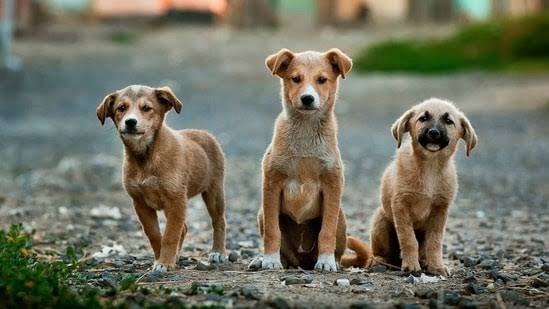
They are my children — each four-legged canine.

I am human; they aren’t, but they are mine.

Each came to my life, made it softer;

Each has brought its share of love and laughter.

Each pup has known my embrace and promise,

And saved the hope life wanted to tarnish.

They shone — white, or fawn, or tiger brindle —

Each brought a flame that’s forever kindled.

They pulled me back from death, I confess, twice;

Leaving them without me was not a choice.

So they stave my depression with their walks;

Most nights, they engage me in play or talks.

Xena is the smartest, Diana the kindest;

Rolfe often brought my temper to the test.

Zoe, my shadow, I loved the very best;

Bonzo was my first, and Zach’s my first-born,

And each passing gets my heart ripped and torn.

I lost my faith in God when Zoe died,

And when death comes to each, how I have cried.

They taught me early how grave loss can be,

And death seems now almost like family.

My kids have helped build all my empathy,

And love, and valour, and brave sympathy.

They have no clue of hardship, death, and life;

They have indirectly taught me a stray’s strife.

I see and judge the world through their pure eyes,

Because no one in it ever lies or dies.

I give them all the love I have and can,

And each of them makes me a better man.

The Lift, the Law, and the Limits of Human Decency

I am tired.

Not the kind of tired that a night’s sleep fixes, but the bone-deep exhaustion that comes from having to fight—again and again—for the most basic decency.

We’ve just taken possession of my mother’s new flat in a Cooperative Housing Society. A Bank of India colony, no less. Two lifts: one passenger, one service. And already, the managing committee has decided that pets are not allowed in the passenger lift. We are to use the service lift—the one meant for goods, for furniture, for trash.

Apparently, our dogs are objects now.

When I heard the news, anger wasn’t my first emotion—it was weariness. I had expected this, of course. The script is always the same. First comes the suspicion, then the whispering, then the notice on the board. “Pets not allowed.” Always the pets. Always the easiest targets.

It took a week in my current home. When we first came in, in 2019, someone immediately complained that a bit of my boxer’s drool had fallen on the lift floor. A couple of small gobs of saliva—nothing more. We cleaned it, naturally. Since then, we’ve been cleaning the lift every time we use it. Fair enough. But when greasy fingerprints line the walls of the lift or the corridors, nobody blinks. When food wrappers are left behind, when someone’s child drops chocolate, when oil marks stain the walls—silence. But dog drool? Outrage.

And now in the new building, a notice appears. Without the secretary’s consent—without even her knowledge. My mother is the secretary, incidentally. Certain members of the managing committee went ahead anyway, decided on its own, and printed that smug, illegal diktat.

She was furious. I was furious. She tried reasoning with them, but words faltered. So I spoke. I told one of them that this was illegal—that no society in India can ban pets from passenger lifts or common spaces. The Animal Welfare Board of India has made this clear. He brushed it aside. “Other buildings do it,” he said. As if illegality becomes law through repetition.

When I pressed him, he cut the phone.

Cut. The. Phone.

That’s what bullies do when logic corner them—they run.

I called a friend, who put me in touch with a lawyer. The lawyer told me I had been too respectful. He was right. He said I should have demanded they put their order in writing. Because once it’s in writing, it’s actionable. Illegal. Enforceable—in court, against them. He was ready to take it up if they dared formalise their prejudice.

And then I realised what this truly was: not about dogs, not about hygiene, not about drool. It’s about control. About people desperate to assert dominance over what they don’t understand.

They will tolerate drunks, loud music, cracker noise, domestic violence, gossip, hypocrisy—everything that corrodes the soul of a community. But not dogs. Not love. Not innocence.

It made me wonder why I even bother calling this place home.

I’ve fought my whole life—since I was a child—for the right to exist, to love, to be. I’ve been beaten, bullied, spat on, mocked—for being gay, for being different, for daring to be myself. I fought then. I fight now. And I will keep fighting.

Because this isn’t just about my dogs. It’s about what kind of people we have become. We cage compassion and call it order. We humiliate empathy and call it discipline. We dress up cruelty as “society rules.”

But I refuse to shrink.

I will speak up—for my dogs, for the voiceless, for those who cannot explain that drool dries and hearts break. I will call out hypocrisy when I see it, even if it’s etched in a printed notice on a lift door.

Yes, I’m tired. But I’d rather be tired from fighting for what’s right than be comfortable in the company of cowards.

So here’s to the next battle.

Because peace, apparently, must always be earned from the people who fear kindness the most.

My Kids and Their Lessons

If you’ve followed my writings, you know that dogs are not simply pets to me — they are companions, teachers, and my children. Living with dogs has been one of the most grounding and transformative experiences of my life. They have walked beside me through loneliness and joy, through grief and laughter, and they have given me lessons that no classroom, book, or mentor could fully teach.

Dogs do not care about the masks we wear for the world. They don’t measure us by our successes or failures, our wealth, or our appearance. For them, love is in the moment — a wagging tail when you walk in the door, the nudge of a wet nose when you’re low, the quiet companionship when words fail. They have taught me that presence matters more than perfection. To truly be with someone — whether human or animal — is the most profound act of love.

Each of my dogs has carried their own story, sometimes marked with pain, abandonment, or fear before they came to me. And yet, I have never seen them give up on joy. They can be hurt and still trust again, neglected and still give love. Their resilience humbles me. They remind me that life can wound us, but bitterness is a choice — and forgiveness, often wordless, can set us free.

As adults, we often forget the simple grace of play. My dogs never do. Whether it’s chasing a ball, running wild in the park, or simply rolling on their backs in the grass, they remind me that joy is not frivolous; it is survival. To laugh, to move, to play is not just about fun — it is about keeping the spirit alive.

Dogs are perhaps the only beings who embody loyalty without condition. They don’t keep count of arguments or misunderstandings. They don’t hold grudges. Their loyalty is not bound by transaction — it is instinct, pure and unbreakable. In a world where human relationships can often fracture under strain, my dogs show me what steadfastness looks like.

Over the course of my life, I have lost four dogs. Each loss has carved a hollow that no words can truly fill. And once, I had to make the most unbearable decision — to end the suffering of the one I held dearest. It is in these moments that my dogs have taught me their most profound lesson: that life is fleeting, and it is made full not by grandeur but by the everyday.

Their short time on earth is a reminder to live in the present — to relish the mundane walk, the quiet nap, the silly game of fetch. Because in the end, only love matters. Only love sets us free. At the final breath, it isn’t the achievements or possessions that count, but the care and presence of those who hold you with love until the very end.

Life, I’ve learned through them, is cyclical. I lose one pup, and another finds its way to me. The poignancy and bitterness of death are inevitable, but so is the sunrise of another day. Their passing has taught me to embrace the paradox of grief and renewal — to know that endings are also beginnings, and that love carries forward even when bodies do not.

Perhaps the most unexpected gift has been this: my dogs have taught me to be gentler with myself. They don’t see my flaws as I see them; they don’t recoil at my scars. In their eyes, I am enough — worthy of affection, worthy of care. And slowly, through their gaze, I’ve learned to soften the harshness of my own.

My house literally, feels more alive because of them. Their presence fills corners with warmth, noise, chaos, and peace all at once. They make even the most ordinary days feel less lonely. For me, home is not about walls or possessions. It’s about the heartbeat at my feet, the bark at the door, the eyes that follow me room to room. Home is where they are.

Dogs have been my healers, my mirrors, and my greatest teachers. They have shown me that love is not complicated; it is given freely and without expectation. They have shown me that joy is found in the smallest gestures, and that resilience is written in the wag of a tail after a storm.

Most of all, they have shown me that life is both fleeting and eternal: fleeting in its moments, eternal in its love.