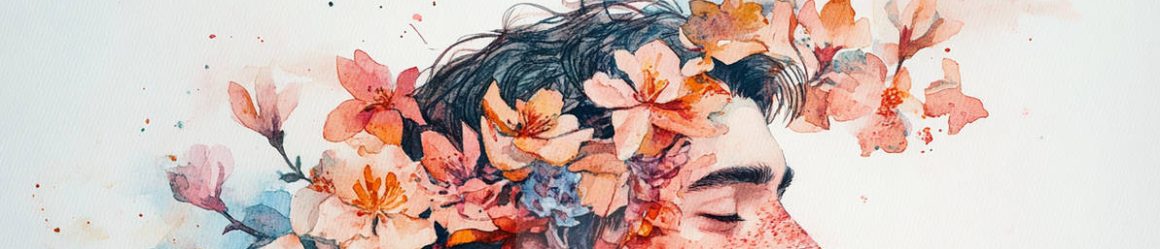

I’ve lived fifty years now. And lately, I find myself drifting gently—sometimes with longing, sometimes with quiet acceptance—into the soft interiors of my past. Rooms, trees, dogs, balconies. I don’t just remember—I love my past.
It comes in flashes. Sitting in goodie Pua’s room, which once was mine. Me on the floor, a book in hand, staring out at a distant building, the same building I used to gaze at as a child, wondering what life would become. There was a hush to those hours. A small stillness, and a vast world just beyond.
I think of Bonzo, my first dog. Amruttara. His head in my lap, and Jim Reeves crooning through the speakers. “Put your sweet lips a little closer to the phone…”—a soundtrack to a time when love felt near, and sorrow hadn’t yet introduced itself.
There was the balcony. That sacred space. My chacha painted his bold, brilliant works there. My grandmother and I sat in wordless rhythm. From there, I watched kestrels fly, tracing circles in the sky for what seemed like hours. Below was Guru Nanak Park, where trees held my childhood laughter like old secrets.
I was taught about Christmas by my closest friends—all girls—who showed me how traditions bloom when shared. I belonged, even if I wasn’t born into their stories. I had my gang too—two Muslim boys. We played without borders. Our games were pure mischief and sunburnt delight.
Then came school. That raucous theatre of growth and crushes and petty fights and stolen glances. Vignettes of benches, chalk dust, and shy grins.
I could go on. I do go on. Because memory doesn’t end—it spills forward, uninvited but always welcome. And then come the losses. The quiet absences. So many deaths. Yet I don’t write this to mourn. Everyone loses. Some have lives infinitely harder than mine. But still—I feel deeply. I remember deeply.
Now, at fifty, a strange quiet has come over me. Not sadness exactly. Not peace either. Something like a hush. A knowing.
I’m still learning things about myself. I haven’t stopped. I still draw attention; I’m still attractive to men. But more than that—I’m aware now that nothing lasts. Everything simply becomes more. I am becoming more.
And yet—I am tired. The body reminds me of its mortality. Aches linger longer. Exhaustion settles faster.
It reminds me of Mary Carson’s words to Father Ralph in The Thorn Birds:
“How unfair, how goddamned unfair it is that the body must age while the heart stays so young. Still wanting, still feeling, still yearning.”
That’s me. Still wanting. Still feeling. Still yearning.
And then, books—my old companions—have come back into my life. I’ve started reading again. And I’m in awe. Words pierce me in ways they didn’t before. Or perhaps, I’m just more porous now. I wish I had never stopped writing. I love it. It’s where I meet myself most honestly.
Sometimes, in reading, I stumble upon truths that feel like echoes of my own heart. Like this, from Marcel Proust:
“The past is hidden somewhere outside the realm, beyond the reach of intellect, in some material object…which we do not suspect.”
For me, that object might be a book spine, a balcony railing, the fur on a dog’s head, or a patch of sunlight on a floor.
Or this, by Joan Didion:
“I have already lost touch with a couple of people I used to be.”
And indeed, I have. But not with sadness. Just a quiet nod to all the Harpreets I’ve been.
And finally, this line by James Baldwin speaks to the weight of remembering:
“You think your pain and your heartbreak are unprecedented in the history of the world, but then you read.”
Reading, remembering, writing—they make me feel less alone. They remind me that while time may take, it also deepens.
And in all of this reflection, perhaps one of the most important things I’ve learnt is this: I no longer owe anyone an explanation. Not for my life, not for my beliefs, not for who I love, or how I live. I should’ve learnt this when I was younger, but back then I was still trying to prove something to the world—that people like me exist, that we matter, that we deserve to be heard. I wanted to prove that we belong.
But now I see it for what it was. Most of the people who tried to drag me into arguments weren’t interested in the truth. They were interested in control. In power. It wasn’t the content of the argument that mattered to them—it was the fact that I reacted. That I gave them my energy.
Now? I don’t.
There are many arguments not worth having. And silence, I’ve come to realise, is golden—especially when you’re surrounded by those who have no intention of listening. Many people around me are naysayers. Not sceptics—scepticism is curious. These people are dismissive. They’re already decided on their truths—whether about religion, sexuality, science, history, or faith.
I don’t have the bandwidth anymore. Nor the energy. And most certainly, not the inclination to engage with these fucktards.
I’d rather sit with a book. Or with my memories. Or just quietly breathe, knowing that I’ve lived fully, fiercely, and without regret.
I suppose I am someone to be feared and loved. Feared, because I’ve lived, and survived, and carry a quiet intensity. Loved, because my heart has never shut down, not once, despite all it has seen.
I may be growing older, but in so many ways, I am only now growing into myself.


 Hearts Still Care
You must be logged in to post a comment.