FRIENDS

The sitcom Friends has long been celebrated as a cultural touchstone for its humor, iconic characters, and portrayal of friendships in New York City. However, watching it again two decades later, the show reveals some cringe-worthy moments, especially for those of us in the LGBTQ+ community. As a proud and out gay man, it’s hard to ignore the problematic tone the show adopts in several episodes.

One of the most glaring issues is Chandler’s attitude toward his father, who is portrayed as transgender. Instead of accepting or even attempting to understand his father’s identity, Chandler often resorts to jokes and derision, feeding into outdated stereotypes.

Throughout the series, Chandler is frequently mistaken for being gay, and he constantly reacts with exaggerated discomfort or anxiety. This recurring joke plays into the idea that being seen as gay is embarrassing or something to be avoided, which subtly reinforces homophobic attitudes. There’s even a flashback episode where Chandler talks about being afraid of “turning gay” because his parents got divorced. This comment reduces complex personal issues to a baseless fear of homosexuality, implying that being gay is something undesirable or linked to emotional trauma.

This discomfort with LGBTQ+ identities is a recurring theme throughout the series, with many characters expressing unease around gay people, whether through homophobic jokes or dismissive attitudes.

Take, for example, the episode where Ross and Brad Pitt’s character cruelly joke that Rachel is a hermaphrodite. The comment isn’t just off-color; it shows a total disregard for sensitivity and the real-life experiences of intersex individuals. When Carol and Susan get married, the ceremony is treated as a novelty, with some characters expressing awkwardness about attending. Though the show deserves credit for airing a lesbian wedding at a time when this was rarely seen on TV, it was still framed in a way that made the audience feel like it was an oddity.

Similarly, Monica and Chandler’s treatment of their maid—accusing her of stealing Monica’s clothes—feels not only overblown but abusive. The way Monica handles that situation, fueled by her insecurities, highlights a troubling power dynamic.

Joey’s character, known for his womanizing ways, also offers moments of toxic masculinity that now feel outdated. He’s perfectly fine with sleeping around, but when it comes to his sister being pregnant, he can’t handle it. Then there’s the issue of his discomfort with grooming and self-care, reinforcing the stereotype that men who take care of their appearance are somehow less masculine. In one episode, Phoebe even calls Joey a “woman” for grooming himself, though Monica rightfully stands up for him. Similarly, Joey’s comments about men doing their eyebrows being “sissy” is another eye-rolling moment.

Joey often makes offhand comments that imply being gay is something to be avoided, like when he jokingly warns Ross about the dangers of hanging out with his lesbian ex-wife and her partner. He treats the idea of being around gay people as if it’s a threat to his own masculinity. Whenever Chandler or Joey show affection toward each other, it’s often accompanied by homophobic jokes or awkwardness, as if two men expressing close friendship must be shielded by humor to avoid any “gay” connotations.

The show is littered with subtle (and sometimes not-so-subtle) homophobia. Ross, in particular, stands out in his awkwardness and unease with anything that challenges traditional masculinity. He’s irritated by Sandy, the male nanny, despite Sandy being the perfect caregiver for his child. Rachel defends Sandy, but in the end, he’s still written off because he doesn’t fit into Ross’s heteronormative idea of a nanny. And when they hire a different nanny, Ross’s immediate reaction is sexual—only to find out she’s a lesbian, which Joey, predictably, finds exciting.

There are countless other moments: Mona’s date commenting on Ross’s pink shirt, the ridicule of a gay colleague at Ross’s conference, and the laughter at Ross’s speech when he uses the term “homo erectus.” These are moments that might’ve seemed harmless to straight audiences at the time but are painful and alienating for LGBTQ+ viewers today. Imagine how I felt when these scenes came up when I was struggling to find acceptance in a homophobic society.

In retrospect, Friends often worked for its straight, cisgender audience by reinforcing the norms of the time. But for those of us who see these jokes and storylines through the lens of experience and pride in our identities, the show feels outdated and at times deeply offensive. What was once a comfort watch has become a reminder of the work still needed to challenge and change these ingrained cultural narratives.
They Ask Me

They ask me,
When I write a poem of sorrow,
How is it that I am sad,
For I wear the smiles of tomorrow?

They ask me,
If they, by chance, see my tears,
Why do I worry,
When I have no cause for fears?

They ask me,
They ask me,
And I would tell them – I could –
(It hardly matters, if I should -)

But how do I explain
The years that pile on grief,
Little memories of deep wounds
That never brought relief,

How a father abused,
And bullies snatched my share,
How society points fingers,
How some malign, how some glare,

How the men I loved
Left me, for who I became,
And how, instead of shaming them,
I took almost all the blame,

How just when I feel at ease,
With the weight of difference I carry,
A sister feels she must lie,
When she makes her plans to marry,

How straight people have rights,
How my mother forgets my love,
How my country condemns me,
How I gave up every god above?

They tell me,
You still shine bright like a star –
And I know, I twinkle,
Because all they want is to watch me from afar.

Shubh Mangal Zyada Saavdhan

I am writing a review on a movie that has me super stoked. I saw Shubh Mangal Zyada Saavdhan yesterday night. It lived up to its hype in my head. Of course, I have seen better movies dealing with gay issues and gay lives. But most of these movies come from abroad. We have had brilliant movies like My Brother, Nikhil and Aligarh that touch upon LGBTQIA lives sensitively, but an all and out romantic comedy that deals with a very proud, out-of-the-closet gay man – never! Very recently, we have had Ek Ladki Ko Dekha To Aisa Laga, with such a brilliant script and supporting cast. But let’s admit it, though I have the greatest respect and admiration for Sonam Kapoor who takes on the role of a lesbian, and makes her the lead in a movie dealing with queer love and coming out, I just don’t like her acting.

So, that brings me back to this no-holds-barred out, gay love story! The movie deals with two boys, Kartik and Aman, who fall in love in Delhi and have to make a journey to Aman’s hometown to attend his cousin sister’s wedding. Aman’s dad finds out about his son’s sexuality and the resulting dynamic between intolerance and acceptance forms the crux of the movie. I won’t lie and state that the movie didn’t see things through the utterly rosy lens of a romantic comedy. It does however deal with a lot of issues, that become the winning formula of any Ayushmann Khurrana movie.

It is very important that an A-lister like Ayushmann has taken up a role that almost no one in Bollywood would touch. Homosexuals were to be made fun of, to be derided. How can I forget John and Abhishek in Dostana? But there was not a moment in this movie that was cringe worthy. Kartik, played by Ayushmann, is a bold, vibrant, out homosexual man, who leads the movie out through the messy mind of homophobia.

Most people find the first half of the movie appealing, but for me, it was the second half that held weight. It has a brilliant dialogue between Kartik and Aman, when Kartik asks Aman to stand up for himself and not get married to a girl. This is the most important conversation for me, because what one must always realise, or make very healthy attempts to, is the truth of who one is. One must always be true to who he or she happen to be. That is what Kartik tries telling Aman. To love yourself before you can ever possibly love anyone else.

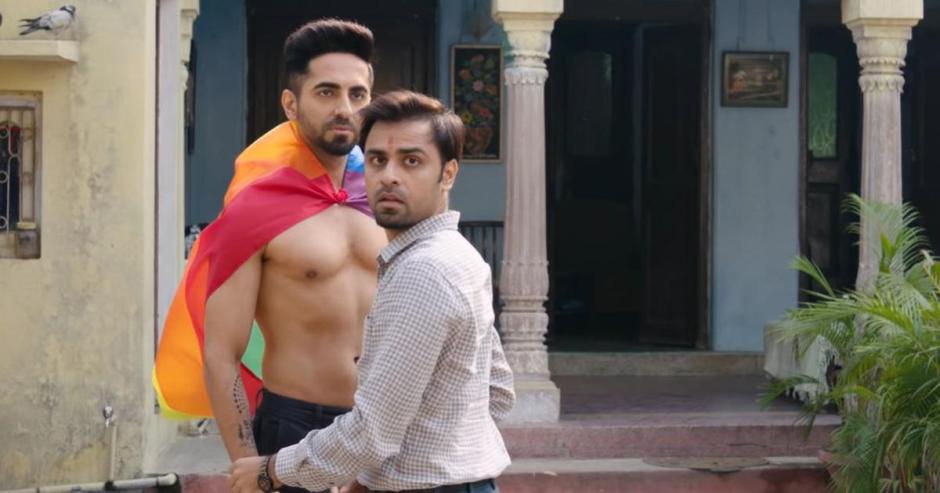
Ayushmann had my heart when he wore the rainbow flag and gave a speech on the dangers of homophobia. The whole scene is over the top, but which self-respecting gay man hasn’t had to say these words to someone in their lives? Well, maybe not shirtless, but hey, who can say that hasn’t happened either? Ayushmann’s Kartik is where LGBTQIA people reach after a while: being sure of who they are and what they want from society. It is Jitendra Kumar’s Aman Tripathi’s shoulders that the movie stands upon. The small town boy who knows he is different, is in love, but cannot face up to parental pressures. This is his story. His journey.

Ayushmann and Jitendra have done lovely work. Many situations in their lives corresponded to either my life, or varied stories I have heard from the lives of my queer friends. Everything that Kartik says in regards to sexuality I have said at some point or the other. It was like hearing myself speak at times. The most important thing is when he tells Aman, twice, in the course of the movie, to completely and deliberately disregard what his father is telling him to do, because he must listen to his own heart. This is not Romeo telling Juliet to disregard convention, this is a Romeo telling a Romeo to understand biology. It’s a very important factor, that most of us do not notice.

Jitendra Kumar took on a role no one really wanted. But he has done lovely work with it. He has beautiful eyes and the vulnerability in them speaks volumes. He is the everyday, desi homosexual who is caught between his biology, his love and his family. And what a family! The supporting cast has done such a fantastic job! Gajraj Rao who plays Aman’s father, Shankar, and Neena Gupta who plays Aman’s mother, Sunaina, have outdone themselves. Their back story has such a layered sensitivity that again is briefly touched upon – having made choices ruled by convention instead of their own hearts. Some people may find Bhumi Pednekar’s cameo confusing, but being gay, one realizes how many of these incidences happen with straight girls and gay boys. (And it’s a nod to Shubh Mangal Saavdhan, their earlier movie together.)

The time given to this movie was too short. It moved too fast for me, especially whilst bringing in so many valid, heavyweight issues and dealing with them quickly. Most of the situations that needed a serious tone were made to seem totally flippant, like the scene where Shankar beats up Kartik. Homosexuals have been killed due to homophobia, and in this case, it was comic fare. I will also very grudgingly give this leeway, because to make something so serious occur would change the entire tone of the movie. Laughter is always easier to digest than tragedy – well, at least for me. I want a happy ending.

I left the theatre feeling good. I know the script had flaws. I know it isn’t a brilliant movie. But it worked for me, because of the very fact that the issues the LGBTQIA community faces were not made into a trope. They were given due importance, without sounding too preachy. And even if it did sound too preachy, it’s necessary, concerning certain audiences are seeing soemthing like this for the first time, in this kind of light! The movie even gave power to the girl who Aman is to marry. Strong women abound in the movie: women with voices, be it Sunaina or Goggle, Kusum or Champa. Everything fell neatly into place – nothing like real life – but if Raj can have Simran, then Kartik should so definitely have his happily ever after with Aman, too.