
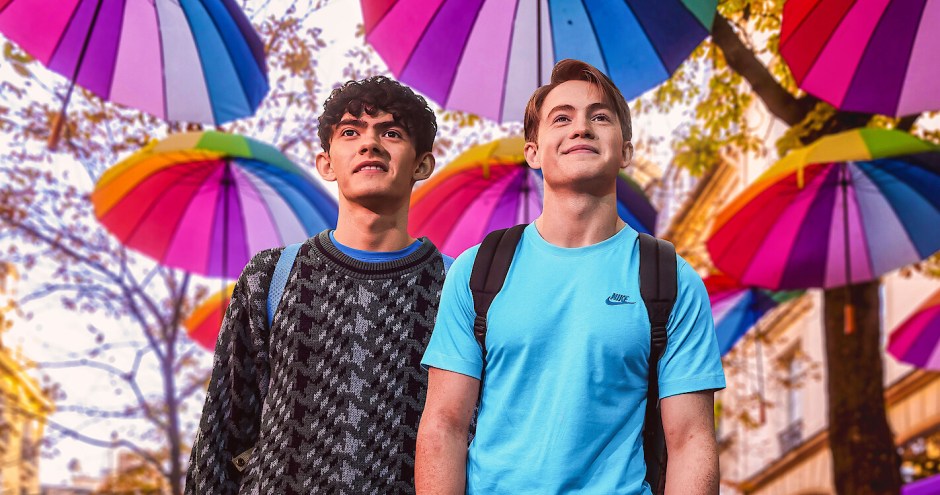
I finished watching the second season of Heart Stopper in one night. There are some wonderful moments in the season, and I had loved the first one. The second season was a worthy follow up. When we began watching the second season, my partner said, “They are going to break up. What else are they going to show?” That made me think. First, he was right in thinking that, because of added viewership, the scriptwriters tend to make the lead couple go through breaks. Purely to create drama. Second, I began thinking whether relationships, it does not matter if they alternate or straight, must necessarily go through break-ups eventually.
I watched the second season with trepidation, after that. I will just say one thing that I found myself disbelieving. Mostly every character, in the series turns out to be a representation of the LGBTQIA+ banner. Even the faculty members turn out to have alternate sexualities. I began thinking, damn, this is an academic environment that I never got around to even knowing of, much less experiencing, when I was a teenager. Someone online said, there must have been gay teachers, when I was studying. True, but I never knew of one who was out and proud of themselves, the way the ones in the series are depicted. Jealous much!
What then happens in the second season? Spoiler alert right away, so don’t read further if you do not like spoilers.
There is no break up. There are several issues that come up in any relationship, post the commitment. The idea of the ‘happily ever after’ works at the end of books and movies. What happens after the marriage or the commitment or the kiss during the sunset, no one really wishes to talk about or address. Thankfully, a good series takes note of this and tries to understand the vagaries of an established relationship in its episodes.
Particularly, for Nick and Charlie, there is the foremost dilemma of coming out to friends and family. Charlie was outed, Nick is not. There is the issue of image and prestige and social disgrace or acceptance. Nick keeps talking about his being bisexual whenever he speaks openly about his relationship. It seems like a cover for him, as it is implied that he is not ‘as gay as Charlie’. Of course, bisexuality is a part of the LGBT spectrum, but in most cases, it is used as a cover-up. In a committed relationship with a gay man, another man can profess his bisexuality. However, does the bisexuality imply that he will be with another person of the opposite sex eventually? If yes, then the break-up is inevitable. If no, then why mention the bisexuality? I understand the need to be imperative about the difference in sexuality, but what effect would this have on a partner/Charlie’s mind.
The process of coming out is a tough one. We who have taken steps to come out have known this to be true. It is an intense process. We come to terms first with ourselves and our difference from mainstream society. We then have to choose to whom to come out. Understanding their personalities becomes a necessity – and still there is a chance that we may not understand them at all. No matter how hard we try. Because we do not know what their response would actually be. So, we begin to test ground – by implication and by strategy. So, on top of the anxiety of wanting acceptance, we have to also understand what the other person is and what their response will be. Planning becomes necessary in most cases. Stress factors compound.
The really thoughtful angle that Heart Stopper brings out, is the fact that Nick’s coming out doesn’t just affect him. It also plays on the peace of mind of Charlie. He doesn’t want to lose Nick, and so he wants the coming out process to go easy for Nick. This is despite the fact that Charlie’s coming out was foisted on him by circumstance and not his own choice. He relives the bullying and the mental torture that he underwent earlier. His mental equilibrium begins to topple.
Charlie’s mental state is already frayed by his past. With the coming out process of Nick, his own peace of mind gets further destabilised, and it manifests in the resurgence of an eating disorder. The scene when he confesses to Nick about his state of mind is a tender one. One of the best scenes in the season. He opens his heart and talks to Nick about self-harm and his abstinence from food. Nick realises even Charlie’s closest friends do not realise this about him. When this comes about, people like me can understand how Charlie chooses to make Nick his first priority throughout the school term. He wants Nick’s coming out process and time in the relationship to be as smooth as possible. The chance of Nick unravelling is unbearable to Charlie – because he has had a first-hand experience of it.
Technically speaking, the emotional intensity of the relationship is very well portrayed. The problem I have had with it is how two teenage boys who are attracted to each other have not progressed to any form of a sexual act. They refrain from making love. This is another angle that may be brought up in season three. Because as I see it, Nick is the one uncomfortable with the sexual part of the relationship. He is not at all ready, and this brings me to the point of how he stresses his bisexuality each time he talks to people. So maybe, my partner is right and eventually they may break up. But the romantic in me thinks may be not. It is just his fear of trying out something he never thought he would be attempting. But – teenage boy – raging hormones – attraction – empty room – Paris – and yet, nothing. (Except for a very small love bite.)
One particular scene made me envious. When Nick and Charlie walk hand in hand in Le Marais, I felt truly envious. I grew up gay, in India, where until September 2018, being gay was actually a criminal offence, punishable by 10-years imprisonment. It was a scene where they realise what being mainstream felt like. They could hold hands and walk out in public, where no one questioned their love. It felt good – a place where hate and discrimination faded away under the rainbow umbrellas. One thing that makes a good story: its ability to touch the hearts of people, no matter the age or the orientation or the country. This moment did it for me more than any other.
The other characters have linear graphs. With the exception perhaps of Isaac Henderson, who has a sexual identity crisis but overcomes it on his own. It is a poignant portrayal of asexuality, which in itself is hard to explain in an otherwise over sexualised world. The other character of note that seems to be at odds with himself is Ben Hope. One can never truly understand whether he has grown as a person or remains his older narcissistic self. There was an interesting angle between Youssef and Ajayi, the teachers who have a same-sex relationship, in the interim of the school trip. But it’s not greatly touched upon, since it seems to mirror the Nick and Charlie relationship.
An honourable mention for one of my favourite actors, Olivia Coleman, who plays the part of Nick’s mom so effortlessly. Thibault de Montalembert has a good cameo as Nick’s dad. It’s quite a typical scenario. But well-played. All in all, the season has set the groundwork for the next season that has already been green lit by Netflix. I think that one will be a far more interesting and passionate one. However, I hope the romance sustains through all odds. It’s a healthy go-to for questing teens and romantic souls of all ages.
 Hearts Still Care