How Women Can Be Their Own Worst Enemies

We talk so much about men being the problem—and let’s be real, patriarchy is a man-made hellscape—but what we don’t talk about enough is how often women themselves keep this toxic cycle alive. It’s not just men enforcing these outdated, oppressive rules. Sometimes, it’s mothers, aunts, teachers, older sisters—the very women who should be fighting for the next generation but instead become their biggest roadblock. And it’s not always because they’re evil or malicious. A lot of times, it’s because they never had the chance to break free themselves.

When Women Become the Enforcers of Patriarchy

Ever met a woman who’s so bitter about her own lack of choices that she makes damn sure her daughter has just as few? It’s tragic, but it happens all the time. A mother who was forced into an arranged marriage at 18 won’t let her daughter marry for love because she wasn’t allowed to. A woman who had to give up her education to be a housewife makes sure her daughter stays “in her limits” instead of pursuing a career. It’s the whole “If I suffered, so should you” mentality.

Why? Because freedom can feel like an insult to those who never had it. Instead of seeing their daughters break the cycle and being proud, they see it as a slap in the face. A reminder of what they never got. And so, they pull their own daughters back into the same trap, justifying it as “tradition,” “duty,” or “the right way for a woman to be.”

Audre Lorde said it best: “The master’s tools will never dismantle the master’s house.” If women keep enforcing the same patriarchal rules that were forced on them, how does anything ever change?

Women Who Defend Their Own Oppression

Then there’s another category: the “pick me” women. The ones who will do anything to be validated by men, even if it means throwing other women under the bus. These are the ones who say, “I’m not like other girls,” who shame feminists, who defend men like Andrew Tate, and who parrot the same misogynistic nonsense they’ve heard from their fathers, brothers, and boyfriends.

This isn’t new. It’s the same reason so many women campaigned against their own right to vote back in the early 20th century. It’s why you’ll find women justifying domestic abuse, policing other women’s clothing, or preaching that a woman’s biggest achievement is “being a good wife and mother”—even when it’s clear they themselves are miserable in those roles.

It’s internalised misogyny at its finest, and it’s exhausting.

Queer Men and the Femme Stigma

As a queer person, I understand this on another level. The world punishes femininity—whether it’s in women or men. One of the reasons so many gay men get bullied isn’t just because they’re gay; it’s because they’re femme. Because in this cis male-dominated world, nothing is seen as more pathetic than a man who acts like a woman. It tells you everything you need to know about how society sees women.

And let’s not forget, a lot of homophobic bullying by boys? It’s done to impress girls. I’ve seen it firsthand—boys making fun of the “gay kid” just to get a few laughs from the girls around them. And some of these girls? They laugh because deep down, they’ve been taught that men being soft, vulnerable, or feminine is disgusting. They’ve learned that from their mothers, who learned it from their mothers, and the cycle goes on.

Let’s break this pattern!

We can’t just say “men need to do better” and leave it at that. Because the reality is, if women are still raising their daughters to be obedient and their sons to be dominant, nothing really changes.

• Teach kids young. This isn’t just about telling girls they can be strong; it’s about telling boys they can be soft. That crying isn’t weak. That being kind isn’t “gay.” That respect isn’t conditional.

• Call out internalised misogyny when you see it. If a woman is tearing another woman down, question it. Ask why. Make her reflect.

• Stop raising women to suffer. If you’re a mother, an aunt, a sister, an older cousin—don’t clip another girl’s wings just because yours were clipped. Let her fly.

At the end of the day, we’re all hurting in one way or another. The least we can do is stop adding to each other’s pain. Instead of telling people to “rise above” their suffering, maybe we should start pulling through it together.
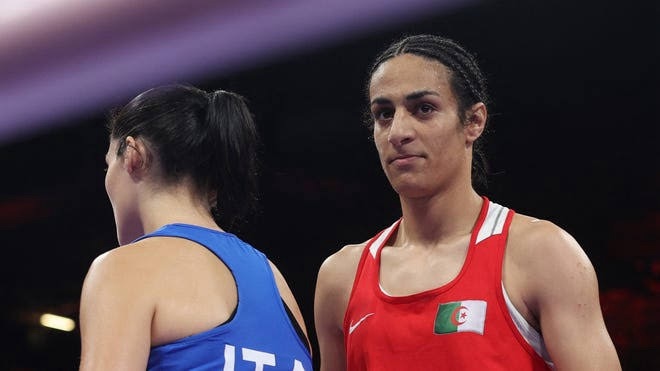

Imane

Imane Khelif has emerged as a prominent figure in women’s boxing, known for her skill, dedication, and perseverance. As a representative of Algeria, she has become a symbol of hope and inspiration, particularly for young women in her country and beyond. Khelif’s journey in boxing is a testament to her hard work and the barriers she has broken in a sport that is often dominated by men. In fact, her father had not wanted her to join the sport of boxing as it isn’t considered  appropriate for a Muslim girl to participate in what is considered to be a “man’s sport”. 

Ironically, the controversy began when Khelif was accused of being a man by Carini, a rival boxer who refused to fight her. The accusations were baseless and seemed to stem from Carini’s inability to face Khelif in the ring. After a day of backlash and public outrage, Carini issued an apology. However, the damage had already been done. The initial accusations had spread far and wide, casting a shadow over Khelif’s reputation. The apology, while necessary, could not undo the harm inflicted by the reckless and irresponsible comments.

Social media platforms can amplify misinformation at an alarming rate. The accusations against Khelif quickly went viral, leading to widespread speculation and judgment. The power of social media lies in its ability to reach millions of people instantaneously, but this power comes with a responsibility that is often neglected. When influential personalities share unverified claims, the consequences can be devastating for the individuals involved.

The damage was done, and the repercussions were swift and severe. Prominent figures like J.K. Rowling, Martina Navratilova, Chris Evert, and Boris Becker weighed in, with some stating that Khelif might be transgender. The hate was clear when the designated pronouns were he/him/his. Such statements, particularly when made without evidence, have a catastrophic impact due to the influential status of these individuals.

It is worth noting that it took an entire day for concerned individuals to raise their voices. Hate spreads rapidly, while wisdom takes time to take hold. It’s crucial to diminish the influence of those who spread hate, but it is disheartening to see that those in positions of power often perpetuate it.

Elon Musk acquired Twitter, then rebranded it as X. He is powerful and wealthy. While his intentions for the platform are varied, he unfortunately contributed to the controversy by calling Imane Khelif “crazy”, a distressing stance, which is particularly noteworthy given that his own daughter is transgender. It is no surprise then that his daughter chose to publicly disown him. 

I once adored J.K. Rowling and all of her work, writing essays and articles about her rise and brilliance. As a gay individual with a tough childhood, I found solace in her books, especially in the character of Dumbledore, whom she outed in 2007 after the series had concluded. At the time, I dismissed any reservations, accepting it as her right to explore her creations.

However, in 2019, my admiration turned to dismay when she posted a tweet rife with transphobia. Since then, I’ve felt a deep sense of disgust and betrayal, especially with her recent tweets about Imane Khelif. Without any basis, Rowling questioned Imane’s gender, an act that is particularly appalling from someone who calls herself a feminist. What she is doing is despicable.

I must further note, J.K. Rowling adopted the pen name “J.K.” to appeal to a broader audience, particularly aiming to attract young male readers who might have been hesitant to pick up a book written by a woman. This strategic choice, advised by her publisher, underscores the gender biases in the publishing industry. Now, as a prominent figure who publicly champions feminism, this decision might seem hypocritical, especially in light of her controversial views on transgender issues, which many critics argue are at odds with inclusive feminist principles. The dissonance between her early career decisions when she wanted to be read and her current stance once she has all her wealth, highlights the complexities and contradictions in her public persona and advocacy.

All of this brouhaha definitely reflects the complexities and contradictions present in the social media landscape and the urgent need for more responsible dialogue. This incident highlights several critical issues. First, it underscores the need for responsible behavior on social media, especially from public figures. The spread of misinformation can have real-world consequences, tarnishing reputations and causing emotional distress. Second, it brings to light the prejudices and biases that still exist in sports. Accusations of being transgender as a means of undermining an athlete’s success are not only baseless but also reflect a deep-seated intolerance.

Furthermore, the incident raises questions about the measures in place to protect athletes from such slander. Governing bodies in sports must take a more active role in addressing and preventing such controversies. Athletes, regardless of gender, deserve respect and fair treatment, free from baseless accusations and societal prejudices.

White privilege often upholds narrow and exclusionary standards of beauty and behavior, marginalizing those who don’t conform. Not just Imane Khelif, but Serena Williams, and Simone Biles have all faced bigoted criticism for not aligning with these restrictive ideals of how a woman “should look.” Khelif just faced racial and gender prejudices that undermine her recognition. Williams, despite her dominance in tennis, is frequently subjected to racist and sexist remarks about her physique. Biles, an extraordinary gymnast, has been scrutinized for her appearance rather than celebrated solely for her achievements. These instances highlight how deeply ingrained stereotypes about race and gender continue to limit the respect and recognition that diverse individuals deserve, revealing the intersectional challenges women of color face in their respective fields.

Imane Khelif’s experience serves as a terrible tale about the power and pitfalls of social media. While it has the potential to celebrate and elevate athletes, it can also be a platform for spreading harmful and unfounded claims. The involvement of high-profile individuals in propagating such misinformation only exacerbates the issue. As a society, it is imperative that we strive for greater accountability and responsibility, ensuring that the successes and struggles of athletes like Khelif are recognized and respected for what they truly are.

Preeti Sikka

I wasn’t going to write a review on a movie like Kabir Singh. But today, I had another discussion with a friend who liked the movie. I don’t consider it to be a good movie. Socially or technically. The movie should actually be called Preeti Sikka. Because let’s face it, the person who breaks the fourth wall is her.

I know where the movie goes wrong. So many places. But look at the way it seems to be earning bucks. Most of the people on social media seem to be loving it. It was made with a budget of 60 crore and it earned 380 crore at the box office. What was I missing?

I decided to save my opinion until after I saw the movie. I first started watching Arjun Reddy on Netflix, and then after a while, the subtitles and what was going on was too much to process for my mind, so I switched over to Kabir Singh. The same director directed the two and the scenes have been replicated to a letter, so I don’t suppose I missed out on nuances in the original. Though I have been told by a director friend, who has seen both, that Vijay Devarkonda version has portrayed sensitivity – attributing it to Vijay’s depiction of the character. I don’t think I shall be able to see Arjun Reddy though.

Most of the vignettes (if I can call them that) in the movie reek with such machismo that it sets feminism back several decades. I have been told of the culture of med college life, but first year college girls, walking like subjugated slaves, (the heroine in virginal white) isn’t something that I can still quite get over. The movie is like the over-the-top, male-dominated Hindi movies you watch, where the brash hero is filled with such ego that the match stick he flicks from his lips can skewer the villain standing yards away. I guess it’s a different sort of fantasy genre.

Maybe not.

Maybe these things actually happen in our society. Where a woman is taken over without a by your leave and branded as a Texan cowboy would do to his cattle. It’s a fair analogy. Because that is exactly what Preeti becomes, essentially.

If I may, psychologically dissecting the character, her father seems to be no better. So she was raised to be subservient? And of course, when hero and father meet there is a furthering of catastrophe. And then there is a slapping episode. Again, I must note, the scene seems to be the rage on tiktok, with most influencers on tiktok, using Kabir’s dialogues, castigating Preeti. (Sometimes, I wonder if the dark ages really left.) No one really thinks about how overwhelming his ego is. And if they do, they are actually celebrating it. Not a very healthy phenomenon.

I am say that this is also really worrisome, because this sort of thing actually happens. People go catatonic after a break up. I know I did. Of course, I am a different breed, because I didn’t go tearing into my ex’s life, demanding an explanation. I did however demand that he choose between his family and my love … but there was no violence. There was a tearing apart. It was a wrenching so devastating, I could feel what Kabir went through. But once again, I just realized that people love differently, some not so strong enough to withstand pressures of the world, and I let it be at that.

There is that kind of love that makes you break all bonds of sanity and society and head into a turmoil of passion. Some would say, that is what passion and love are. Haven’t romance novels written copiously of strong, hot headed heroes lifting girls and carrying them off to their castles? I should know, I used to read them by the dozen. Have society and age influenced me so strongly that I have forgotten what it was to be in the grips of passion? Of course, if I met my ex, I may ask for an explanation. Because I don’t believe that true love ends. It carries on. As is shown in this movie.

Which is the only part of the movie I liked, the fact that he overcomes his ego enough to take on the girl and her baby – even if it was not his own. And then the about turn by Preeti. Seriously though, the movie should have been named after her. The only character that sticks to her guns and lives by her code. I mean, she could have started drinking and hooking up, too… but I guess that is just too much to ask – to even be thought of for a woman to do. Or maybe, let’s just face it, the movie wanted to portray that women aren’t stupid enough to be so utterly selfish and self-destructive.