When I watched Adolescence, I couldn’t stop thinking about the themes that run through the show—bullying, toxic masculinity, social media radicalization, and the collapse of authority in today’s world. But what unsettled me the most was how difficult it is to pinpoint Jamie’s true motive.
Jamie isn’t just an aggressor—he’s also a boy who’s humiliated, rejected, and stripped of his dignity online. Katie turns him down, but that alone isn’t what breaks him—it’s what follows. She and her friends publicly emasculate him, using coded digital language that adults wouldn’t even recognize as bullying. They flood his Instagram with:
• “📉” (chart decreasing) → Suggesting he’s losing status, becoming irrelevant.
• “🌽” (corn emoji) → A veiled insult implying he’s pathetic or embarrassing.
• “🪑” (chair emoji) → Originally a meme, now used to call someone a loser.
• “🤡” (clown emoji) → Mocking him as a joke, a failure.
• ”#4473” → A number code in the show that essentially brands him as an incel.
This isn’t just name-calling—it’s a calculated digital assault, designed to socially destroy someone without leaving direct proof of bullying. Gen Alpha doesn’t need slurs anymore; they weaponize the very structure of the internet to erase someone’s worth. And Jamie? He internalizes it. But does this alone explain his descent into violence?
So is Jamie a Budding Psychopath or a Product of His Environment? I struggled with this question, just like the detective in the show. I was bullied too. I know what it’s like to be humiliated, to feel powerless. But I didn’t turn into a psychopath. Maybe that’s because, despite everything, I had a loving family to balance out the pain. Jamie had his mother. He had Eddie, his father, who—though strict and temperamental—never abused him, never stopped loving him. So what went wrong?
Psychologically, Jamie displays classic traits of conduct disorder and early psychopathy:
• Lack of empathy – He doesn’t react to the suffering of others.
• Emotional detachment – Even in high-stress situations, his expressions remain eerily controlled.
• Manipulative tendencies – He learns to adapt, charm, and deceive when needed.
• Entitlement and resentment – His frustration at rejection doesn’t lead to self-reflection but rather a belief that he must regain control.
But Adolescence refuses to give us an easy answer. Maybe Jamie was always inclined toward violence, and the bullying only accelerated what was already there. Maybe he was looking for an excuse. Or maybe he’s what happens when a system allows boys like him to slip through the cracks until it’s too late.
A key theme in Adolescence is the failure of authority figures—parents, teachers, even psychologists—to intervene before things spiral out of control. One of the most striking moments is when the psychologist in Episode 3 is visibly afraid of Jamie. This isn’t just a child with anger issues—this is a boy who understands the power he holds over others and enjoys wielding it.
There’s also a generational shift at play. In Episode 2, we see students openly mocking and disrespecting their teacher without consequence. It’s not just about kids lacking fear—it’s about the absence of structure, discipline, and moral guidance. When you combine this with unregulated access to toxic online figures, the result is kids shaping their worldviews based on whoever speaks the loudest.
And this is where the show forces us to confront something deeply uncomfortable. Jamie’s radicalization isn’t just a personal failure—it’s a collective one.
Beyond its themes, Adolescence is a technical masterpiece. Each episode is filmed in one continuous shot, meaning there are no visible cuts—just an unrelenting, immersive experience that traps you in the characters’ world. The sheer amount of planning and execution that must have gone into this is mind-blowing.
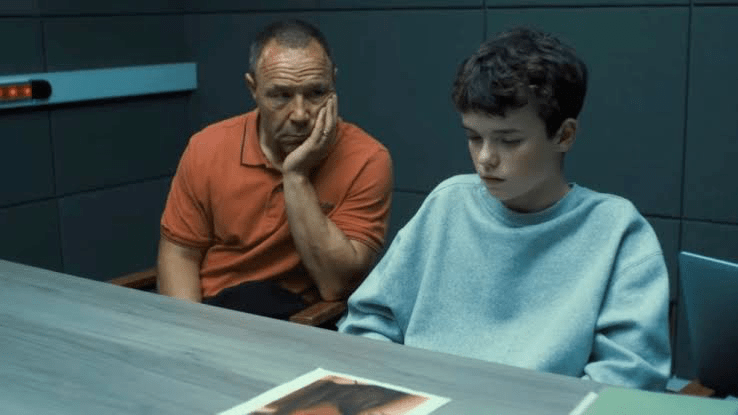
Owen Cooper (Jamie) is phenomenal. His ability to shift between vulnerability and cold detachment is chilling, and watching his transformation feels disturbingly real. Stephen Graham (Jamie’s father, Eddie) delivers a gut-wrenching performance, portraying a man who knows he failed his son but doesn’t know how to fix it. The psychologist in Episode 3 is also haunting—seeing an adult woman visibly shaken by a 13-year-old boy speaks volumes about how dangerous Jamie has become.
Adolescence isn’t just about one boy’s descent into violence—it’s about what happens when we ignore the warning signs. It’s about how social media radicalizes young men, how modern bullying has evolved into something almost undetectable, and how the collapse of authority leaves kids to raise themselves in digital echo chambers.
Was Jamie always destined for this path? Or was he a product of his environment? That’s the disturbing question the show leaves us with.
One thing is certain—Adolescence is not an easy watch. But maybe that’s exactly why it needs to be seen.
 Hearts Still Care