Here

I love the movie. I saw the late-night show. After the movie ended, the audience remained seated as the titles rolled. No one spoke and no one got up to leave, though it was well past 1 am. I came out with my partners from the theatre hall; all three of us were still silent as we got into the car and drove for a good 5 or so minutes without speaking a word.

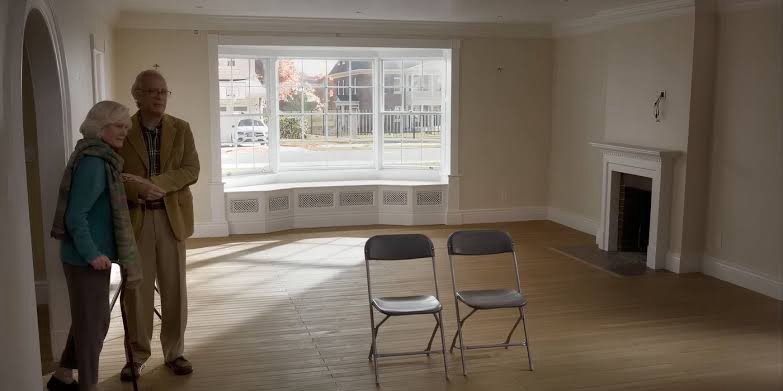
The beginning of the movie is absolutely charismatic. The way the journey through the ages is depicted is mesmerizing. The single, unmoving camera makes it feel as though we have a view into the lives of all those who passed through that house. It’s a surreal, almost voyeuristic experience. The final sequence takes your breath away—that’s when the camera finally moves, panning across, and we see the entire household. It’s almost like a vista of someone’s life opening up before you, and as the camera moves out into the garden and over the sky, giving a panoramic view of the house, it’s amazing. The sight of one kingfisher flying through the air connects ages that have passed. Time flies, time flies, time flies. The movie keeps reminding us of this phenomenon, beautifully captured by the stationary camera, bringing us through all those eras, memories, heartbreaks, bonds, happiness, and sadness—all merging into one big experience. And with the title itself, the director asks you to live in the “here and now”!

In crafting Here, director Robert Zemeckis described how, from the very beginning, every member of the crew had to “commit to the language of the movie.” For Zemeckis and his cinematographer Don Burgess, this meant filming from a single, fixed point, with every bit of set dressing needing to be “right where it needs to be—not just for one scene but for every scene.” The challenge of shooting all the scenes within a single view turned out to be more difficult than anyone anticipated, with Zemeckis calling it “the hardest movie any of us have ever made.” The decision to shoot in a taller 1.85:1 aspect ratio added further complexity, as the team had to spend three months experimenting with lenses to find the one that would best suit the film’s vision. Zemeckis, who famously incorporates active camerawork and computer graphics into his films, noted how his experience with technically complex shots in Contact and What Lies Beneath ultimately prepared him for the restrictions he embraced in Here.

The film drifts through time, shifting from pre-independence America, colonial America, the early 1900s, the Great War, World War II, the Vietnam War, and the Covid pandemic. It moves in a way that sometimes reminds me of a stream of consciousness—flickering between experiences and capturing how the mind flows from one memory to the next. The film doesn’t shy away from portraying the tough conversations that come up in life. One especially poignant scene features a Black father talking to his son about how to stay safe if ever pulled over by the police—a piece of writing that’s terribly heartbreaking, especially because it’s still so pertinent here and now in the lives of people of colour.

The storyline interweaves elements like the Native American experiences, and her necklace that is found centuries later, beautifully connecting different eras. It shows that the nostalgic pieces we leave behind can be a bridge, letting future generations wonder and try to understand the experiences of all those who lived before them.

This movie stirred up a lot of nostalgia in me because I connect so deeply to the homes I’ve lived in. I spent my childhood in a joint household much like the Youngs’, where my grandparents, aunts, uncles, and my parents lived together with us. So many experiences in the movie echoed my own, like the scene where John and Pauline’s daughter stands before the window as Pauline lifts her bags, planning to leave the house. The daughter wistfully says, “I will miss this house.” That moment took me right back to my own childhood home, where I still remember waving to my grandmother as we left. My mother’s experience was quite like Pauline’s, but mine was like the daughter’s. It was an instant connect.

The film’s use of “panels” within each scene adds an evocative layer to the storytelling. Zemeckis explained that these panels were intended to create subtle shifts between scenes, allowing one moment to blend naturally into the next, like the scene where the Beatles first appear on The Ed Sullivan Show, leading into the wedding scene of Wright and Hanks. These transitions, Zemeckis said, weren’t in the script because they would “make the reader’s head explode,” but they were “refined throughout” the film to bring the audience effortlessly from one era to the next. Editing Here became a significant, unexpected challenge. As Zemeckis explained, “You wouldn’t think it would be. You say, ‘Oh, well, aren’t you going to just cut the slates off and assemble everything?’ Well, right? No, that can’t happen.” Each panel’s timing and pacing required intricate care, making the editing process an “elaborate chore.”

The performances are deeply compelling, with the cast delivering authentic, nuanced portrayals that evoke genuine emotion. The dialogue is written with such care, sparking both introspection and connection.

What sets Here apart is its ability to capture the essence of time and memory, weaving them seamlessly into a narrative that feels universal yet personal. The film lingers with you long after the credits roll, as I mentioned earlier, inspiring reflection and conversation. It’s the kind of movie that challenges conventions and speaks to a collective consciousness—a testament to the power of storytelling and its ability to remind us of the profound moments found in the everyday.

The acting in the movie was more than exemplary, but that’s what you expect in a movie by Robert Zemeckis. I was looking forward to this movie, and I was not disappointed in the least. There were several moments that touched me: the scene where Hart’s daughter speaks about missing the house, the story of Alan and Rose, and especially the scene where the housekeeper Raquel dies of Covid. And the very, very last scene, where the camera closes in on the faces of Tom Hanks and Robin Wright as she says, despite all the tears she has shed in that house, just how much she loved it—how much I truly loved it here.

The Black Stallion

The Black Stallion is a film that has stayed with me ever since I first saw it as a five-year-old in the theatre. Released in 1979, it wasn’t until a year later that I watched it—first with my mother and later with my grandmother, in the theatre. Those memories of sharing this film with them have made it all the more precious to me, especially since many of those who shared that experience are no longer with me. The movie itself captured my young imagination with its stunning depiction of bonding between a boy and his horse, a fascination that had already been kindled by hours spent watching David Attenborough narrate the wonders of our planet.

Directed by Carroll Ballard, The Black Stallion tells the story of Alec Ramsey, a young boy marooned on a deserted island with a wild, black, Arabian horse. What makes the movie so unforgettable is the wordless bond that forms between Alec and the Black. The first half of the film has minimal dialogue, allowing the majestic visuals to take centre stage. Ballard’s direction in these moments is magical—especially the scene where Alec and the Black connect for the first time against the backdrop of a glowing sunset. The beauty and stillness of those scenes are seared into my mind as vividly as though I were watching them unfold in front of me even now.

Kelly Reno, who played Alec, was just 11 years old when he took on the role, and his natural performance helped make the relationship between the boy and the horse feel completely believable. But of course, the real star of the film was Cass-Olé, the Arabian stallion who played the Black. His grace, power, and beauty were breathtaking to watch on screen, and the bond between horse and boy felt as though it transcended the screen. The other horses used for racing scenes were just as magnificent, but none captured my imagination quite like Cass-Olé.

Mickey Rooney’s performance as Henry Dailey, the retired jockey who trains Alec and the Black for the climactic race, added warmth and depth to the second half of the film. The race itself remains one of the most thrilling and beautifully shot sequences in cinema. Even now, I haven’t seen another horse race in film that matches the raw intensity and realism of The Black Stallion’s final race—except, perhaps, Seabiscuit, another favourite of mine. Yet, for all the greatness of the narrative of Seabiscuit, The Black Stallion will always hold a special place as my personal, all-time favourite.

The music in the film, composed by Carmine Coppola, is hauntingly beautiful. Every note lingers, creating a dream-like atmosphere that draws you back into that misty world of ocean air, dewy mornings, and the wild freedom of a horse’s mane flowing in the wind. I can still hum the title music and recall the melodies that accompanied the final credits.

What makes The Black Stallion so poignant to me personally is that it holds memories of every member of my family who once watched it with me. Watching the film was a shared experience that transcended the screen, making it a cherished part of my life. Today, when I think of this film, it’s not just the beauty of the story or the visuals that come to mind, but the deep, emotional connections I had with my mother, my grandmother, my aunts, and others who sat beside me in the theatre all those years ago. It’s more than a movie—it’s a piece of my past, and that’s why it will always be so dear to me.

Watch the End Credits and hear the music in this video: it begins from 1:06 minutes…

End Credits – The Black Stallion

Sense & Sensibility

Sense and Sensibility has always been a story close to my heart. I first discovered Jane Austen while studying literature in college, and I instantly fell in love with her writing. Among her works, Sense and Sensibility stood out to me with its beautiful exploration of emotion and reason, the delicate interplay of love, loss, and societal expectations. Imagine my joy when, during my final year of college—a year where I had fully embraced my passion for literature—Ang Lee’s adaptation of the novel was released.

Emma Thompson, one of my favourite actresses, not only starred as Elinor Dashwood but also wrote the script. Her adaptation beautifully captured the essence of Austen’s work. The year this film came out was a wonderful one for me, filled with personal contentment and a deepening love for literature. It felt like a perfect alignment: one of my favorite books brought to life by someone I admired.

The cast was nothing short of extraordinary. Kate Winslet, who played the sensitive and passionate Marianne Dashwood, burst onto the scene for me. This was the first time I had seen her perform, and she captivated me instantly. Of course, Alan Rickman’s portrayal of Colonel Brandon added a depth of quiet longing and sincerity that made him unforgettable. His tender yet restrained devotion to Marianne was delivered with such subtlety that you couldn’t help but root for him. And then there was Hugh Grant, portraying Edward Ferrars with his signature mix of charm and awkwardness. His performance brought the comic timing needed to balance the film’s more tragic moments.

What made the film remarkable for me was the way it navigated between comedy and tragedy. Thompson’s script effortlessly balanced the comic relief found in awkward social situations with the deeper emotions of unspoken love and personal sacrifice. There’s a certain emotional rise and fall to the movie, a tempered build-up that reflects life’s natural ebb and flow. The highs and lows, the elevation and depression of Austen’s narrative, were captured so vividly, it felt like watching a delicate dance.

Nearly 30 years have passed since I first saw it, yet I still consider it one of the finest Austen adaptations. I can quote its dialogues by heart, and some of its comic moments still lift my spirits when I think of them. It’s a timeless piece that catapulted Kate Winslet into stardom, leading her to even greater heights with Titanic. But for me, Sense and Sensibility will always remain special—a film that arrived in my life at the perfect moment, one that still holds a cherished place in my heart.