Sabar Bonde

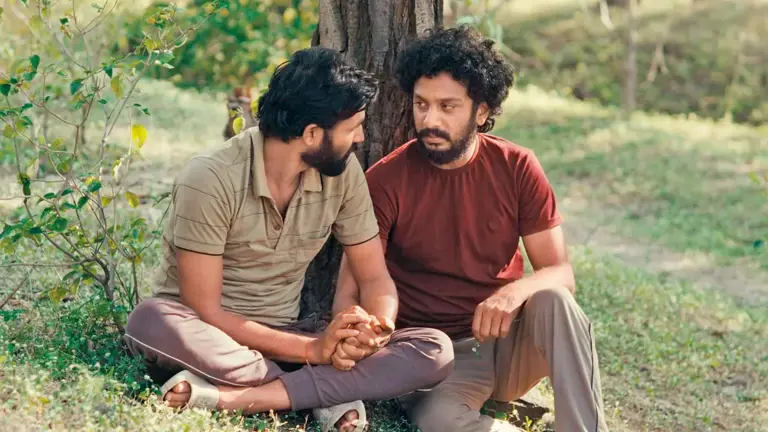
I watched Sabar Bonda at its 4:20 show at PVR Andheri — an experience that turned out to be more than just cinema, but a mirror. What most gay men go through, irrespective of class. A simple thing like a parent being worried about the future of his gay son. 

It began with death. A father passes away, and rituals immediately take over: what to wear, what to eat, how to mourn, what to suppress. That opening sequence pierced me deeply because my bua — whose birthday coincidentally fell on the day of my viewing — was like a father to me. The grief, the weight of conduct, and the demands of tradition all struck a profoundly personal chord.

What makes Sabar Bonda so powerful is that the protest it mounts is whisper-quiet. It doesn’t erupt in melodrama; it lingers in what society insists upon — in colour, rules, and ritual. A grey shirt Anand is told to change. Much like how people ask us to change, to convert. The slippers he wears – bringing comfort to his feet – but only in the company of his lover, because ritual forbids it. The shadows of who he is, pressed against the mould of what he’s “supposed” to be. The film reveals itself in the texture of small moments: Balya’s gift of cactus pears, the shared silences, the tension between city and village, heartbreak and love, grief and continuity.

Anand’s mother is the film’s moral and emotional backbone. She loves, supports, and resists in her own way. His father’s eventual acceptance, Balya’s steady care, and the hesitancy threaded through each character are rendered human. There is no villain here — only systems and traditions, and people trying to navigate them quietly.

Critics have largely echoed these impressions. Moneycontrol calls it “a gentle story of grief, memory, and love told with quiet honesty. It lingers in the silences and small moments …” Times of India writes: “to enjoy the sweet taste of cactus pears, you must first carefully remove the sharp spines from the skin of the fruit … meant to be savoured exactly like that.” That metaphor mirrors the story’s truth — love, identity, and acceptance are like a fruit you crave, but you must first tend to the pain. Indian Express highlights the film’s visual poetics: the still camera, wide frames, and static gaze that holds ritual, grief, and distance until intimacy seeps in. Hindustan Times calls it “a tender, deeply moving study of queer love in one of the year’s best films,” noting how customs, everyday pressures, and quiet longing are handled with exquisite precision.

Where my own experience diverges is in how deeply the symbols resonated. The cactus pear, unlike the peach in Call Me By Your Name, isn’t about erotic awareness, but about care, concern, and tenderness — love that is rare, difficult to find, but sustaining. The rituals aren’t simply a backdrop; they are choreography, dictating what must and must not be done. Anand’s protest is not loud — it is embodied in small refusals, in gifts, in a silent embrace.

Long after leaving the theatre, certain truths lingered. Rituals and rules aren’t just external constraints; they are the inner architecture Anand must resist and reshape. The sensory texture — touch, clothing, light, the sound of goats, footsteps, and fields — builds an emotional world as vivid as any dialogue. There is the courage of saying no to what one is “meant” to be, and yes to a hidden version of self. And there is the way family, particularly the mother, becomes both an anchor of tradition and a wellspring of possibility.

Some critics have noted the film’s pace is slow. I felt that too — but its slowness isn’t a flaw. It forces us to sit with grief, longing, and ritual as the characters themselves must. It may not satisfy those expecting dramatic peaks, but its reward is in its lingering — in the way it teaches us to notice what we otherwise overlook.

The caresses are felt through the screen. The running of hands in the hair. The embrace to ward off the cold. The closeness found at last in the privacy of the city. They permeate through the screen and fall into your hands and heart. The emotion there becomes visceral and that’s what makes the movie brilliant – it’s like reading a book, you are pulled into deeper nuance and feeling.

Sabar Bonda doesn’t shout its declarations. It doesn’t need to. Instead, it builds a space where grief, yearning, and identity coexist in fragile balance, where society’s insistence collides with the quiet affirmations of love and humanity. It reminds us that love can be radical, even when soft. That rituals can suffocate as much as they anchor. That resistance doesn’t always roar — sometimes it whispers, gently, persistently, and all the more powerfully.

If I were to give it a frame, I’d say: Sabar Bonda is a film of small revolutions. It doesn’t overthrow. It loosens. And in that loosening lies its beauty — because it allows tenderness the room to breathe.

Superman

Light Restored: David Corenswet’s Superman Shines

I went to the first-night late showing of Superman with zero expectations—especially not expecting anything from star David Corenswet. But from the very opening, the film radiates light in a way Henry Cavill’s brooding take simply never did. Cavill’s Superman was relentless, vicious, bleak—more dark Batman than hopeful beacon. Corenswet, on the other hand, embodies everything good Superman should be: optimism, warmth, light.

From the start, the film introduces Superman at his most vulnerable—hurt, uncertain—and brings in Krypto, his loyal super‑dog, at just the right moment. Krypto’s entrance is delightful: “the canine sidekick steals the show, and his goofy interactions with Superman will resonate with anyone who loves dogs”. It was a moment that brought me—and, I suspect, dog lovers everywhere—to tears of joy.

Corenswet as Clark Kent / Superman reminds us of a young Christopher Reeve: dimpled, earnest, charming. He truly “soars as the Man of Steel”  , balancing vulnerability with heroism, sunlit goodness with real human emotion. As one review put it: “David Corenswet is just right for the dual role”.

Nicholas Hoult as Lex Luthor brings a modern tech‑tycoon je ne sais quoi—smart, menacing, magnetic. Many critics praised his turn, though some felt his performance didn’t match Gene Hackman’s classic menace.

The supporting cast includes: Rachel Brosnahan as Lois Lane: vibrant, sharp, independent. Critics say their chemistry is one of the best since Margot Kidder. Jimmy Olsen – Skyler Gisondo. Guy Gardner / Green Lantern – Nathan Fillion – is always a pleasure to watch. I couldn’t help remember him in Firefly. He’s back to his forté. Hawkgirl – Isabela Merced – brought in that element of darkness whereas Mister Terrific – Edi Gathegi – was indeed terrific. I liked the inclusion of Metamorpho (substance-shifter) – Anthony Carrigan – it brought in someone we hadn’t seen in the DC verse so far. These characters, dubbed the “Justice Gang” in a nod to the Justice League, provide depth and interactivity— and though some critics found the ensemble slightly overloaded – for me, it was just right. 

Director James Gunn steers Superman away from darkness. Thankfully! The film bursts with colour, lightheartedness, and earnest hope—exactly what the genre needed, described as a “colourful, breezy reinvention”. One critic noted the tone rejects “grim and gritty” in favour of “empathy… a radical tenderness over traditional machismo”.

The story skips a long origin arc and jumps into Clark’s life as a reporter and a hero. The film is tight, fast-paced, and brings back the classic John Williams–inspired trumpet theme—rejuvenating that sense of nostalgia I felt as a child growing up with Reeve.

Yes, there are a few hiccups: Some plot lines feel overcrowded—global politics, misinformation, and pocket-dimension mayhem. And let’s not forget the white man protecting the brown population from imperialists is an age old-trope that doesn’t sit well with me but even the CGI quality varies, especially in later action scenes.

Despite the missteps, Superman is an earnest, uplifting ride. It’s a heartfelt tribute to the Christopher Reeve era—sunlit, moral, full of hope. As one critic said: “I went into ‘Superman’ with low expectations… this reboot… is infused with heart, humour and a fresh optimism that the franchise desperately needed”.

So, if you’re longing for the Superman of light and goodness—not darkness and cynicism—this Superman is your film. It wants us to believe again—and it succeeds. This Superman is light reborn: hopeful, sincere, and undeniably fun. If you’re tired of the brooding, Nolan‑style heroes, let Corenswet’s Superman carry you back into the sun.

Adolescence

When I watched Adolescence, I couldn’t stop thinking about the themes that run through the show—bullying, toxic masculinity, social media radicalization, and the collapse of authority in today’s world. But what unsettled me the most was how difficult it is to pinpoint Jamie’s true motive.

Jamie isn’t just an aggressor—he’s also a boy who’s humiliated, rejected, and stripped of his dignity online. Katie turns him down, but that alone isn’t what breaks him—it’s what follows. She and her friends publicly emasculate him, using coded digital language that adults wouldn’t even recognize as bullying. They flood his Instagram with:

    •    “📉” (chart decreasing) → Suggesting he’s losing status, becoming irrelevant.

    •    “🌽” (corn emoji) → A veiled insult implying he’s pathetic or embarrassing.

    •    “🪑” (chair emoji) → Originally a meme, now used to call someone a loser.

    •    “🤡” (clown emoji) → Mocking him as a joke, a failure.

    •    ”#4473” → A number code in the show that essentially brands him as an incel.

This isn’t just name-calling—it’s a calculated digital assault, designed to socially destroy someone without leaving direct proof of bullying. Gen Alpha doesn’t need slurs anymore; they weaponize the very structure of the internet to erase someone’s worth. And Jamie? He internalizes it. But does this alone explain his descent into violence?

So is Jamie a Budding Psychopath or a Product of His Environment? I struggled with this question, just like the detective in the show. I was bullied too. I know what it’s like to be humiliated, to feel powerless. But I didn’t turn into a psychopath. Maybe that’s because, despite everything, I had a loving family to balance out the pain. Jamie had his mother. He had Eddie, his father, who—though strict and temperamental—never abused him, never stopped loving him. So what went wrong?

Psychologically, Jamie displays classic traits of conduct disorder and early psychopathy:

    •    Lack of empathy – He doesn’t react to the suffering of others.

    •    Emotional detachment – Even in high-stress situations, his expressions remain eerily controlled.

    •    Manipulative tendencies – He learns to adapt, charm, and deceive when needed.

    •    Entitlement and resentment – His frustration at rejection doesn’t lead to self-reflection but rather a belief that he must regain control.

But Adolescence refuses to give us an easy answer. Maybe Jamie was always inclined toward violence, and the bullying only accelerated what was already there. Maybe he was looking for an excuse. Or maybe he’s what happens when a system allows boys like him to slip through the cracks until it’s too late.

A key theme in Adolescence is the failure of authority figures—parents, teachers, even psychologists—to intervene before things spiral out of control. One of the most striking moments is when the psychologist in Episode 3 is visibly afraid of Jamie. This isn’t just a child with anger issues—this is a boy who understands the power he holds over others and enjoys wielding it.

There’s also a generational shift at play. In Episode 2, we see students openly mocking and disrespecting their teacher without consequence. It’s not just about kids lacking fear—it’s about the absence of structure, discipline, and moral guidance. When you combine this with unregulated access to toxic online figures, the result is kids shaping their worldviews based on whoever speaks the loudest.

And this is where the show forces us to confront something deeply uncomfortable. Jamie’s radicalization isn’t just a personal failure—it’s a collective one.

Beyond its themes, Adolescence is a technical masterpiece. Each episode is filmed in one continuous shot, meaning there are no visible cuts—just an unrelenting, immersive experience that traps you in the characters’ world. The sheer amount of planning and execution that must have gone into this is mind-blowing.

Owen Cooper (Jamie) is phenomenal. His ability to shift between vulnerability and cold detachment is chilling, and watching his transformation feels disturbingly real. Stephen Graham (Jamie’s father, Eddie) delivers a gut-wrenching performance, portraying a man who knows he failed his son but doesn’t know how to fix it. The psychologist in Episode 3 is also haunting—seeing an adult woman visibly shaken by a 13-year-old boy speaks volumes about how dangerous Jamie has become.

Adolescence isn’t just about one boy’s descent into violence—it’s about what happens when we ignore the warning signs. It’s about how social media radicalizes young men, how modern bullying has evolved into something almost undetectable, and how the collapse of authority leaves kids to raise themselves in digital echo chambers.

Was Jamie always destined for this path? Or was he a product of his environment? That’s the disturbing question the show leaves us with.

One thing is certain—Adolescence is not an easy watch. But maybe that’s exactly why it needs to be seen.