50’s

I’m looking forward to my 50s, perhaps because my 40s were the decade in which I truly began to live. It was in my 40s that I confronted my insecurities, endured heartbreaks, and experienced immense loss. I lost many of the people who truly loved me, and I nearly lost myself during the pandemic. I faced grief. I faced death. I faced the difficult truths of who I am, what I deserve, and what I can and cannot tolerate.

My 40s taught me that life is beautiful—even in its darkest moments. And if there is one thing I am utterly certain of, it is that nothing lasts forever. Everything is transient. And I don’t just mean happiness fading; even sadness must eventually leave to make space for joy. Life moves in cycles. That, I think, is the greatest lesson of the past decade—the understanding that permanence is an illusion.

I once believed that some things would always hold, while others would inevitably fall apart. But I have come to realise that even truth wavers with time, space, and circumstance. Life, by its very nature, is constantly evolving—and so have I. That is why I look forward to the next decade, because I know I will keep evolving. I am not someone who remains stagnant or gives in to complacency.

I have come to understand that the things that truly matter are not grand achievements but the small moments that bring joy. Whether it’s love, relationships, something abstract or something tangible—like playing a video game, walking on the beach, or simply stroking the head of a pet as they rest in your lap—if it brings you happiness, then it is worth embracing. It has never been the big things that mattered most. I learned this long ago—not just in my 40s, but through a slow and gradual process of self-awareness.

The things I have worked hardest to achieve—genuine human connections, staying true to myself, and being honest with the world about who I am—have always been the most important to me. I began that journey at a very young age, and by the time I reached my 40s, everything started falling into place.

Now, as I step into my 50s, I feel assured of who I am. And yet, I know I can still become better. That, perhaps, is the most exciting part—that no matter what life throws my way, I will rise above it. I will endure it. And I will grow from it.

The Favourite

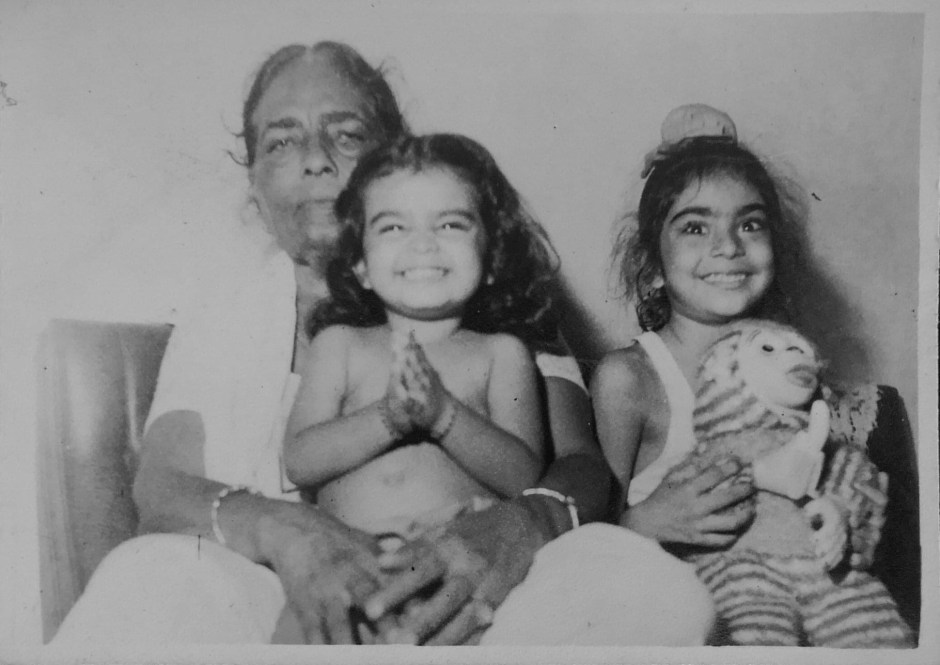
Growing up, I was incredibly close to my grandmother. I called her Dadan, an affectionate term for Daadi, which means grandmother in Hindi/Punjabi. She was my rock, my constant source of warmth and love. I was also the favourite of both my paternal aunts. The eldest, who had stepchildren, and the youngest, who had no children of her own, poured their affection into me. My youngest aunt, during her courtship days, often took me along on her dates. Together, we visited beautiful hotels and places, and those moments felt magical in my childhood. When she married, I was only six years old, and her absence created a void. I felt as though I had lost a cherished friend.

[l-r]Munni Pua, Dadan, Goodie Pua and me (in the corner)

But my grandmother, my Dadan, made up for that loss in every possible way. She loved me fiercely, making me feel like the sun and the moon in her eyes. I felt it too, deep in my soul. My cousins and sibling often claim, to this day, I was spoiled by her and my aunts. Perhaps I was, but their love shielded me from a harsher reality. My parents were far from ideal. My father was abusive, an alcoholic, and, from the age of 13 to 19, his physical violence escalated, fuelled by his hatred for my sexuality. My mother, meanwhile, was preoccupied with earning a living and running a household. She was emotionally distant, perhaps sensing that I was different and not the son she had envisioned. She redirected her energy towards my younger sister, Geetanjali, who, being four years younger, became the focus of her affection and aspirations.

[l-r] Me, Dadan, Geeta

When my mother left the joint family, taking me away from my grandmother, I was about to turn 13. My sister was barely eight or nine, giving my mother ample opportunity to mould her into the perfect daughter. I, however, remained the imperfect son—a reminder of the family my mother was trying to leave behind. I was the unique link between her new life and the one she had given up, while my sister became her connection to her own family. This duality shaped our relationships, and as the years passed, I felt punished for the love I had received from my paternal grandmother and aunts.

[l-r] Me, mom, Geeta.

At the time, I couldn’t understand any of this. All I knew was that I wanted to maintain my bond with my grandmother and aunts, but distance creates rifts in even the strongest relationships. Back then, mobile phones weren’t available, and my home life became a nightmare of abuse and violence. After a particularly horrific incident, where my father nearly strangled me, my mother finally decided to pursue divorce. This further deepened the distance between me and my paternal family.

Dadan

In my twenties, I reconnected with my eldest aunt. By then, I was navigating the aftermath of a failed relationship and battling severe depression. Our bond took on a deeper, more complex meaning, rooted in shared pain and an understanding that transcended words. But by the time my grandmother passed away when I was 25, I felt as though a part of my heart had been burned away, leaving a scar that would never heal. She had been more of a mother to me in those formative years than my own mother, and her absence left an aching void.

[l-r] Goodie Pua, Me, Munni Pua

Now, as I look back, I realise that my grandmother’s love was the anchor that held me steady. With her gone, and both my aunts having also passed away, I feel as though I have lost the last remnants of unconditional love in my family. Today, it often feels like my mother and sister are united against me. While this may not be entirely true, the feeling of alienation is overwhelming. It’s as if the familial bonds that once nurtured me have unravelled, leaving me adrift.

I wish I could remember more vividly the years between one and twelve when love and warmth surrounded me. Perhaps those memories would balance out the lack of affection I feel now. But dwelling on the past serves little purpose, except to remind me that, for a time, I was truly loved, cherished, and cared for. That knowledge is both a comfort and a sorrow, a bittersweet reminder of what I have lost.

Abuse

From the age of 13 to 19, I endured physical abuse from my father, and as a gay teen, this had a profound impact on me. Beyond the trauma any child experiences from abuse, my sexuality made me a particular target for my father’s rage, which was fuelled by his homophobia. What should have been a safe space, my home, became a place of fear and isolation.

The beatings weren’t constant, but they came when I challenged his authority. These moments left me with deep emotional scars, especially when I realised that the very person who should protect me from the world’s cruelty was the one inflicting it. Like many queer teens, I was already grappling with internalized shame due to societal rejection. But when that rejection comes from your father, it cuts way deeper. His abuse reinforced the debilitating belief that I was undeserving of love simply because of who I was.

A father, in most cultures, represents the ultimate symbol of masculine protection. For me, already feeling distant from these expectations, his violence only reinforced the notion that I wasn’t “man enough” not just by his but by society’s standards. Yet, despite his aggression, I refused to believe I deserved it. I learned to stand my ground outwardly, though inside, I was terrified.

What was not standard was my reaction to this abuse. Unlike others who may internalize such hatred, my response to the abuse was different. Rather than feeling shame about my sexuality, I grew more determined to embrace it. I devoured any knowledge I could find about gay pride. I fully understood by 15, that society expected something I could never give. While the abuse made me feel as though I was being punished for who I was, it didn’t lead me to hate myself. Instead, I became prouder, hungrier to learn about myself, and more resolute in my identity.

The violence instilled a deep wariness towards men, making me see them as potential bullies who, like my father, would hate me. This abuse also left me with profound trust issues, especially in forming healthy relationships. The painful irony is that I feared the very people I longed to be loved by. Emotional safety felt elusive, and I was constantly bracing for betrayal or harm. Anxiety has been the undercurrent of all my relationships with men, rooted not in who they are, but in how I see myself, deep down. When these relationships fail, I often end up blaming myself, unable to hold the men I love accountable, even when they cause me pain. I do stand up for my beliefs and fight when wronged, but there’s always that nagging fear that pushing too hard might drive my partner away. The fear of abandonment overrides my sense of self.

It’s no surprise that physical abuse during adolescence can lead to severe mental health problems. For gay teens, the risk is even higher. Depression, anxiety, PTSD—these are just some of the effects I’ve struggled with. To this day, I can’t enter a room full of men without feeling a wave of panic. Every slammed door brings back memories of my father’s drunken rages.

The abuse left me feeling powerless and ashamed that I couldn’t stop it myself. It only ended when my sister and grandfather witnessed it firsthand, which ultimately led to the tearing apart of my parents’ already frayed marriage. Over time, I let go of the bitterness towards my father, replacing it with indifference. But his homophobia never died. I remember, at 35, after a Pride meeting at home, he admitted he knew I was “like this” since I was two. Those words indicated he still held my sexuality against me.

I remember just two incidents when he did anything remotely fatherly. Once, when he was terribly low and horribly drunk, he had hugged me. I won’t forget his smell or the mixed emotions coursing through my body at that display of abject emotion. I remember every detail of that scene, predominantly because it had never happened before or after. The second thing he did was tell me to get into the stream of Arts instead of Commerce or Science. He was lying in bed and I was discussing college with my mother when he said, “you need to get into Arts.” And I did, never regretting the choice once.

As the years passed, I don’t pretend the abuse didn’t shape me. It did. I became clingy in emotional relationships, seeking validation from men even though I could manage well on my own. Authority figures still unsettle me, and I often assume they’re entitled bullies. But the abuse also made me stronger, more capable of standing up to those who try to control or demean me. It instilled a fierce pride in my queer identity. It’s why I came out to my mother at 16 and to the world by 20. It turned me into an activist, someone who wears their heart on their sleeve and fights for acceptance. I wouldn’t change any of my experiences because, in the end, it made me who I am.

Abuse takes a terrible toll, but it doesn’t have to define your life. For me, it became the catalyst for pride, resilience, and a commitment to live authentically. The scars remain, but they remind me of how far I’ve come.