I am living inside inevitability.
Two of my senior dogs are dying slowly of cancer. There is no emergency, no dramatic collapse — only a steady narrowing of the world, measured in medications, mobility, and attention. I know where this leads. What I refuse to allow is suffering to arrive unnoticed.
So I put on a brave face for the family.
And when I can’t, I put on vigilance instead.
A House That Runs in Shifts
Care in our home does not happen all at once. It moves like a relay.
Anand carries the mornings and the day.
I take over from late afternoon and keep watch through the night — from about 4 pm until 9 am.
Between us, nothing slips through.
Zach: Learning the Language of Decline
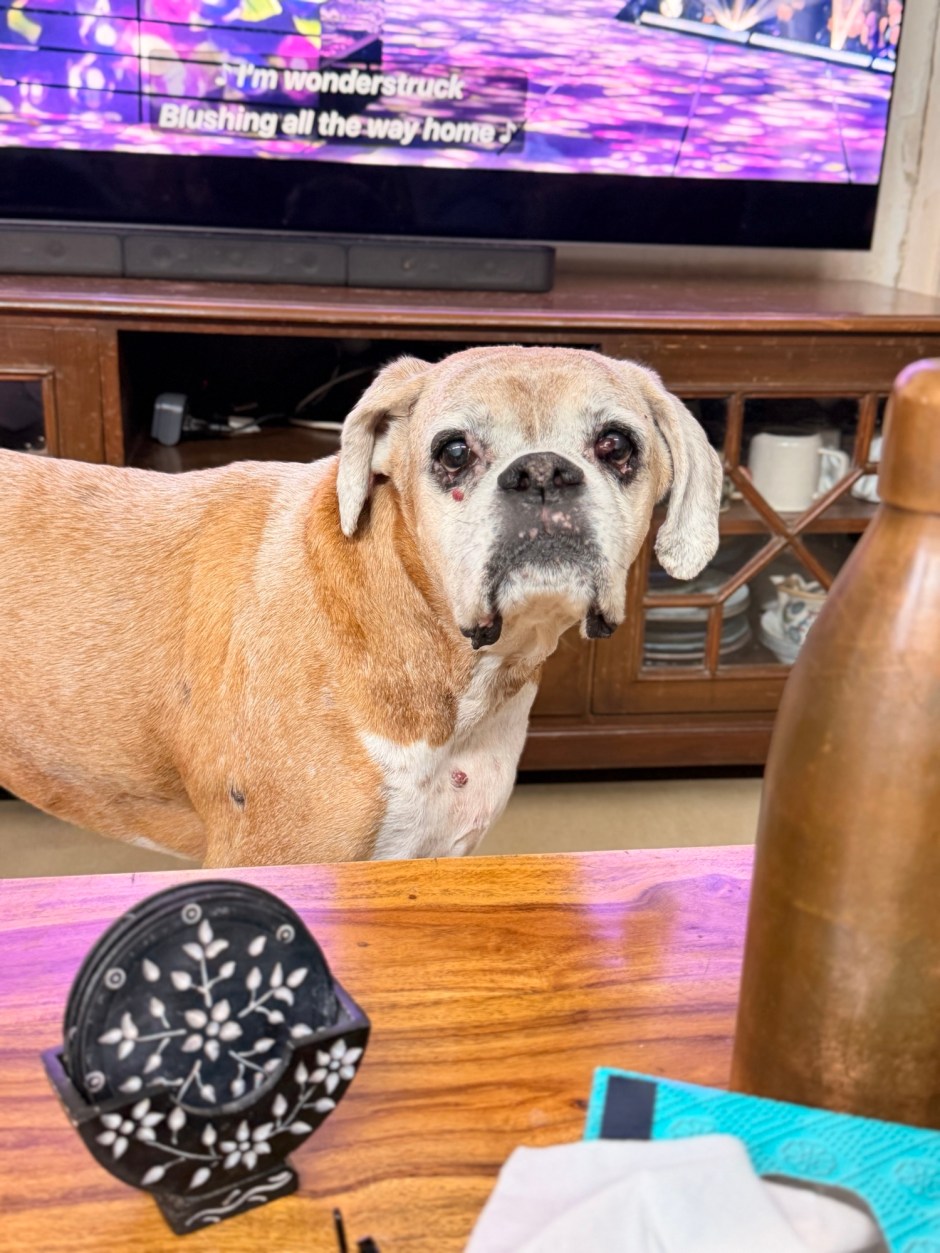
Zach has lymphoma. His body is changing in very specific ways.
He no longer walks much for pleasure. When we go downstairs, he does his job and immediately wants to come back home. Once standing, his hind legs still carry him — but they can no longer lift him up from the floor. I now have to help him stand. He can still rise from mattresses on his own, where the body remembers leverage and comfort.
This isn’t collapse.
It’s negotiation.
His day begins with Anand, who gives his medications without ceremony:
Morning
Pan 40 Uripet Intense Syrup – 5 ml Viusid – 7 ml Deep TBR Vibact Wysolone 20 mg Moxikind 625
Wounds are checked. Cleaned. Redressed. Anand waits for Zach to catch up with himself. There is no rushing a body that is learning its limits.
By afternoon, the watch passes to me.
I help Zach move when he needs to. I clean wounds again if required. I speak to him even when he doesn’t lift his head, because recognition does not need eye contact.
Today, while I was dressing one of his wounds, I stroked his cheek.
He lifted his left paw and placed it on my hand.
There was no weakness in it.
Just intention.
Something broke inside me then — completely and quietly.
But I didn’t cry.
Because he was watching.
And because sometimes love asks for stillness instead of collapse.
Evening
Uripet Intense Syrup – 5 ml Condrovet Dental Powder
Night
Uripet Intense Syrup – 5 ml Wysolone 20 mg Moxikind 625 Deep TBR Gabapentin 300 Vibact
At night, his hind legs fail him more often. I help him settle. I make sure he never feels abandoned by his own body.
Xena: Illness Without Surrender
Xena’s story is different — and that contrast is its own cruelty.
She has mast cell disease, now spread across her body. She has already been through multiple surgeries. I will not put her through more. Her eye carries a tumour growing into the third eyelid. Her chest has two large, problematic masses. The disease is everywhere — but her spirit has not retreated.
She is full of vigour.
She wants to play.
She wants to join Zuri. But she can’t. She has a large sore under her left paw that needs to be protected.
She hates it when I give Zuri the toy and barks ferociously, jealous as ever.
That jealousy is not a problem.
It is proof of selfhood.
Morning
Bladder Plus Wysolone 15 mg Cetirizine 10 Viusid – 6 ml
Her eye is cleaned gently. Drops and ointment are applied patiently. She is spoken to, not restrained. She is still herself.
Afternoon
Keppra 250 Famocid 20
She still wants her walks. I don’t let her decide the distance. I try and make peace with her energy.
Evening
Condrovet Omega Oil Dental Powder Cetirizine 10
Night
Bladder Plus Keppra 250 Cetirizine 10 Avil (pheniramine) Gabapentin 100 Wysolone 15 mg
At night, her eye now itches more. The tumour becomes restless when the house quietens. I will have to put a cone on her before bed — not as restraint, but as protection.
Tonight, because I was awake, I caught the bleeding in time.
If I hadn’t been —
I don’t know what might have happened.
That is why I stay awake.
What This Life Is — And Is Not
This is not denial.
This is not heroism.
This is not clinging.
This is two people refusing to let suffering arrive unaccompanied.
Zach is teaching me once again, how the body lets go before the heart does.
Xena is teaching me once again, how life can blaze even while it is failing.
I know how this ends. I have known for a while.
What I will not allow is panic, violence, or unnecessary intervention to steal what remains.
When the time comes — before pain, before fear, before indignity — I will let them go.
Until then, this is my work:
Following charts.
Measuring doses.
Lifting bodies.
Cleaning wounds.
Watching eyes through the night.
Holding paws when they ask.
Not crying when they are watching.
This is what love looks like at the end.
Not loud.
Not dramatic.
Just present.


 Hearts Still Care
You must be logged in to post a comment.