Dean & Rory

We make so many mistakes when it comes to the question of love. We ache to be in love, even when we know that we won’t be able to handle it at a given time. Then, when we do fall in love, we tend to fall in love with people who are wrong for us, or who do not love us back. If and when we do find someone who loves us back, time soon comes as the great leveler of romance.

It confuses us with thoughts of what love ought to be, and how romance should have lasted. There is a mix-up of sorts and we tend to think of the gradual, staid warmth of love to be a poor substitute for the initial, tumultuous heat. We wonder. We worry we have lost what we had. We demand more. And then – then, we lose what was hard sought after. We forget what it took to get us to that point. Instead of understanding its progression, we mistake it as regression.

Maybe we get greedy. Maybe we deserve more. Who knows? What I do know is that we take what we have for granted. We forget how we felt before we had it and comparisons are made with probable things. Pride takes over, and most times, lies come crawling in. And the love that you had sought becomes something cold.

If it ever truly existed, love never dies. We bury it alive, in its comatose state.

Shubh Mangal Zyada Saavdhan

I am writing a review on a movie that has me super stoked. I saw Shubh Mangal Zyada Saavdhan yesterday night. It lived up to its hype in my head. Of course, I have seen better movies dealing with gay issues and gay lives. But most of these movies come from abroad. We have had brilliant movies like My Brother, Nikhil and Aligarh that touch upon LGBTQIA lives sensitively, but an all and out romantic comedy that deals with a very proud, out-of-the-closet gay man – never! Very recently, we have had Ek Ladki Ko Dekha To Aisa Laga, with such a brilliant script and supporting cast. But let’s admit it, though I have the greatest respect and admiration for Sonam Kapoor who takes on the role of a lesbian, and makes her the lead in a movie dealing with queer love and coming out, I just don’t like her acting.

So, that brings me back to this no-holds-barred out, gay love story! The movie deals with two boys, Kartik and Aman, who fall in love in Delhi and have to make a journey to Aman’s hometown to attend his cousin sister’s wedding. Aman’s dad finds out about his son’s sexuality and the resulting dynamic between intolerance and acceptance forms the crux of the movie. I won’t lie and state that the movie didn’t see things through the utterly rosy lens of a romantic comedy. It does however deal with a lot of issues, that become the winning formula of any Ayushmann Khurrana movie.

It is very important that an A-lister like Ayushmann has taken up a role that almost no one in Bollywood would touch. Homosexuals were to be made fun of, to be derided. How can I forget John and Abhishek in Dostana? But there was not a moment in this movie that was cringe worthy. Kartik, played by Ayushmann, is a bold, vibrant, out homosexual man, who leads the movie out through the messy mind of homophobia.

Most people find the first half of the movie appealing, but for me, it was the second half that held weight. It has a brilliant dialogue between Kartik and Aman, when Kartik asks Aman to stand up for himself and not get married to a girl. This is the most important conversation for me, because what one must always realise, or make very healthy attempts to, is the truth of who one is. One must always be true to who he or she happen to be. That is what Kartik tries telling Aman. To love yourself before you can ever possibly love anyone else.

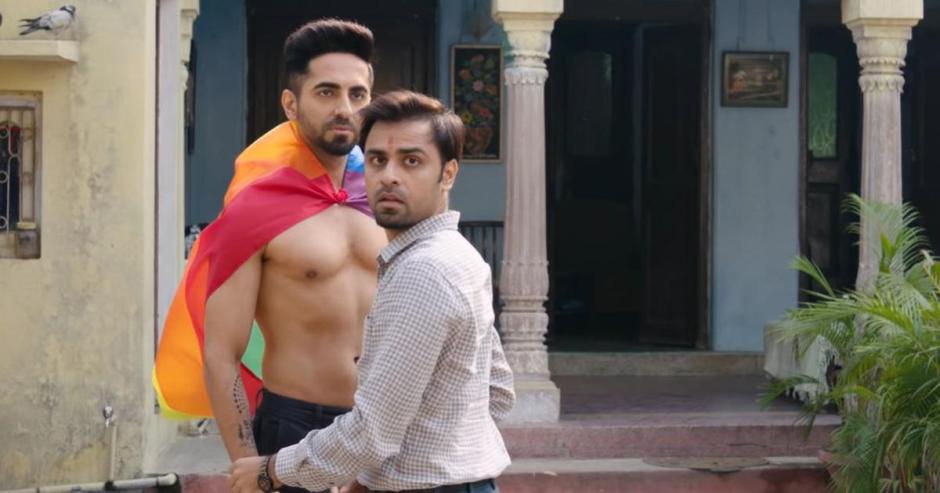
Ayushmann had my heart when he wore the rainbow flag and gave a speech on the dangers of homophobia. The whole scene is over the top, but which self-respecting gay man hasn’t had to say these words to someone in their lives? Well, maybe not shirtless, but hey, who can say that hasn’t happened either? Ayushmann’s Kartik is where LGBTQIA people reach after a while: being sure of who they are and what they want from society. It is Jitendra Kumar’s Aman Tripathi’s shoulders that the movie stands upon. The small town boy who knows he is different, is in love, but cannot face up to parental pressures. This is his story. His journey.

Ayushmann and Jitendra have done lovely work. Many situations in their lives corresponded to either my life, or varied stories I have heard from the lives of my queer friends. Everything that Kartik says in regards to sexuality I have said at some point or the other. It was like hearing myself speak at times. The most important thing is when he tells Aman, twice, in the course of the movie, to completely and deliberately disregard what his father is telling him to do, because he must listen to his own heart. This is not Romeo telling Juliet to disregard convention, this is a Romeo telling a Romeo to understand biology. It’s a very important factor, that most of us do not notice.

Jitendra Kumar took on a role no one really wanted. But he has done lovely work with it. He has beautiful eyes and the vulnerability in them speaks volumes. He is the everyday, desi homosexual who is caught between his biology, his love and his family. And what a family! The supporting cast has done such a fantastic job! Gajraj Rao who plays Aman’s father, Shankar, and Neena Gupta who plays Aman’s mother, Sunaina, have outdone themselves. Their back story has such a layered sensitivity that again is briefly touched upon – having made choices ruled by convention instead of their own hearts. Some people may find Bhumi Pednekar’s cameo confusing, but being gay, one realizes how many of these incidences happen with straight girls and gay boys. (And it’s a nod to Shubh Mangal Saavdhan, their earlier movie together.)

The time given to this movie was too short. It moved too fast for me, especially whilst bringing in so many valid, heavyweight issues and dealing with them quickly. Most of the situations that needed a serious tone were made to seem totally flippant, like the scene where Shankar beats up Kartik. Homosexuals have been killed due to homophobia, and in this case, it was comic fare. I will also very grudgingly give this leeway, because to make something so serious occur would change the entire tone of the movie. Laughter is always easier to digest than tragedy – well, at least for me. I want a happy ending.

I left the theatre feeling good. I know the script had flaws. I know it isn’t a brilliant movie. But it worked for me, because of the very fact that the issues the LGBTQIA community faces were not made into a trope. They were given due importance, without sounding too preachy. And even if it did sound too preachy, it’s necessary, concerning certain audiences are seeing soemthing like this for the first time, in this kind of light! The movie even gave power to the girl who Aman is to marry. Strong women abound in the movie: women with voices, be it Sunaina or Goggle, Kusum or Champa. Everything fell neatly into place – nothing like real life – but if Raj can have Simran, then Kartik should so definitely have his happily ever after with Aman, too.

1917

I have seen how directors pour in beauty in a war film. One only has to watch Spielberg weave his mastery in Schindler’s List, Saving Private Ryan and War Horse and a certain realization grips you. It’s poetry. Sam Mendes tries this with 1917. He attempts and succeeds to create a great dignity to the genre. I loved the film for itself, because it has such poetic moments! But it also left me wanting – I shall let you know exactly what.

The movie starts with this shot that starts with wildflowers and seems like a seamless shot of artistry in film making. The shot goes on and on and it makes you realise that the tunnel the protagonists are walking in is like this endless horror stream. The shot IS the tunnel that the Great War was based on. Sam Mendes takes you into the horror that was tunnel warfare during that Great War that made Tolkien write his epic fantasy. But I digress.

Each shot had artistry that made you want to pause each frame and look at the detailing given to the scene. It is estimated that 484,143 British horses, mules, camels and bullocks died between 1914 and 1918. And many hundreds of dogs, carrier pigeons and other animals also died on various fronts. And Mendes brings this poignantly to the screen. You are taken into the muck and are laid down with the bodies of horses and dogs in the very first scenes of the movie. The way he portrays death: it’s like you can smell the rotting of the carcasses, and feel the blood-soaked rats creep over your shoes.

Mendes takes the “one-shot” format and hypnotises your senses, it feels as though if you blink you will miss something really important. And it really does work, because within this tableau of breathless war chaos he stretches the one-shot effect to feature length. There is this feel of a continuous cinematic POV. But I will state what my partner who is an avid gamer stated just as we were leaving the theatre after the film ended. He mentioned that the movie made him feel as though he was in a video game and he was seeing everything from the first gamer perspective. And that hit me hard – it was true.

I don’t know whether that made me wonder why it made me feel so immersed into the action… but I will also state that though I was immersed in the action, I could not feel any of the emotional connect with any one character that I had felt while watching Schindler or Ryan or Joey. 1917 then seems to be involving for sure, but it is also seems impassive as it leads the viewer through the battlefields of northern France. But on hindsight, if one would like to read between scripting sensibility, the impassivity could also relate to the lead character’s dejection. I immersed so deeply into the movie’s environs that I felt what he was feeling. A loss of hope and complete passivity towards the situation at hand.

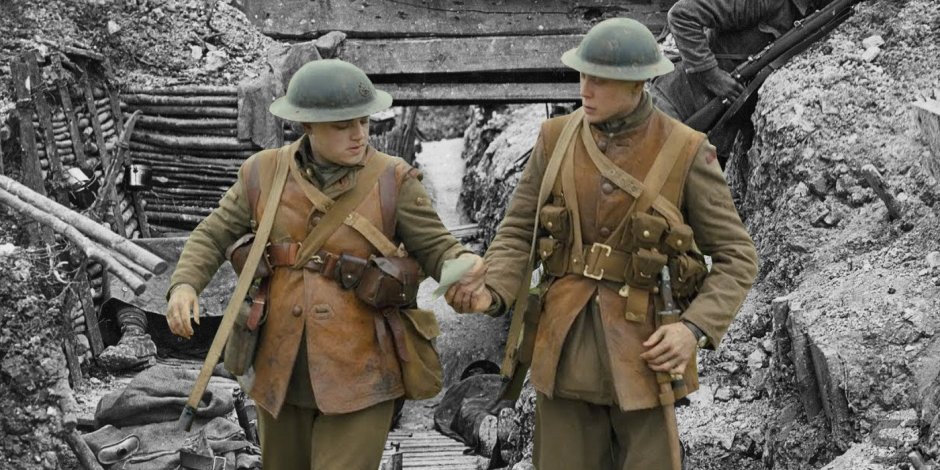
George MacKay and Dean-Charles Chapman are cast as Schofield and Blake, the lance corporals recruited to get into enemy territory with a message for fellow troops waiting to launch a potentially catastrophic assault. The Germans have seemed to pull back from the front lines, suggesting that they are retreating. But, in fact, they’re lying in wait, armed and ready to repel the planned British push. Together, Schofield and Blake must reach their comrades, amongst whom Blake’s brother is one, and halt the attack.

Production designer, Dennis Gassner, has recreated the war imagery to such astonishing detail that one can actually feel the utter barbarity and chaos of the war. The surreal cinematography by Roger Deakins takes you on a slow roller coaster ride, shifting between muck and death to the gentle falling of cherry blossoms. The pathos of death comes randomly, sometimes with such stark jolting horror and other times with adequate preparation. Make no mistake, death lingers in every frame of the movie. Even where there is hope, the inevitability of it filters through George McKay’s eyes. The scenes that remain seared in my mind is that of a burning church, covering the screen in a surreal yellow haze, a dead dog lying on its side in wind-blown grass and a well-fed rat wanting human food.

The movie may not reach to the heights of human pathos as some of the movies I mentioned earlier have. Probably, because, except for the main characters brotherhood, the journey doesn’t let us bond with the affliction of the other secondary characters. It lacks this element that seems to me to be a fatal flaw in a movie that deals with war. It is not just death that one must deal with, at the uttermost edge of the precipice, you do not just see the abyss below but also the sky above.

McKay tries bringing this elemental humanity within his character. However, his meeting with other living beings is so fleeting that he can only show relatability to the minimum. We see human resurrection in the saving of a child, the concern of a wayfarer and the grace of a superior officer, but these are fleeting. And if I must play the Devil’s Advocate, I would perhaps mention that hope is not just a dangerous thing, as Colonel MacKenzie states, it is also a fleeting thing. This depiction is perhaps what makes 1917 epic.

And if that isn’t enough to make the movie a worthy watch, then it would be the song I heard Johnny Cash sing such a long time ago, which has been sung by a Devon soldier at the final stages of Schofield’s journey. The Wayfaring Stranger resonates into our hero’s senses as he walks out from a river he has fallen into. The song is a resurrection in itself as he arises cleansed of his wounds in icy water. The movie touches a spirituality that only those who recognise empathy feel. It forms the crux of peace that so many war ravaged hearts ache for. After the tumult of war and death and loss, the voice of the soldier is like a balm that most movies that deal with sadness require.

And if you are like me, where the allusion to religion and salvation isn’t really a matter of hope, then the penultimate scene is Schofield’s dash across the line of control with bombs exploding to try and stop the attack. It is a mirror of the silence and death of the first scenes which is a fait accompli and what could actually transpire again if the message isn’t delivered. The movie takes you back full circle. I was relieved.