When the Body Breaks Before the Heart Does

I am afraid of losing Xena.

And my body knows it before I allow myself to say it aloud.

We have organised our lives around her illness. Anand and I orbit her like anxious moons — checking tumours, adjusting dressings, watching if she paws at the wound, fitting the cone, giving  her with food, measuring medicines, studying her eyes for discomfort. Love has become vigilance.

And now I have fallen sick.

Acid roars in my stomach like a pit of hellfire. It burns up my chest as though grief is rehearsing its entrance. A cold sore blooms at the corner of my lip — a painful eruption that feels like accusation. As if my body is saying: you cannot control this either.

I hate the helplessness.

I hate that my immune system falters under fear. That I am shivering while she lies there with a body at war with itself. I can take paracetamol. I can swallow an antiviral. I can ask for help.

What does she do?

She paws at the tumour that offends her skin. She endures.

I just lost my son. And I am strangely relieved that I believe in no higher power to blame. There is no heaven to petition. No prayer to bargain with. There is only flesh. Biology. Cells that turn rogue. Love that cannot prevent it.

But hell — hell I feel. It sits in my gut, acidic and churning.

I hate death not because it exists, but because it rarely comes gently. It arrives dragging pain and anticipatory grief behind it. It makes you rehearse goodbyes before they are required. It makes you ill before anything has even happened.

And still, she eats. She looks at me. She responds. She plays.

So perhaps this sickness is not prophecy. Perhaps it is fear trying to outrun reality.

I am trying my best. This has to be enough?

The Weight of Love

On Monday, I took Xena to see Dr Dipti. She has always been steady and clear with me, never dramatic, never vague. She told me that the mast cell cancer may have reached her lymph nodes. She saw new tumours forming around Xena’s right eye. The large mast cell tumour on her chest — the one we have been monitoring so closely — has grown from three centimetres to four.

She said Xena’s pain would likely sit at four or five out of ten. Not sharp. Not acute. Chronic. A quiet inflammation spread through the body. Not the kind of pain we recognise with a cry — but the kind that lingers like background static.

I see it. The tumours are multiplying. Three on her chest. One large one on her hip, exactly where the nappy used to tie — I have stopped using it because the friction made it form and then bleed. Another one near the collar of her T-shirt. So now, before she slept, I removed the shirt. I bandage the lesions under her chest so she does not scratch at them in the night.

Every evening, my mother, Anand and I sit down together and dress her wounds. Paraffin gauze. Gauze. Fixomull tape. Earlier we were using silver nitrate and Placentrex; now we are more careful, more protective. I give her Maxmoist epithelial cyclosporine drops. Ocupol DX for her eyes. She is on Keppra, Gabapin, Avil, Famocid, Condrovet, Sucrafil, Prolivit, Quercetin, Ceterizine. The list feels endless. She is filled, almost overflowing, with medication.

And yet — at five o’clock l, every evening, and a half hour after midnight — she rises.

She lifts her head. She takes a toy in her mouth. She runs after Zuri. Given half a chance, she will steal the toy from Zuri’s mouth as well. There are tumours on her paws, on her hips, on her chest, near her eye. There is a lipoma near her anus that we clean gently every day. Her body is fighting a war. She still wants to play in the sunset. 

That is the cruelty of this stage. The body falters. The spirit does not.

Dr Dipti gently said that we need to start thinking about letting her go. I called Geeta immediately. She was in Jammu. She took a flight and came down last night. That is what love looks like in our family — we gather when it matters.

I am not ready. Not after losing Zach less than a month ago. I cannot bear the thought of losing another child so soon. It feels like Zuri all over again — that tearing open of the chest, that helplessness.

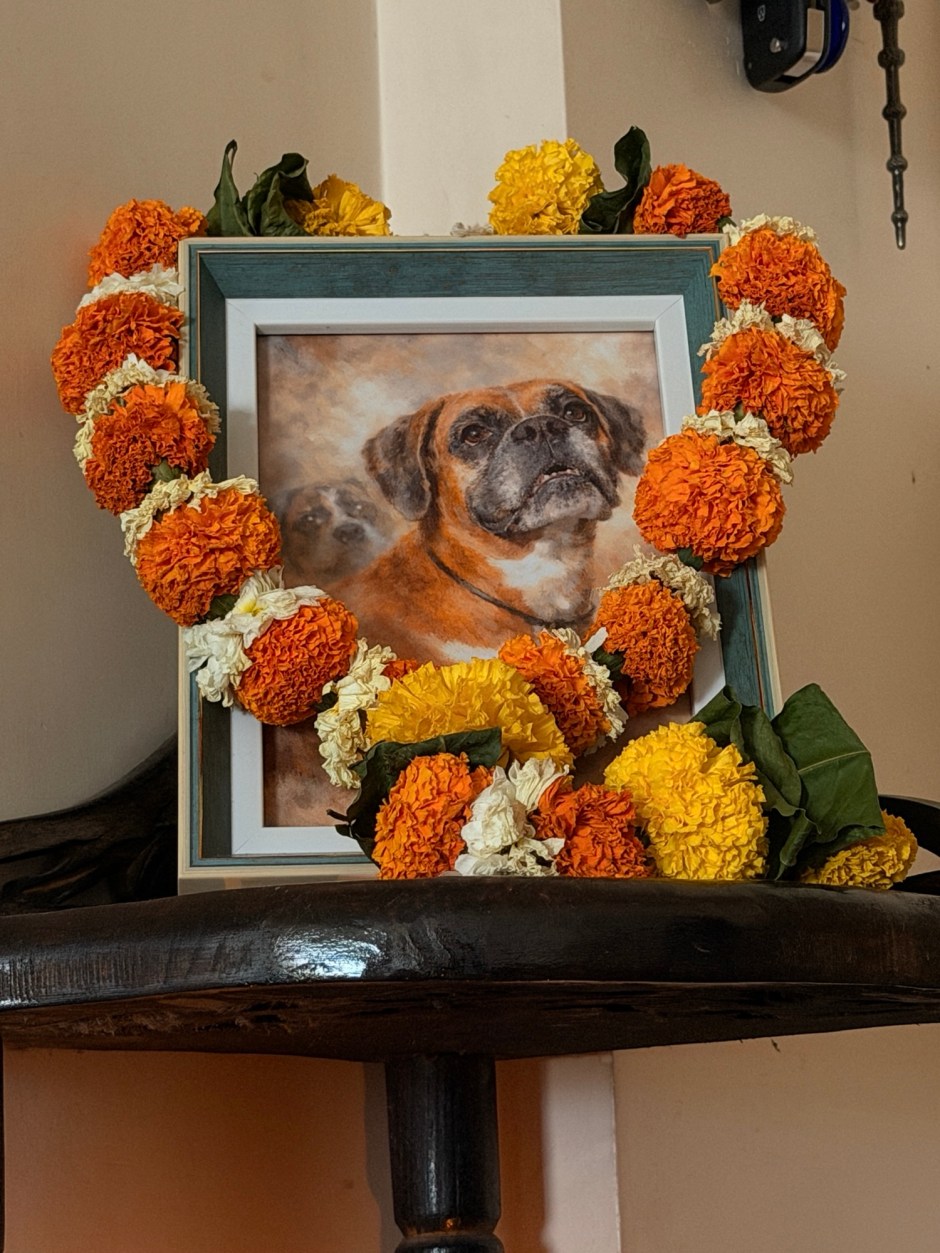
Xena is my baby girl. She came all the way from Bangalore in a tiny crate. She was smaller than a foot when I first held her. A fragile, wee little thing who trusted me without question. She grew into the most intelligent, observant companion. On walks, if she is ahead of me, she turns to check if I am following. If Anand is about to take them downstairs and I step into another room, she comes back to ask when I am coming along. She waits for me.

She has seen everything.

She has seen Rajmahal. She has seen me in love and in heartbreak. She has witnessed my journey through open relationships and the quiet complexities that come with them. She has seen my buas — Munni and Goodie Pua. She has known my aunts while they were alive. She was there when my mother came through cancer. She saw me emerge from a very dark space in my life. She lived through COVID with us. She was there when my father died. When my aunts died. She has watched the seasons of my becoming.

Like Zach.

Our dogs are not just companions. They are witnesses. They are milestones in our histories. 

I know this path was inevitable. I always knew. Loving animals means accepting that their time is shorter than ours. I have said goodbye before — Zach, Zoe, Rolfe, Diana, Bonzo. I survived each time. I still think of them. I still love them.

I know I will survive this too.

But survival does not cancel heartbreak.

Tonight, I removed her T-shirt and bandaged her gently. I had to put a cone around her neck because she paws at the lesion near her eye. She settled down, trusting me as she always has.

And I sit here wondering: when is the right time?

She still eats. She still drinks water. She still wants to go out. She still plays at five in the evening. She still loves me with everything she has.

How do you measure the end when love is still present?

How do you decide when a body that is failing still houses a spirit that shines?

I do not have the answer yet. I only know that whatever happens, she has been brave beyond measure. She has lived surrounded by devotion. 

And – if love could cure cancer, she would have been immortal.

What Animals Teach Our Children

This evening, while walking in the compound with a few members of the building, I found myself in a conversation that stayed with me long after it ended.

One of the ladies asked about a puppy I had rescued — Drizzle. I told her I had fostered the sweet fellow  and then found him a good home. Another mother, who had just joined us who had a young son — a boy of eleven or twelve who adores dogs and kittens — quickly said, half-laughing, “Oh, don’t tell my son that. He’ll want one. And I don’t want that happening.”

I understood what she might have meant. Often, when children ask for pets, the adults become the primary caretakers. Feeding schedules, vet visits, cleaning up, supervision — it is work. Real work. And not everyone is prepared for it.

But as she spoke, my mind wandered elsewhere.

In our very own building, there is a dog reared by two boys who were then in the eighth and ninth standards. They were young, still children themselves. Today, years later, those boys are in college. The dog is fully grown. And they have cared for him beautifully. Consistently. Tenderly. Responsibly.

It made me think about what animals actually do for children.

Animals Teach the Value of Life

The first lesson is simple and profound: life matters.

When a child feeds a dog, refills a water bowl, or sits quietly with a frightened kitten, they begin to understand that another being’s survival can depend on them. Responsibility stops being abstract. It becomes embodied.

They learn that hunger is real. That thirst is real. That comfort is real.

And that their actions — or inactions — have consequences.

Animals Teach Empathy Without Language

Children are not taught empathy through lectures. They learn it through experience.

A limping dog.

A frightened cat hiding under the bed.

A pet recovering from surgery.

In these moments, children begin to understand pain — not intellectually, but emotionally. They see vulnerability. They witness fragility. They learn how to sit beside suffering without turning away.

No textbook can offer that.

Animals invite children to feel.

What Animals Teach Our Children

Human relationships are layered with expectation, negotiation, ego, reciprocity. We love — but often with conditions attached.

Animals are different.

They ask for food, water, shelter, companionship. In return, they offer loyalty, presence, joy — abundantly. Freely.

For a child, this is transformative.

They experience giving without bargaining. They experience receiving without performance. They learn that love is not always a transaction.

And perhaps, somewhere quietly, that reshapes the way they grow into adults.

Learning About Loss

There is another lesson that is harder to speak about, but equally important.

Animals introduce children to the finality of life.

If a pet falls ill or passes away, a child encounters loss in a contained, intimate space. They may not articulate philosophical ideas about mortality, but they feel it. The absence. The ache. The silence.

They learn that life is ephemeral. That presence is precious. That time is not guaranteed.

This awareness — however painful — deepens them.

It teaches them to value the present.

Becoming a Citizen of the World

When a child loves an animal, something expands inside them.

They begin to understand that the world is not built solely for human beings. That other creatures share space, air, vulnerability.

It dismantles the illusion that we stand at the top of some moral pyramid.

It softens the ego.

A child who grows up caring for an animal often grows up more aware — of suffering, of environmental impact, of kindness beyond their own species. They become, in the truest sense, a citizen of the world.

The Tragedy of Suppressed Kindness

I do not dismiss the practical challenges of having a pet. They are real. Time, money, commitment — these are not small matters.

But I wonder if sometimes, in protecting ourselves from inconvenience, we also protect ourselves from growth.

If a child shows kindness — genuine, unprompted kindness — towards another living being, is it not something to nurture rather than silence?

In a world that feels increasingly cruel, hurried and indifferent, the impulse to care is sacred.

When a child says, “I want to love this being,” they are revealing the softest and strongest part of themselves.

To deny that entirely — without even exploring the possibility — feels like a small tragedy.

Because animals do not only enter our homes.

They enter our conscience.

And sometimes, they help raise better humans than we ever could alone.