Kingdom of the Planet of the Apes.

I liked the first instalment of the franchise. It really had all the makings of an epic. Followed Caesar’s story avidly as the other two sequels came to theatres. There was a cascade of evolutionary processes, where the apes evolved and where the humans devolved. It was good fare.

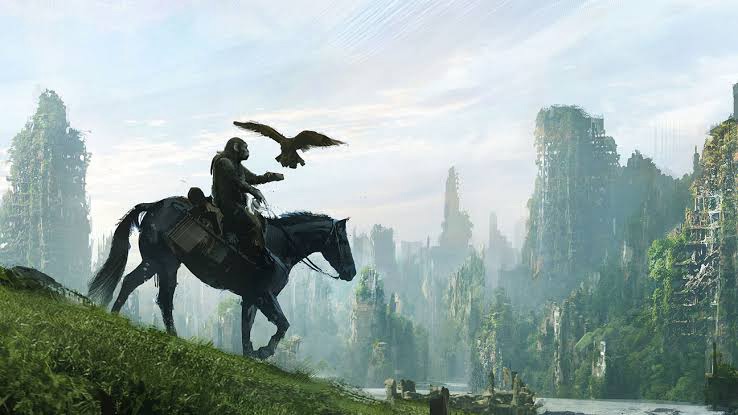
Then came along the movie I watched last night. It is set about 300 years post the death of Caesar. His fame has turned him into a Prophet and nearly into god for certain ape communities. There are other communities who have returned to the natural habitat and take their evolution as a natural process. They haven’t even heard about Caesar. They have their own system of beliefs. From these come the main protagonists. Noa, Anaya, and Soona. 

The tribe has their own law and Noa struggles to follow them. From the beginning he is shown to be the one who chooses his own path. They are close to nature and the eagles they bond with become the metaphor for all that is natural. 

Some followers of Caesar have become zealots and believe that it is their right to subjugate humanity. But it is not only human beings that they have a problem with. They have turned into evangelistic bullies, like most people who have misplaced faith in one entity do. Caesar has become the equivalent of the Roman Emperor that ruled with autocratic might. There are many megalomaniacs who want that kind of power, but without the honesty and morality that Caesar possessed. He was willing to work with humans for the betterment of the Apes. 

And this is the second part of the analogy. The first being respectful of the natural world. The second the problems that occur when faith turns into fanaticism. This is wonderfully brought out by the perspective of Noa, the human protagonist.

He is astounded by how apes kill apes – something that Caesar had a law about in the first three movies. Then he gets to know Nova, who can speak. There are those humans who do not as well and Nova does not see herself as part of that tribe. In fact, she comes with her own agendas and racial prejudices, and those juxtapose the ones Proximus Caesar has. They both want one race to subjugate the other. Each feels it is their Right to do so.

The themes are well-woven and intertwined with lovely spectacles and hard-hitting action. Each character stands out as unique and they all linger in the mind long after the movie is done. The tragedy of the movie is that human beings are coming back into power and the beauty of the natural world is once again in peril. If only the rise of the Right and the people who push religion down other’s throats in the guise of morality and proper conduct would understand what is being said. The world would be the home that Noa so desperately seeks to build and preserve, devoid of guns.
Heteronormativity

Yesterday night, I was having a conversation with a friend and my mother and partners were present, too. I mentioned how different the relationship between my mother and my partner was when compared to my mother’s relationship with my grandmother, my mom’s mother-in-law. I told her how differently your son-in-law treats you as compared to how you treated my grandmother.

And she instantly retorted, without a moment’s hesitation, or concern for feeling or reality, “He is not my son-in-law.”

“Huh?” I was shocked. “Then what is he?”

“Your partner,” she snapped back.

Of course, in my head, a relationship that has lasted through twenty-five years amounts to more in my head. For me, marriage is not a piece of paper or standing before any god and promising to be together. It is love and concern that keeps us bound together. Unfortunately, a heterosexual mother wont really understand that.

I immediately wanted to retaliate. “Your daughter’s marriage that has barely passed two years of age amounts to labels and tags and, more importantly, respect, but my relationship that has seen us struggle to be with each other despite all odds, family, work, staying apart and then together after 6 years, coming out as a couple, standing up for each other, making our own lives together, braving hurdles of conflict and affliction, deserves nothing?”

But all I told her was, “my sister has a husband since two years because they are “married” and my relationship of 25 years is nothing?”

I haven’t been able to look at her since then. But it is not just her. It is my best friend who has suddenly become closer to my sister because they have the similar bond of talking about their husbands – which I could never have. Despite the fact that all my relationship secrets she has been privy to, she won’t ever be able to understand – because we don’t base our judgements of equality on love itself, but on gender, on sexual orientation, on what society expects of us.

Maybe someone with a deeper understanding of how things are and what emotions truly mean to someone, may get it. May. But then even if they do, they won’t really understand our throuple. Because polyamory is still a far way to be understood even by the gay community itself.

Today I woke up and read a post by a gay friend. He is one of my oldest friends in the community, and he had a post about gay marriages and in the comments section someone mentioned if it was possible in India. He replied with a list of couples and neglected to mention my name with my partners. Of course, it is because he sells the idea of gay marriage. I don’t fit the bill with two partners.

Don’t get me wrong, I am not against gay marriage. You see, my point is I am not against any marriage of any kind. If there is love and concern and respect, any relationship between people is a marriage to me. But when the gay community falls back upon a heteronormative standard, it seems ludicrous.

We are not the same, we are different. Our sexuality ranges a whole spectrum of colour. We are gays, lesbians, bisexuals, trans, pansexuals, demisexuals, non-binary, sapiosexuals, asexuals, and a host of others. How can we fit ourselves into the normative standards of man and woman? We are not as simple as that. If any relationship can be simplified, that is.

I do not think that the human race is equipped to understand differences. Even if they accept them to be socially cool, they will never really understand them. Because you see, people do not understand love. If you get the nature of love, you will accept it in any form.

Most people understand what is different, because all of those differences cater to the five senses. Love becomes an abstract concept that can only be felt. And the brain insists that there is only one kind of abstraction. The way someone looks at a dark person or an over weight person and forms an idea of what he or she or they must look like. People look at love as they grow up and think that’s the way all love should be.

In order to simplify things, they actually create chaos. Accepting all forms of love becomes so simple. Love is love, after all.

This also then brings my self to my attention. I got stuck on a label, too. A “son-in-law”, what is that but a heteronormative label. And technically, though my mother didn’t say it in this way, she is right: He is my partner. Not any son by law, because neither does the Law accept our relationship in this country, nor does she treat him like a son. The sad part is that he treats me like his husband and lover and treats her like she is his mother.

And that is what shall keep us together for another 25 years.

Parents

I was just scrolling though instagram and I read a post where someone was exuberantly praising their mother. I am going to say something real here. We all have parents. According to society and many religions we are suppose to love them. But it’s not always possible.

Firstly, I do not come from the mind set where being brought into this world is something to be lauded. The world is a crazy place. It’s filled with angst of living right from the get-go. Sure, it has love and beauty, but the hate and the ugliness over powers the former most times. I understand all the copious ideologies that talk of light overcoming dark. Pick up movies, books, education, theology, and they will talk about the reason-to-be and why light is better than the dark. I don’t think either is better. They’re the same. Birth isn’t better than death. And being isn’t better than non-being. The best questions Shakespeare asked were in Hamlet’s famous soliloquy.

Parents then aren’t meant to commemorated. Loved surely. All living beings need love and should be. That’s the point of life actually. But loved blindly just because of blood ties. Na. Any woman who works hard and gives her children the best life she can give them should be loved. But not celebrated, the choice of being a parent was hers. So the duty of being a good one isn’t anyone else’s but hers. Therefore, the duty she has taken on becomes the judge of her parenthood. Not the children. The children haven’t chosen her to be their mother. So they aren’t in any way responsible for her as adults. It’s love that makes them responsible. Not duty.

I speak from personal experience and so I shall also talk about things when they go wrong. When you have a father who isn’t capable of love or parenthood but capable of reproduction and does, you’re also in some deep shit. The idea of respecting a person who falls in his duty is preposterous. Krishna himself said this to Arjun at the brink of a war. When the people who create culture fail to uphold it there is a collapse of society. We do not live in the wild, where animals stay with their parents up to a point and then don’t bother if the parents are old enough to care for themselves or not. We live in a culture that has created these rules. If an animal is a bad parent, the child dies, here society prevents that from happening. And thus, pathologies develop. Serial killers go on rampages. The idea of duty becomes the benchmark for everyone.

I live with anxiety and depression created by an abusive father and fear of the world created by an over protective mother. Yet, I function in society because that is my duty- which I never asked for. Essentially, I should love being who I am. But I do not. I have made my peace with it. As such, I have made peace with the fact that parents are human beings who are capable of disastrous mistakes. They are to be loved, yes, but worshipped, no.

I had aunts who cared for me like they were my parents. One of them filled the place of my father. Strong, supportive and loving. She did more for me than my father ever did. It was not her duty to do so. She had not given birth to me. But she loved me like I was her own. Some say, that was because she did not have children of her own, but that doesn’t mean she did not love me. That only meant that her duty would have been to her own children first. And I would not expect any less of that. But would she have loved me less? I do not think so. Irrespective, of that digression, I will just reinstate that motherhood or fatherhood or parenthood, itself, is created by love. If it is a hallmark of duty, it needs not be respected but taken as a matter of life. If it is an act of pure love, it won’t need reciprocation.

No one asks to be born. And as such the one who procreates has a moral obligation towards culture itself to make sure that the offspring contributes to the love needed in the world. Nurture is always more important than nature and that is a parent’s job. Not the child’s. As you grow you can appreciate what your parent has done – but in the sense, of how well they did their duty. Love is a necessary by-product of that duty. And one need never be grateful to be loved.