
There is nothing I can say that hasn’t already been said by both sides of the argument. A station for metro cars needed to be made. The government wanted to cut down 2,500 trees of a forested area to build it. The environmentalists wanted the land protected. They took it to court. The court ruled in the favour of the government. The corporations in charge disregarded the fifteen-day wait period after the verdict and in the dead of night began cutting the trees down. The protests started immediately. The retaliation started immediately. Laws were disregarded and people were gagged. The matter escalated and the Supreme Court now is involved and will set precedent, within six hours.
I pause here. Because I have much to say, but I know it will not be heard. I have much to discuss, but discussions are moot. I will, though, write in what I feel.
When the trees slept, they were cut down. In the larger scheme of things, every industrial revolution has happened with the greens being cut down and machinery imposed to help humanity progress. It happened earlier in all first world countries. Forests were brought down for various reasons, the predominant one was agriculture. Then it was industry. Science sits on the periphery of this classic argument. It cannot move against progress, but statistics have it that most cures and medicines prevail within the forests of the world. Of course, the vested interests pharmas have are moot, for obvious deductions.
Ever since I was a child, I have loved watching shows on the natural world. My dream destination is Kenya. I would like to watch the annual migration of the wildebeest from the Masai to the Serengeti or vice versa. I think watching millions of animals move in unison, answering a call of nature, that even they don’t know exists, but feel, would be something spectacular to witness. I have watched David Attenborough talk about the minutest lifeform to the most dynamic, in our world. Over the decades I have seen the wild deteriorate and some wildlife go extinct. In my lifetime, I know of the Saudi Gazelle, Père David’s Deer and the Scimitar oryx that have gone extinct in the wild. We already know the battle tigers face to survive and I won’t even get into the fabulous victories of trophy hunting.
I am not against progress. I think of myself as an urban human and I don’t do well with the thought of being in the wilderness. This is how I was raised and I find comfort in urban structures. That being said, I do not find myself to be a proponent of progress for progress’ sake. Just because a thing can be done, it shouldn’t be done without thinking of the end. I think the most important thing that humanity must do is keep a check on how fast we reproduce. It is basic common sense. Our planet has limited resources and those resources need to be taken care of. As such, we all, each and everyone of us, have a duty to think about how far we can place a burden on our planet. We need to stop being selfish.
Mumbai is one of the fastest growing urban cities. It has a population of 22.5 million human souls. The transport systems of the city are clogged with teeming masses of people. Traffic has surged and peak hour travel seems daunting to the bravest heart. In the midst of all this burgeoning life, we have a national park that spans about 87 square kilometres that hosts Buddhist caves, two lakes and is home to a number of endangered species of flora and fauna. The forest area of the park houses over 1,000 plant species, 251 species of migratory, land and water birds, 50,000 species of insects and 40 species of mammals. In addition, the park also provides shelter to 38 species of reptiles, 9 species of amphibians, 150 species of butterflies and a large variety of fish. Did you know there is a species of moth in this forest that is as big as a sparrow?!
That being said, the current point of dispute is the Aarey area which spans across three thousand one hundred and sixty-six acres of land in the south-western borders of the park. The land here is needed to create a shed for the metro cars of the newly emerging western line. If one thinks about it negligibly, the cost of 2500 trees seems a mere pittance for the sake of development. But there are two valid points to further think about. Firstly, what is to stop more of the trees being cut down eventually, because progress doesn’t have a tendency to stop. And arguments for development are always keen. Secondly, someone on twitter said this and it stuck in my mind: ‘a station or a shed can be moved, a forest cannot’ – despite all the assurances of political parties that the same number of saplings will be planted elsewhere in the city, it seems like a poor consolation.
Here are full grown trees being hewed down. The area in Mumbai happens to be termed a green lung of the city. The amount of help the trees would bring now cannot be compared to what the new saplings will bring by the time they grow. It roughly takes a tree 10 – 30 years to reach full maturity. The other arguments thrown around is the amount of pollution that a metro line will help in decreasing. However, one should take into consideration that the protesters are not against the rise of the metro, but against the cutting down of the trees. One doesn’t necessarily have to weed out the other. There are always other places to be found and could have been – if adequate importance was given to nature.
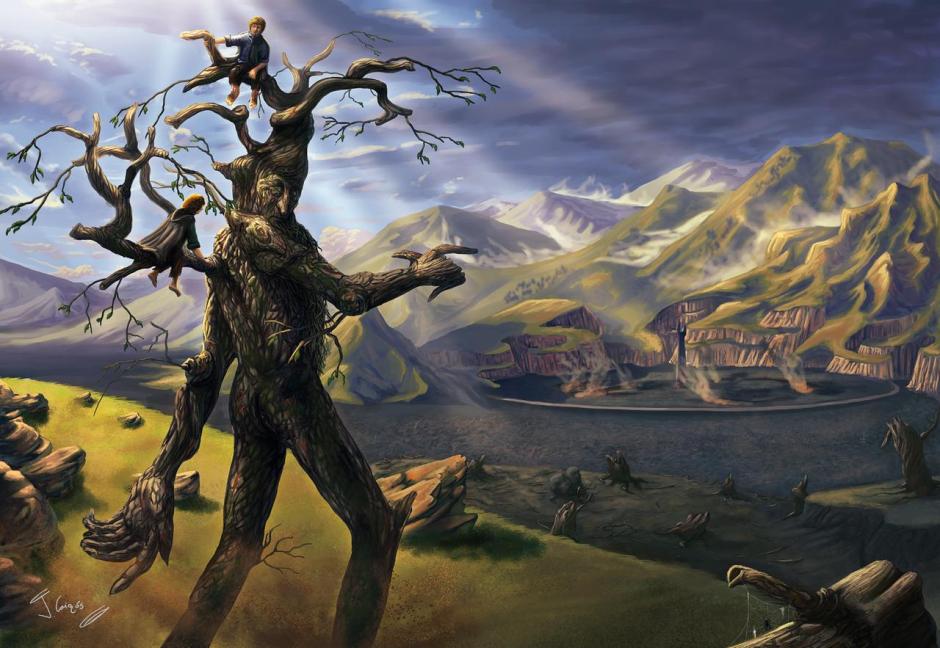
That is the grouse that should be most important. That we do not think of natural resources as a sustainable backbone to prevent a natural calamity. The accusation I hear is that trees matter more than human beings to people like I. The question I would like to ask is why does nature matter so less to people? We think too little of groundwater reserves. We bring down green cover that promotes better atmospheric temperatures. We abuse the use of plastic and its availability. While reading Tolkien as a growing teenager, I remember the sorrow of Treebeard. He quietly states, “Side? I am on nobody’s side, because nobody is on my side…” The trees continue to fall. And if we, like Pippin, think that this will not affect us in the long run, that we shall be safe in our homes, when the day of reckoning comes, we but have to heed Merry’s words in retaliation. “The fires of Isengard will spread, and the forests of Tuckborough and Buckland will burn. And all that was once great and good in this world will be gone. There won’t be a Shire, Pippin.”
Finally, I would like to end with a poem, I, as an English teacher, used to teach high school students as part of their curriculum. I wonder how many actually remember this enough to have learnt from it.
On Killing a Tree, by Gieve Patel
It takes much time to kill a tree,
Not a simple jab of the knife
Will do it. It has grown
Slowly consuming the earth,
Rising out of it, feeding
Upon its crust, absorbing
Years of sunlight, air, water,
And out of its leperous hide
Sprouting leaves.
So hack and chop
But this alone wont do it.
Not so much pain will do it.
The bleeding bark will heal
And from close to the ground
Will rise curled green twigs,
Miniature boughs
Which if unchecked will expand again
To former size.
No,
The root is to be pulled out –
Out of the anchoring earth;
It is to be roped, tied,
And pulled out – snapped out
Or pulled out entirely,
Out from the earth-cave,
And the strength of the tree exposed,
The source, white and wet,
The most sensitive, hidden
For years inside the earth.
Then the matter
Of scorching and choking
In sun and air,
Browning, hardening,
Twisting, withering,
And then it is done.

 Hearts Still Care
You must be logged in to post a comment.