
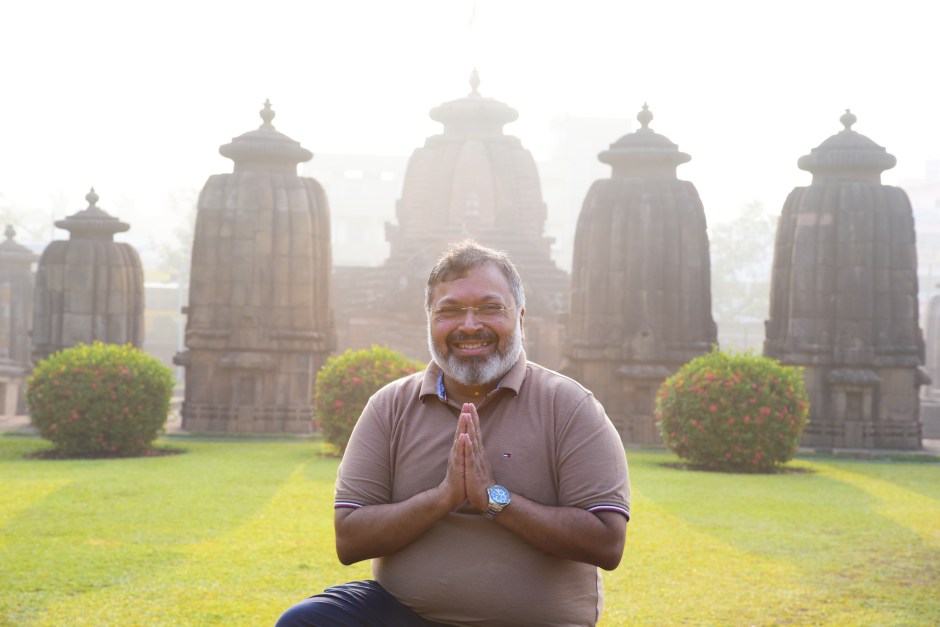
Devdutt Pattanaik is a difficult person to categorise. And perhaps that is precisely what makes his work so interesting.
He studied medicine at Mumbai University and spent nearly fifteen years working in healthcare and the pharmaceutical industry before becoming a full-time writer. Today, with more than seventy books to his credit, he is one of India’s most widely read writers on mythology.
He writes about Hindu, Jain and Buddhist traditions, but his interests extend well beyond India. He has explored Greek mythology and the religious narratives of Christianity and Islam, included in his book, Eden: An Indian Retelling of Jewish, Christian and Islamic Lore. Drawing on ancient texts, translations and their many interpretations, he examines how different cultures use stories to make sense of the world. But he isn’t a priest, a traditional religious scholar or a trained historian.
This unusual position has earned him both admirers and critics. Some academics consider him a populariser rather than a serious scholar. Hindu nationalists have accused him of distorting and undermining Indian traditions.
Interestingly, both groups seem uncomfortable with him for very different reasons.
But perhaps the problem is that Devdutt doesn’t quite belong to either camp. He approaches mythology with curiosity, questions established interpretations and, most importantly, encourages people to look at familiar stories differently.
And that is worth examining.
What exactly is a myth?
One of Devdutt’s most important ideas is explained in his book Myth = Mithya (2006).
In everyday English, we often use the word myth to describe something that isn’t true. But Devdutt uses the word differently.
For him, a myth is a belief that a community accepts as its truth. It is a way of looking at the world that becomes so familiar that people stop questioning it.
Myths aren’t restricted to religious stories. They exist in our rituals, festivals, symbols, traditions and even our everyday lives.
For example, the belief that progress always makes society better is also a kind of myth. So is the idea that economic growth is always good. Even the belief that modern, rational people have outgrown mythology is, in itself, a belief system.
This doesn’t mean that science and mythology are the same thing. Science examines the natural world through evidence and testing. History investigates what happened in the past. Mythology asks a different question: why do people believe in certain stories, and what do those stories mean to them?
Whether Rama actually lived is one question. Why millions of people look at Rama as an ideal king is another.
Devdutt is interested in the second question.
Gods, psychology and the human mind
Devdutt often approaches mythology through human emotions and behaviour.
He explores fear, desire, insecurity, ambition, relationships and the choices people make. His gods and goddesses aren’t simply distant divine figures. They also represent different ways of understanding human life.
His thinking draws from several Western philosophers and psychologists, particularly Freud and Jung. However, one of the more interesting influences on his work is the French anthropologist Claude Lévi-Strauss.
Lévi-Strauss studied myths by looking at opposing ideas and relationships: nature and culture, forest and village, wilderness and civilisation.
Devdutt uses similar contrasts when explaining Indian mythology.
Take Shiva and Vishnu, for example. Shiva represents the hermit who withdraws from the world, while Vishnu represents the householder who participates in it and maintains its order.
Neither is necessarily superior to the other. They represent different approaches to existence.
Similarly, the forest and Ayodhya in the Ramayana represent two different worlds, each with its own rules and understanding of society.
Even Devdutt’s familiar line drawings serve a purpose. They help readers understand how these ideas relate to one another.
There is, however, a limitation to this approach. Indian mythology has developed over thousands of years, across different regions, communities and traditions. It isn’t a perfectly organised system designed by one person.
Sometimes, Devdutt’s neat explanations can make a rather complicated history look more organised than it really was.
To his credit, he often complicates his own arguments by introducing alternative versions of the same story.
And that brings us to one of the most important aspects of his work.
There is never just one Ramayana
One of the people who influenced Devdutt’s thinking was A.K. Ramanujan, whose famous essay, Three Hundred Ramayanas, argued that there isn’t one single, original Ramayana with several imperfect copies. There are hundreds of versions, each shaped by the community and culture that tells it.
The essay itself became controversial and was eventually dropped from Delhi University’s syllabus in 2011 following protests.
Devdutt took this idea beyond university classrooms and into the hands of ordinary readers.
Books such as The Pregnant King (2008), Jaya (2010), Sita (2013) and Shikhandi (2014) introduced readers to versions of familiar stories that many had never encountered.
He brought together the Valmiki and Vyasa traditions, Tamil and Bengali retellings, Jain versions of the epics and regional practices such as the Aravan festival at Koovagam.
He reminded readers that Sita’s story doesn’t have just one ending. He also drew attention to references in the Valmiki Ramayana that challenge popular assumptions about Rama, including references to meat consumption.
For many readers, this was an eye-opening introduction to the diversity of Indian mythology.
Of course, there is a responsibility that comes with retelling these stories. When versions from different centuries and regions are presented together, readers can sometimes mistake a later interpretation for an ancient source.
A village tradition may be mistaken for the universally accepted version. An author’s interpretation may be remembered as something actually written in the original text.
This is where Devdutt’s work could benefit from more detailed references.
The importance of knowing where a story comes from
There is an important distinction between preserving a story and explaining where it comes from.
India has thousands of communities with oral traditions. Their stories have been passed down through generations without necessarily being written in books.
It would be unfair to dismiss these stories simply because they don’t have a Sanskrit manuscript or an ancient written reference.
But that doesn’t mean we shouldn’t ask questions about their origins.
Who tells the story? Which community does it belong to? Where is it told? When was it recorded?
These are important questions.
Writers such as Verrier Elwin documented the stories of communities such as the Baiga, Gond and Agaria in Myths of Middle India (1949). Bhagwandas Patel spent years recording the Mahabharata traditions sung by the Bhil communities of Gujarat.
These examples demonstrate that oral traditions can be documented without taking away their cultural identity.
In fact, documenting their origins protects them.
Otherwise, a writer can simply say that a particular tribal community believes something, without explaining which community, which region or which storyteller the account comes from.
The community disappears, while the author becomes the face of the story.
At the same time, we shouldn’t romanticise oral traditions. They evolve, change and sometimes reflect the inequalities of the communities that preserve them.
The absence of a written text doesn’t automatically make a story ancient, authentic or superior.
What matters is that we respect these traditions enough to document them properly.
East versus West: Is the distinction justified?
Perhaps the most controversial aspect of Devdutt’s writing is his comparison of Indian and Western ways of thinking.
Critics often describe this as an East-versus-West argument. They accuse him of creating an artificial division between two very different civilisations.
There is some justification for questioning such broad comparisons.
Devdutt’s central argument, however, is about two different understandings of life, death and time.
In Judaism, Christianity and Islam, the broad theological understanding is that we live one life, die and eventually face judgement.
In Hinduism, Jainism and Buddhism, the idea of rebirth is central. Actions have consequences that extend across lifetimes, and liberation means escaping this cycle.
These are two very different ways of understanding existence.
Devdutt illustrates this through the story of Alexander encountering an Indian sage. Alexander comes from a tradition in which one life is precious and lasting fame matters. The Indian sage belongs to a worldview in which life and death are part of a much larger cycle.
It is an effective way of introducing the difference.
But there is a problem when we make the distinction too absolute.
Ancient Greece also had traditions of rebirth. Pythagoras believed in the transmigration of souls. Plato discussed rebirth in his writings, including the story of Er in The Republic. The ancient Druids also believed that souls passed into new bodies.
Even within Judaism, the mystical tradition of Kabbalah includes the concept of reincarnation.
And India itself wasn’t always organised around the idea of rebirth.
The Rigveda largely describes the dead going to the world of Yama. The idea of rebirth becomes clearer in later texts such as the Brihadaranyaka and Chandogya Upanishads.
In other words, both civilisations have had different beliefs at different points in their history.
The more accurate argument, therefore, is not that the West never believed in rebirth or that India always did. It is that certain beliefs eventually became dominant in different religious traditions.
That distinction matters.
Why academics are uncomfortable with his arguments
Interestingly, Devdutt isn’t the first scholar to make comparisons between Indian and Western thought.
Louis Dumont, in Homo Hierarchicus (1966), examined Indian society through the idea of hierarchy and compared it with Western ideas of equality.
A.K. Ramanujan also explored differences between Indian and Western ways of thinking in his essay Is There an Indian Way of Thinking? (1989).
Both works are taken seriously in academic circles.
So why does Devdutt attract such resistance?
Perhaps part of the answer lies in the way he communicates.
He takes complicated ideas and presents them through stories, drawings, accessible language and books that people actually want to read.
He doesn’t always use the language of academia. He doesn’t necessarily follow its conventions. And he has managed to reach millions of readers without having to pass through the traditional academic system.
There is something rather uncomfortable about that for an establishment that has traditionally controlled who gets to interpret and explain knowledge.
This doesn’t mean that academic criticism of Devdutt is automatically unfair. His arguments deserve scrutiny, just like those of any other writer.
But dismissing his work simply because it is popular is equally unfair.
Where Devdutt sometimes gets it wrong
It would be dishonest to suggest that Devdutt’s work is beyond criticism.
One of the weaker aspects of his writing is when he moves from explaining religious and cultural ideas to making broad claims about how people behave.
In Business Sutra (2013), for example, he draws comparisons between Indian and Western approaches to business and management.
The suggestion that Western business behaviour is shaped by linear ideas of time, while Indian business behaviour is influenced by the cyclical understanding of the Gita, can be interesting as a starting point.
But it becomes problematic when these ideas are treated as explanations for how entire societies behave.
A businessman in Mumbai chasing quarterly profits isn’t necessarily operating within a cyclical understanding of time. Similarly, a banker in Frankfurt isn’t automatically driven by a particular religious worldview.
Human behaviour is considerably more complicated than that.
The same caution applies to his other comparisons. A useful framework should help us understand the world, not become a convenient explanation for everything.
Why Hindu nationalists dislike him
Devdutt has attracted considerable criticism from Hindu nationalist writers and commentators.
Some accuse him of reducing gods and goddesses to ordinary human characters with personal problems, rather than recognising their divine and cosmic significance.
Others object to his interpretations of the epics, his references to meat consumption in ancient texts, and his insistence that there are multiple versions of the Ramayana.
The argument about food is particularly revealing.
References to meat consumption in ancient Sanskrit texts aren’t inventions of modern writers. They exist in the source material.
What seems to trouble some critics is the suggestion that the religious traditions they regard as fixed and unchanging have actually evolved over time.
There is also a problem with the way Devdutt is categorised. His critics sometimes place him alongside academics and historians such as Romila Thapar, Sheldon Pollock and Wendy Doniger, treating them as part of one larger intellectual conspiracy.
That is hardly a serious way of examining individual arguments.
Some of the philological criticisms made against Devdutt deserve proper answers. Others are little more than ideological disagreements.
Devdutt, unfortunately, hasn’t always helped his own cause.
His responses on social media can sometimes be unnecessarily combative, dismissive and, frankly, quite unpleasant. While he is perfectly entitled to disagree with his critics and defend his work, the manner in which he occasionally engages with people can become a distraction from the very ideas he is trying to defend.
There is a difference between challenging someone’s argument and making the exchange personal. At times, his social media responses have given critics an opportunity to focus on his temperament rather than engage with the substance of his writing.
For someone who has spent so much of his career encouraging people to question ideas and look at different perspectives, a little more restraint in these exchanges would perhaps serve him well.
The academic establishment has its own problems
The resistance Devdutt faces from sections of academia is perhaps more interesting than the criticism he receives from political and religious groups.
The academic establishment values qualifications, peer-reviewed research, citations and established methods of scholarship.
These things are important. They help ensure that ideas are examined, questioned and tested.
But academic institutions can also become exclusive clubs.
A person who hasn’t followed the conventional route can find it difficult to gain acceptance, even if their work reaches a much larger audience.
Devdutt has a medical degree rather than a history doctorate. He writes popular books rather than conventional academic monographs. His columns reach readers who may never pick up a university publication.
And perhaps that is precisely what makes him difficult to accommodate.
The French sociologist Pierre Bourdieu wrote about how academic institutions maintain their authority and determine whose knowledge is considered legitimate.
There is a larger question here: should popularity disqualify someone from being taken seriously?
Of course not.
Popularity doesn’t make an argument correct. But neither does an academic qualification make it automatically correct.
The answer should lie in examining the work itself.
If Devdutt gets a source wrong, point it out. If his interpretation is weak, challenge it. If his argument is interesting, take it further.
Silence isn’t a particularly useful response.
And by leaving the conversation to ideological opponents, academics may actually be surrendering the very space they claim to want to protect.
Mythology and history are not the same thing
One of Devdutt’s more interesting distinctions appears in his work on Itihaasa.
He separates two subjects that are often confused.
The first is the history of mythology. This examines how stories and beliefs have changed over time.
When did the idea of rebirth become established? How did Vedic religious practices evolve? What did ancient texts say about food, sacrifice and social customs? How did different versions of the Ramayana emerge?
These are questions that require historical evidence, textual research and an understanding of how societies change.
The second is the mythology of history.
This examines the stories that communities tell themselves about their past.
For example, the idea of a glorious ancient India, the belief that everything was better before foreign invasions, or the image of particular historical rulers as perfect heroes.
These are not simply historical accounts. They are narratives that help people understand their identity and their place in the world.
And this applies to everyone.
Nationalists have their preferred versions of history. Political movements have theirs. Even historians can approach the past with assumptions about which questions matter and which events deserve attention.
The important point is that history and the stories we construct around history aren’t necessarily the same thing.
Devdutt’s argument is that we need to examine both.
So, how should we read Devdutt Pattanaik?
I think the best way to approach Devdutt’s work is to separate three questions.
Is the story he is telling accurately represented in the original source?
Is his interpretation of that story convincing?
And does the interpretation help us understand something about the way people live, think and behave today?
These are three different questions, and they don’t always have the same answer.
A retelling may not be entirely accurate but may still offer an interesting interpretation. An interpretation may be original but poorly supported. A historical fact may be perfectly correct but tell us very little about why a particular community continues to value a story.
We need to be able to appreciate what works, question what doesn’t and remain open to different interpretations.
That, after all, is what reading should be about.
The final word
There is an interesting example in Indian history.
D.D. Kosambi was a mathematician who became one of India’s most respected historians, despite not having followed the conventional academic route into the discipline.
His work survived because other scholars engaged with it, challenged it, built upon it and took his arguments further.
That is ultimately what determines whether an intellectual contribution has lasting value.
Devdutt already has something that most writers can only dream of: an enormous readership. He has introduced millions of people to stories, traditions and interpretations they might otherwise never have encountered.
But readership and intellectual legacy aren’t necessarily the same thing.
For his ideas to survive beyond his books, other writers, researchers and scholars must engage with them seriously. They must challenge his arguments, correct his mistakes, expand his ideas and sometimes disagree with him entirely.
Perhaps that is the next stage of the Devdutt Pattanaik story.
He has made mythology accessible to millions. He has encouraged people to question the idea that there is only one version of a story, one interpretation of a god or one way of understanding India’s past.
Now the question is whether others will take that conversation forward.
Because the purpose of knowledge isn’t to create another authority that must never be questioned.
It is to make us question a little more, understand a little better and remain curious enough to know that there is always another story.

