Love Means Always Having to Say When You’re Sorry

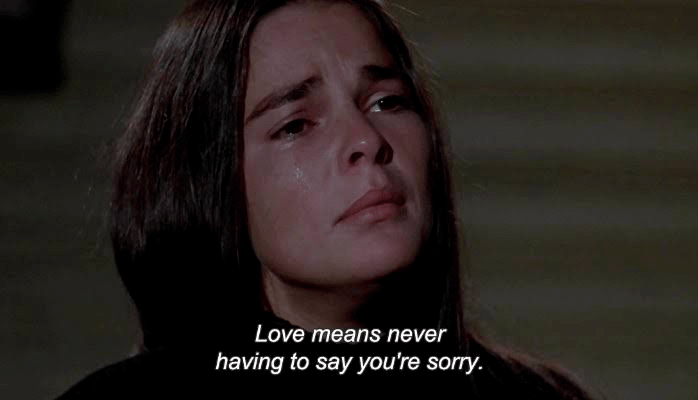
In Love Story, when Ali McGraw says, “Love means never having to say you’re sorry,” she offers a sentiment that I find deeply flawed. For me, love does mean saying you’re sorry – and often. When you care about someone, and your actions cause them pain, that pain becomes even more significant because of the love between you. It’s precisely why acknowledging that hurt and apologising is so crucial.

Consider a situation where you’ve made plans with someone. You’re delayed for reasons beyond your control, and by the time you arrive, they’ve been waiting for you – possibly having made all the necessary preparations and feeling excited to see you. When you finally get there, instead of offering an apology, you brush off the delay because it wasn’t your fault. You expect the other person to simply understand that external factors were to blame. However, this kind of thinking overlooks the other person’s feelings. Even though the delay wasn’t deliberate, the other person has still been affected by it.

This is the key issue: it’s not always about fault or blame. When we love someone, we need to consider how our actions, even if unintended, impact them. Love isn’t just about being right; it’s about understanding and acknowledging the other person’s emotional experience. Skipping the apology sends a message that their feelings don’t matter – that their hurt is irrelevant. It builds quiet resentment, and over time, this neglect can lead to the erosion of a relationship.

Add to this the fact that even when we know each other very well, there are always moments when we unintentionally hurt those we love. It might be something as simple as not being able to be quiet when your partner needs rest. If one person is disturbed and unable to sleep, it may be because the other finds it hard to stay quiet. Now, the person who has been disturbed could easily think, “Why can’t you just be quieter when I need it?” But instead of expecting that understanding, love should prompt the person who caused the disturbance to acknowledge it and apologise. That’s what love is about: trying your best to ensure the other person’s comfort. And if you can’t meet their needs in that moment, then at least show you recognise that by saying sorry.

The failure to apologise, to simply assume the other person should understand, misses the point of love’s emotional exchange. In fact, I believe this is why many relationships struggle. We often excuse ourselves, thinking that external circumstances, or aspects of our personality, excuse the hurt we’ve caused. But we forget that the hurt is real, regardless of fault. The key is to acknowledge it – to take responsibility for the emotional consequences of our actions, even if those actions were beyond our control.

Returning to Love Story, it’s worth noting that the idea of “never having to say you’re sorry” can also be seen as a reflection of patriarchy. When Ali McGraw’s character says this to Ryan O’Neal, she’s essentially excusing him from taking responsibility for her feelings, giving him a pass simply because they’re in love. But that’s not how love should work. When you love someone, you should be even more motivated to show that you never want to hurt them – and that if you do, you’re sorry for it, even if you didn’t mean to cause the pain.

At its core, love is about effort – about trying your best to make the other person comfortable, happy, and valued. When you can’t achieve that, an apology is the least you can offer. It’s not just about taking blame; it’s about showing empathy, understanding, and a desire to make things right.

Ultimately, love means always being willing to say you’re sorry when your actions, however unintentional, hurt the person you care about. An apology is not about blame or fault. It’s about recognising the emotional weight that love carries and showing that the other person’s feelings matter. After all, love is what makes those apologies – those simple acknowledgments of shared vulnerability – so necessary.

Luck

When I reflect on my life, I often hear people telling me, “You are so lucky.” A recent conversation with a friend brought this to the forefront when I shared my journey—coming out to my mom at 16 and to the rest of the family by 19, eventually gaining their acceptance. His response, “you are so lucky,” struck a familiar chord. But each time I hear it, I can’t help but feel a bit uneasy. It’s not that I don’t appreciate their sentiment; it’s just that I don’t see my path as a matter of luck.

I once heard Oprah say something that resonates with me deeply: it’s not luck that places us where we are, but the choices we make… way before Albus Dumbledore said it. And I couldn’t agree more. My decision to come out wasn’t a matter of fortune. It was an active, conscious choice made from a place of certainty about who I am. I was, and still am, absolutely sure of my sexuality. It is an irrefutable part of my existence. When I came out to people, I made it clear that this is who I am, and there would be no argument or debate about it.

Luck didn’t play a role in those moments; courage did. Courage, as C.S. Lewis wrote, “is not simply one of the virtues, but the form of every virtue at the testing point.” Coming out required that kind of courage—the courage to be unapologetically myself, even at the risk of rejection. I didn’t present my sexuality as a negotiable part of me, but as a fundamental truth. As Mark Twain once remarked, “Courage is resistance to fear, mastery of fear—not absence of fear.”

Yet, despite this courage, I rarely take credit for what I’ve achieved. I’ve often compared myself to others, feeling I fall short in the shadow of their accomplishments. But when I look back on my own life, I see that my journey, my milestones, have been remarkable in their own right. My family’s acceptance wasn’t a matter of luck; it was a result of my unwavering stance. I gave them no choice but to accept me as I am. And if they didn’t, I was ready to move on without them. It was simple, and they recognized that strength.

As Ralph Waldo Emerson wisely noted, “The only person you are destined to become is the person you decide to be.” I decided to live authentically, and the world had no option but to accept it. I don’t stand for mere tolerance, because tolerance, to me, is just a polite way of saying, “We don’t like you, but we’ll put up with you.” That’s not the life I want. I want to be accepted wholly, and if that’s not possible, then I’ll move on.

So, what is luck to me? It’s a fleeting concept, a brush of serendipity that might bring someone into your life. But beyond that, luck holds no lasting power. People come and go despite your best efforts. The truth is, I don’t attribute my journey to luck. Instead, I credit my honesty with myself and others. As Seneca once said, “Luck is what happens when preparation meets opportunity.” In my case, preparation took the form of self-awareness, honesty, and courage. I choose to live according to who I am, and that is the only role I play in this life.

Ultimately, the notion of luck feels like a disservice to the courage it takes to live authentically. For me, it’s about ownership of who I am and the choices I make. Those choices—not luck—are what shape my life and define my future.

The Ambition of Love

Be careful how much you tolerate, because you are teaching others how to treat you. I learned this lesson the hard way. I’ve been giving of myself for as long as I can remember. I came from a broken home where my father was abusive, and this fostered an inferiority complex early on. This feeling of inadequacy grew into an overpowering need to be loved, especially by men. It suppressed my will to shine.

I am talented. I speak well, I write well. I used to paint and still sketch occasionally. I’m a good photographer, with a keen eye for style. People often come to me for fashion advice. I can orate. I am intelligent— and I am aware of how rare a quality that truly is. I am courageous. I’ve stood up to bullies, for as long as I can remember. I am a survivor, enduring my father’s regular abuse from the age of 13 to 19. I never show that I’m scared, even when I’m in the midst of an anxiety attack. Despite knowing I didn’t have to hide my fear, I did.

I haven’t succumbed to depression, though I came close. At 21, I was on the verge of taking my own life but stopped myself, realising that life isn’t just about one experience, one decision, or even today. I came out to my mum at 16, and by 19, my whole family knew. I was out and proud.

Human relationships became paramount in my life, and I placed a high value on abstractions like love and fidelity. I looked down on those who struggled with the pursuit of material ambition. I used to dismiss their drive for money, believing it paled in comparison to the importance of human connection. During my studies in English literature, I came across the famous lines in Paradise Lost, where Lucifer (Satan) declares in defiance:

“Better to reign in Hell, than serve in Heaven.”

This quote, from Book I, reflects Satan’s refusal to submit to God’s authority and his preference for ruling over his own domain, even if it meant enduring eternal damnation. His ambition and desire for power were central to his rebellion.

Over time, however, I stopped believing in God. I began to read what various religions had to say about ambition, because I was free from the tethering to one. Most theologies encourage ambition, but only when it’s rooted in moral, spiritual, or altruistic goals—serving others, improving oneself, or seeking knowledge. And, unchecked or self-centred ambition—linked to pride, greed, or ego—is frequently seen as a source of suffering, spiritual downfall, or ethical corruption. A balance of ambition with humility, selflessness, and alignment with higher principles is a common thread across these belief systems.

While ambition in both material and relational spheres can be noble, it is still bound by human limitations. No matter how altruistic the goal, human fallibility—whether one’s own or others’—can lead to suffering. The pursuit of meaningful relationships, like any other ambition, sometimes results in disillusionment.

This realisation led me to further reflection. If both material and relational pursuits are prone to failure, what remains? Perhaps this hints at the need for a broader acceptance of impermanence, acknowledging that all human endeavours—whether rooted in religion, ambition, or love—are inherently transient. The sense of abjection I’ve experienced after nearly 50 years of human interaction points towards the same fundamental truth found in spiritual teachings: that suffering arises from attachment. This time, however, the attachment wasn’t to material gain but to relationships themselves.

In this sense, the ideology I have developed may be evolving towards a philosophy where the emphasis is not just on ambition or relationships but on a broader equanimity. The wisdom lies in accepting that ambition—whether spiritual or secular, whether tied to relationships or success—is part of the human experience, but it is not its endpoint. Life’s impermanence flows through everything we pursue, and the challenge is to navigate ambition and relationships with care, knowing they too are temporary.

The trajectory of my life shifted from religious ambition to the pursuit of human connection, only to discover that even these relationships, which I once saw as the ultimate goal, are susceptible to profound loss. This ideology grapples with the limits of ambition in any form—religious or secular. The ultimate challenge seems to be finding peace in the space between striving and letting go. While the ambition to cultivate relationships is meaningful, it must also come with the understanding that even the best connections can be lost.

In the end, it is only the self that can truly be relied upon. Even though we need wider sustenance—whether in the form of money or love from the outside world—what we fold into ourselves remains ours. This, perhaps, is what I’ve learned. There is no right or wrong way to live. In the end, everything crashes and burns, only to build up again. And that’s life.