
Sabar Bonde

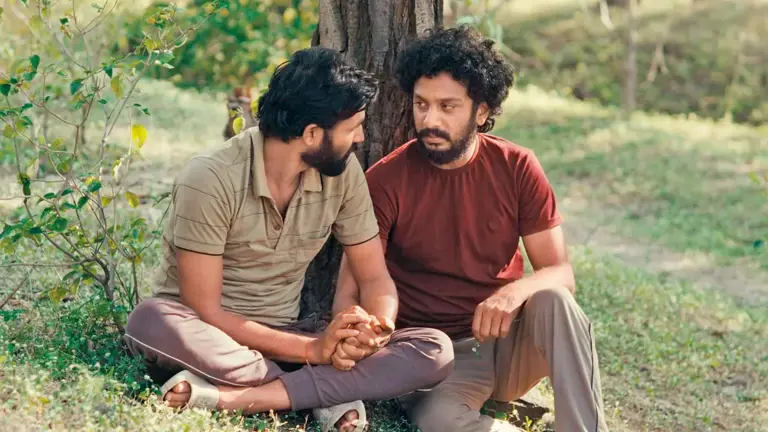
I watched Sabar Bonda at its 4:20 show at PVR Andheri — an experience that turned out to be more than just cinema, but a mirror. What most gay men go through, irrespective of class. A simple thing like a parent being worried about the future of his gay son. 

It began with death. A father passes away, and rituals immediately take over: what to wear, what to eat, how to mourn, what to suppress. That opening sequence pierced me deeply because my bua — whose birthday coincidentally fell on the day of my viewing — was like a father to me. The grief, the weight of conduct, and the demands of tradition all struck a profoundly personal chord.

What makes Sabar Bonda so powerful is that the protest it mounts is whisper-quiet. It doesn’t erupt in melodrama; it lingers in what society insists upon — in colour, rules, and ritual. A grey shirt Anand is told to change. Much like how people ask us to change, to convert. The slippers he wears – bringing comfort to his feet – but only in the company of his lover, because ritual forbids it. The shadows of who he is, pressed against the mould of what he’s “supposed” to be. The film reveals itself in the texture of small moments: Balya’s gift of cactus pears, the shared silences, the tension between city and village, heartbreak and love, grief and continuity.

Anand’s mother is the film’s moral and emotional backbone. She loves, supports, and resists in her own way. His father’s eventual acceptance, Balya’s steady care, and the hesitancy threaded through each character are rendered human. There is no villain here — only systems and traditions, and people trying to navigate them quietly.

Critics have largely echoed these impressions. Moneycontrol calls it “a gentle story of grief, memory, and love told with quiet honesty. It lingers in the silences and small moments …” Times of India writes: “to enjoy the sweet taste of cactus pears, you must first carefully remove the sharp spines from the skin of the fruit … meant to be savoured exactly like that.” That metaphor mirrors the story’s truth — love, identity, and acceptance are like a fruit you crave, but you must first tend to the pain. Indian Express highlights the film’s visual poetics: the still camera, wide frames, and static gaze that holds ritual, grief, and distance until intimacy seeps in. Hindustan Times calls it “a tender, deeply moving study of queer love in one of the year’s best films,” noting how customs, everyday pressures, and quiet longing are handled with exquisite precision.

Where my own experience diverges is in how deeply the symbols resonated. The cactus pear, unlike the peach in Call Me By Your Name, isn’t about erotic awareness, but about care, concern, and tenderness — love that is rare, difficult to find, but sustaining. The rituals aren’t simply a backdrop; they are choreography, dictating what must and must not be done. Anand’s protest is not loud — it is embodied in small refusals, in gifts, in a silent embrace.

Long after leaving the theatre, certain truths lingered. Rituals and rules aren’t just external constraints; they are the inner architecture Anand must resist and reshape. The sensory texture — touch, clothing, light, the sound of goats, footsteps, and fields — builds an emotional world as vivid as any dialogue. There is the courage of saying no to what one is “meant” to be, and yes to a hidden version of self. And there is the way family, particularly the mother, becomes both an anchor of tradition and a wellspring of possibility.

Some critics have noted the film’s pace is slow. I felt that too — but its slowness isn’t a flaw. It forces us to sit with grief, longing, and ritual as the characters themselves must. It may not satisfy those expecting dramatic peaks, but its reward is in its lingering — in the way it teaches us to notice what we otherwise overlook.

The caresses are felt through the screen. The running of hands in the hair. The embrace to ward off the cold. The closeness found at last in the privacy of the city. They permeate through the screen and fall into your hands and heart. The emotion there becomes visceral and that’s what makes the movie brilliant – it’s like reading a book, you are pulled into deeper nuance and feeling.

Sabar Bonda doesn’t shout its declarations. It doesn’t need to. Instead, it builds a space where grief, yearning, and identity coexist in fragile balance, where society’s insistence collides with the quiet affirmations of love and humanity. It reminds us that love can be radical, even when soft. That rituals can suffocate as much as they anchor. That resistance doesn’t always roar — sometimes it whispers, gently, persistently, and all the more powerfully.

If I were to give it a frame, I’d say: Sabar Bonda is a film of small revolutions. It doesn’t overthrow. It loosens. And in that loosening lies its beauty — because it allows tenderness the room to breathe.

Am I Gay Enough? The Side Debate and the Pressures of Conformity

I’ve been in a loving gay relationship for 25 years. I’ve been attracted to men for as long as I can remember—my first love was Superman when I was five. Yet, here I am, still having to defend my sexuality because I identify as a side. Apparently, for some, that disqualifies me from being “properly” gay. It’s absurd, but it’s also revealing. It shows how much pressure we, as gay men, place on each other to conform—not just to straight norms, but to the rigid sexual roles we’ve constructed within our own community.

Growing up, I knew that straight people expected me to conform to their world. They wanted me to be straight, to marry a woman, to have kids, to blend in. And when that failed, they at least wanted me to be the right kind of gay—either the tragic figure hiding in the closet or the overly sexualised stereotype. But what I didn’t expect was that, even after coming out, I’d have to deal with a different kind of policing—from my own people.

At some point, gay men started mimicking the worst aspects of straight culture, forcing labels on each other: top, bottom, versatile. As if our entire existence boils down to what we do in bed. It’s ironic—our community has fought against being reduced to just sex, yet we’ve turned around and done the same to ourselves. If you don’t fit into these roles, you’re treated as an anomaly, an incomplete gay man. Before I even knew what “side” meant, guys used to tell me I was into “body sex,” and I suppose that’s what they meant—that I preferred intimacy without penetration. But instead of that being just another way to be, it became something that needed justification.

When I first read the Huffington Post article in 2013 about sides, it was a revelation. Until then, I had internalised the idea that maybe I was broken, that I was missing some essential “gay” experience. Because that’s the message that gets drilled into us—not just from straight people but from within the LGBTQ+ community itself. The idea that real sex has to include penetration, that masculinity is tied to what you do in bed, that the spectrum of gay relationships has to mimic the dynamics of straight ones. And if you don’t fit in? You’re sidelined. (Pun fully intended.)

It’s exhausting to navigate a world where both straight and gay people are telling you how to be. Straight society pressures us to assimilate, while gay culture tells us to conform in a different way—be masc, be a top, be a bottom, fit into a category. If you’re anything outside of that, you’re made to feel less valid, less desirable, even less gay. It’s ridiculous. My 25-year relationship with a man, my lifelong attraction to men, my love, my desire—those define my sexuality. Not some arbitrary checklist of sexual acts.

The truth is, being gay isn’t about what you do in bed. It never was. It’s about who you love, who you desire, who you build a life with. And no one—not straight people, not other gay men—gets to tell you that you’re not gay enough.

Relationships

In a conversation among friends at a recent gathering, the topic of relationships took center stage. As part of the LGBTQ+ community, we discussed the many ways in which we experience and interpret love and partnership. One particular theme that stood out was the diversity of relationships—ranging from monogamous to polyamorous, open, and asexual arrangements. This led me to reflect on how, historically and presently, human relationships are not one-size-fits-all, nor should they be. For those of us in the LGBTQ+ community, embracing relationship models outside heteronormative boundaries isn’t just personal; it’s also a form of resilience, autonomy, and freedom.

Historically, relationships have evolved alongside societal norms, yet they’ve rarely been as rigid as we might think. As sociologist Anthony Giddens has noted, “intimacy has undergone a transformation from an institutionally defined marriage model to a more personalized form of intimacy based on the principles of equality and self-realization.” This shift is particularly visible today, especially in LGBTQ+ circles, where relationships naturally push against traditional molds and emphasize diversity in partnership structures. However, embracing this fluidity doesn’t mean our relationships lack structure or purpose; rather, it underscores the power of choice and authenticity.

Polyamory, or the practice of engaging in multiple consensual and loving relationships, is one such model that challenges monogamy. Unlike traditional relationships, polyamory centers around the idea that love is not a limited resource. It requires, perhaps more than monogamy, deep levels of communication, respect, and honesty. In polyamorous relationships, all partners are aware of each other, and boundaries are established to maintain emotional wellbeing.

In mainstream society, polyamory is gaining attention. According to a 2020 study by Kinsey Institute researcher Dr. Justin Lehmiller, around 1 in 5 Americans have engaged in consensual non-monogamy at some point in their lives. This statistic reflects a growing acceptance and curiosity about alternative relationship models. Despite this, polyamory is often judged through a monogamous lens, which can make it difficult for those in polyamorous relationships to feel fully accepted. Many in the LGBTQ+ community have embraced polyamory as a means of finding and expressing love in ways that feel authentic, acknowledging that relationships are not confined to the binary of monogamy or celibacy.

For LGBTQ+ individuals, the added layer of heteronormative expectations can create significant pressure to conform to “acceptable” forms of relationships. Heteronormative models tend to uphold monogamy as the ideal and imply that any deviation from this structure is a threat to stability. However, as LGBTQ+ relationships inherently defy heteronormative standards, the community often explores diverse arrangements that align with individual values and lifestyles.

This diversity in relationships is vital to personal freedom, as sociologist John D’Emilio argued: “The capacity to choose and form intimate bonds according to individual desires…is a victory against the social script imposed by dominant norms.” This capacity is particularly empowering within the LGBTQ+ community, where members often need to carve out new paths to love and partnership due to a lack of societal role models that represent them.

Yet, as our discussion highlighted, the tendency to compare LGBTQ+ relationships to straight, monogamous relationships remains prevalent. This comparison can create an unnecessary hierarchy of relationships, implying that monogamous, heterosexual partnerships are the gold standard. Such comparisons are misguided because relationships, whether between heterosexual or same-sex couples, are deeply personal and shaped by individual personalities, lifestyles, and needs. Straight relationships themselves are varied, encompassing everything from strictly monogamous marriages to open marriages, indicating that diversity in relationship structure is not unique to the LGBTQ+ community.

The recognition that relationships differ fundamentally within human spheres emphasizes a central point: there is no universal “correct” way to engage in a relationship. We must resist the urge to place relationship structures on a hierarchy, particularly as doing so can invalidate or marginalize the choices of those who do not fit the mold. As philosopher Michel Foucault famously said, “where there is power, there is resistance,” and the diversity of relationships within the LGBTQ+ community reflects a resistance to the power of societal norms.

The world today is shifting toward a more inclusive understanding of relationships. From growing visibility of polyamorous and open relationships to legal recognition of non-traditional unions, society is gradually moving toward a broader acceptance of varied relationship forms. Still, a long road lies ahead in terms of full acceptance. This journey, however, begins with understanding and respect for each individual’s relationship choices.

In essence, relationships are as varied as the individuals who create them. The LGBTQ+ community, with its unique perspectives on love and partnership, offers a vibrant example of how diverse, autonomous relationships can thrive. Embracing these differences enriches our understanding of human connection and reminds us that love is boundless—transcending labels, societal norms, and any one-size-fits-all standard. In doing so, we affirm that all relationships, regardless of structure, hold their own beauty, dignity, and worth.