My Family’s Faith

In my family, religion has never been a matter of compulsion, inheritance, or rigid tradition. It has been a deeply personal and often private path—respected, explored, questioned, and above all, lived with empathy. We are a family not bound by sameness, but knitted together by love, resilience, and the shared grace of accepting each other as we are.

The generation before mine taught me this without ever having to explain it in so many words. My mother, a Parsi woman, met and fell in love with my father, a Sikh man. Their union was not seen kindly by many in her community, and she was shunned—albeit briefly—before her parents came around and welcomed her back. That moment of reconciliation, to me, holds more spiritual weight than any sermon could offer.

On my father’s side, every sibling followed their own truth, and none bowed to the pressures of uniformity. My eldest paternal aunt married a Maharashtrian Hindu man with four children. She chose not to have biological children of her own because she wished to raise his as hers. She did so with grace and devotion, speaking fluent Marathi, transforming his household into a space of warmth. He passed away just five years into their marriage, at a time when they were only beginning to build something tender and lasting.

My second paternal aunt married a Gujarati man with children from a previous marriage, and once again, she made the choice not to bear children, instead pouring her love into me and my sister. She was more of a father to us than our own, who fell into alcoholism not long after I was born.

My paternal uncle married an American Catholic woman—an intercultural and intercontinental union—though the marriage did not last. Yet she was known to all of us, accepted fully during the time she was part of our family.

On my mother’s side, the inter-faith marriage she entered into was a rarity. Her siblings all married within the Parsi fold. But then came the next generation: my cousin Natasha, the daughter of my maternal aunt, married a Malayali Catholic. No one raised an eyebrow. It was accepted as natural—as it should be.

My own sister married a Kashmiri Pandit. Other cousins married Catholics, Gujaratis, Hindus—no one seemed to view these marriages as transgressions. To us, they were unions of love, not religious negotiations.

As for me—I have loved a Hindu man. I have loved a Muslim man. I have loved a Danish Christian. And I am an atheist. The irony is not lost on me. But I don’t find contradiction here. I find cohesion. I do not reject belief systems—I observe, absorb, appreciate, and honour what others hold dear. In many ways, that is my faith: the sanctity of personal belief, whether present or absent.

Recently, I had a conversation with an acquaintance about this tapestry of interfaith relationships in my family. His response stunned me. He said something to the effect that such a thing would never be allowed in his family. And worse, he spoke with a tone of disdain—almost pity. For the first time in a long while, I was made to question whether what I had always considered a strength—this lived secularism, this openness—could be seen as a flaw.

It shook me. For a fleeting moment, I felt dislodged from my own certainty, my own probable pride in coming from a family that embraced diversity as if it were the most natural thing. But I recovered that sense quickly. Because what he dismissed is, in truth, what I hold dearest: a family that opens its doors wide, where beliefs may differ but love remains constant.

As a child, I was educated in a convent school. I learnt Catholic prayers. My paternal grandmother taught me Sikh prayers. My mother still prays every Friday—a habit I have inherited in spirit if not in ritual. From friends and relatives, I’ve picked up Hindu customs, observed Jain decorum, joined in Eid celebrations, decorated the tree each Christmas, danced in the colours of Holi, and set up Pooja rituals during Diwali. I celebrate Ganesh Chaturthi, Bhau Beej, Rakhi, Dussehra, and Navratri. Every festival that holds meaning for someone I love, holds meaning for me too.

As I see it, religion is not a divide. It is an offering—one that can be accepted with grace, even if not practiced. Love is the force that ties all these practices together. Belief is not a boundary but a bridge.

“All differences in this world are of degree, and not of kind, because oneness is the secret of everything.”

— Swami Vivekananda

My upbringing has taught me that India is not one story. It is a grand, complex novel—interwoven with hundreds of narratives, dialects, faiths, food traditions, music, prayers, and paths. It is not unity through sameness. It is unity through difference.

And for those who reject that difference, who turn away from the beauty of co-existence, I can only feel sadness. Because they are missing out—not just on festivals, or food, or languages—but on the rich, life-changing encounters that can shape a soul.

I may be an atheist, but I believe—deeply, fervently—in the sanctity of human connection. And perhaps that is the greatest faith of all.
The Fellowship of Fantasy

Today, I was made to feel bad about the fact that I wasn’t adult enough, by a dear, old friend, who is a mentor to me, as well. On the whole, it began with his trip to New Zealand and how he visited all those places that I would love to have seen: Hobbiton, Matamata, the Old Mill, Bag End, SamWise Gamgee’s hobbit home, with the yellow door, Weta Works, etc. Of course, he visited all those places and I didn’t, even though I would have enjoyed them far more than he ever could, for the simple reason that he isn’t a Tolkien book or movie fan, whereas I am all things nerdy, when it comes to Middle-earth.

He gifted me the vinyl figures of Gandalf and Saruman and I loved them so much that I thought of getting the Fellowship. My aunt who was sitting beside me offered to get them for me as gifts and so I went ahead and ordered them online. My partner mentioned this to my friend who wrote to me, later on, during the evening, and chastised me for not saving money and splurging it on unnecessary things.

I understand where he is coming from, of course. I am 44 years old and I save only as much as is required with no great thought about the future and the terrors it could bring. Unbeknownst to him though, I have tackled worst case scenarios in my lifetime and I don’t believe they hardened me enough to let go of the child in me. I have faced the impact of great diseases, taken care of loved ones who have survived them, have also cared for and lost to death those who couldn’t. Childhood was kind and I was loved but my teen years impacted me with the abuse of a father and the torment of being ridiculed for my sexuality. Irrespective, I did well for myself academically and I fixated on happy endings in the books I read and in the movies I watched.

I became a people person, when I grew seemingly confident about myself. I was betrayed in love, I was cast away, I was lost. I lose myself often, when reality strikes with a bludgeoning. But I always find myself, though I was chipped and have lost faith in the existence of gods. I take heart in what they stand for as I battled to see the good in life. Irrespective of the fact that I saw very little of it, I tried to be the good I wanted to see in others. I retained the honest streak I grew up with and still clung to happy endings. As the real got difficult, I clung to the fantastical and saw this as a means to deal with existential truths.

When I see Frodo losing his sanity at the edge of Mount Doom, I revel in the tenacity of SamWise as he rallies forth. I cry when I share Harry’s despair as he realizes he must be sacrificed to shatter a Horcrux – I walked the walk to the Forbidden Forest right alongside him. When Superman flies, I do not see just his indomitable strength of muscle, I take heart in the idea of all that he stands for. At the age of five, Clark Kent taught me to love, to be kind to animals, to take heart in the fact that negativity cannot survive in the end. And apart from the fantastical, a shipwrecked boy finds hope and solace in an Arabian Stallion, he calls Black … it could sustain me a lifetime of memory and faith. Anne of Green Gables assures me that tomorrow has no mistakes in it – yet.

So, I cling to this notion – and if one chooses to call it a fantasy, so be it. I am not sad for being called a child, or of that I am assured of the probability that the future is a bleak prospect. I am crestfallen because growing up is equated with becoming wiser, and that turning a certain age implies that all of childhood is negated. All the lessons I learned from childhood weren’t centered around life being grim and bleak… most of the lessons came from a place where Sith lords ruled the world and then through sheer dent of will and determination, the Jedis cast them down. I go back to the thought of another real life super hero when he enunciates, “When I despair, I remember that all through history the way of truth and love have always won. There have been tyrants and murderers, and for a time, they can seem invincible, but in the end, they always fall. Think of it – always.”

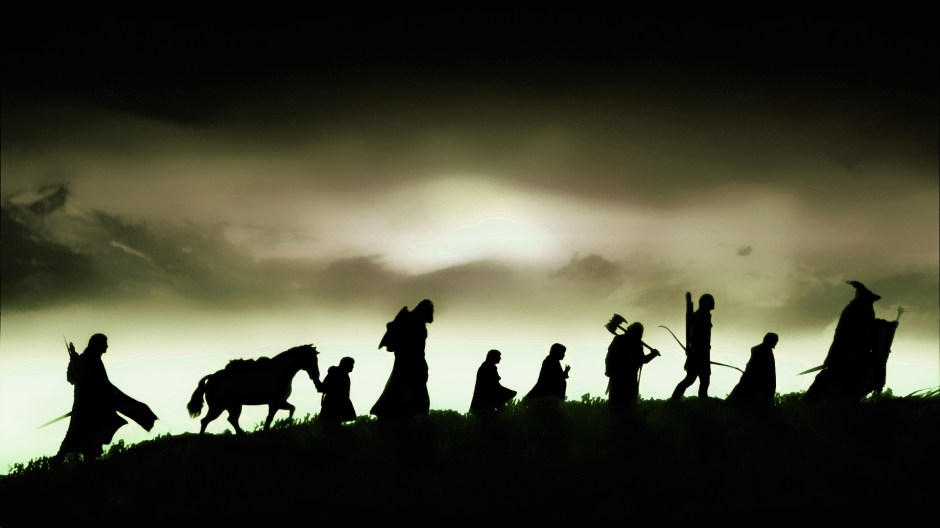
So, I order the vinyl figures of Gandalf, Frodo, Sam, Aragorn, Merry, Pippin, Boromir, Legolas and Gimli, to remind me that matters of personal strife, prejudice, envy, greed, error can be overcome with hope, love, faith and determination. As I see them, I will think of the fact that there are people who care about me, who lift me up in my sorrow and guide me towards a future that no one can truly comprehend. Like Gandalf, one can fall and rise; like Gimli and Legolas, one can overcome prejudice; like Sam, one can be steadfast and honourable; like Merry and Pippin, one can relish the child and still be an adult; like Boromir, one can overcome insecurity and fear; and, like Frodo, deal with immeasurable burdens of the heart and soul and eventually be uplifted.

Spoiler

The thing about life is that no matter how honest you want to get with it, it always wants a show. Something sensational! Something that will make others go, oh, really! How terrible! Or, really, how incredible! When you want to live your life according to the honest, and being truthful and wish to live your life according to your own terms, you can do so – but two conclusions happen. One where the world decides that you cannot be trifled with and so leaves you to their own devices. Two, where the world pretends to assume that it was not you who helped with the creation of your life but everyone around you made who you are and so credit should never come to you.

When I was young, I was bullied, ridiculed and beaten. Society – from my father to my friends – tried to make me behave in a certain way. If I didn’t, I was beaten, thanks to my father, or I was left, like countless friends and lovers. If I came out, it was because I had a fantastic support structure. If I stood up against bullies, it was because my father toughened me up. If I decided I would leave my family if they didn’t accept my sexuality, and they did accept me, it was because I had a fantastic, understanding family. If I was cheated on by my lover of thirteen years, and opened up my relationship so that I could participate in a new world view, my lover was broad-minded enough to accept this change. If my mother left my father, after he nearly strangled me to death, she was brave enough to do so.

I sound petulant now, don’t I?

No.

In this day and age, I have realized one thing. I have made me who I am. I have been broken. I have been torn apart. I have been beaten. Literally. And I have made it through. I have lived my life on my terms. I have decided that the path of honesty is something I want to walk on, irrespective of what and who I might lose. I have been true to every single value that I took up and I have never shirked my responsibilities. I have been through shit, of course, there is this concept of whose shit is more difficult, harder, crueler… but we are not comparing.

I remember a dialogue from Ally McBeal. Georgia goes, “Ally, why are your problems bigger than the rest of ours?” And Ally replies, “Because they are mine.” However, that is not even the issue I am trying to bring about. I am not complaining about the problems I have faced. I am not even complaining about the acknowledgement that goes elsewhere. I am just asking for some honesty. If you don’t wish to listen to me, do not. Do not, however, make the pretence of listening and then realizing I don’t make good matter, because I am unbreakable.

We all want good drama. But I realise I am now a spoiler. I am the ending that is sure. The path already taken. And as I write this down, I realise that if that is so, I should also know that people in general are flawed, like me, and prefer the journey while the destination is unknown. I on the other hand, am comfortable where I am because I know the destination and the journey are all a part of drama any way.