Peter

I have Peter Pan tattooed on my arm. Let me tell you why he means so much to me, and what he really stands for — not just in stories, but in the way writers and thinkers understand childhood itself.

When I was young, I didn’t get the soft, safe childhood that many children do. Life pushed me to grow up quickly, to understand things too early, and to protect myself in ways a child shouldn’t have to. But somewhere inside me, there was still a tiny spark that refused to die — a spark of imagination, wonder, humour, hope. That little spark kept me alive, and in many ways, Peter Pan represents that part of me.

Most people think Peter Pan is just a boy who refuses to grow up. But his name comes from the ancient Greek god Pan — the wild spirit of nature.

Pan wasn’t gentle or civilised. He was half-human, half-goat, with horns, hooves, and an erect phallus, which represented nature’s raw life-force. He was joyful and frightening, beautiful and wild, playful and powerful. He stood for the part of the world that adults try to tame but never truly can.

E. M. Forster wrote a story called The Story of a Panic, where Pan appears not as a monster but as a force of pure, natural joy. The adults in the story are terrified of him because they’ve forgotten what it feels like to be free. But the boy who feels Pan’s presence becomes alive in a way the grown-ups can’t understand.

Peter Pan is exactly that kind of spirit.

He is childhood in its raw, untamed form — full of imagination, wildness, fearlessness, and joy. The kind of childhood that today’s world has almost forgotten.

And that brings me to another writer: William Blake.

Blake wrote two famous collections of poems — Songs of Innocence and Songs of Experience.

In the Songs of Innocence, he spoke about childhood as a sacred, magical time — a world full of wonder, trust, and imagination.

In the Songs of Experience, he showed how the world crushes that innocence — with fear, cruelty, knowledge that comes too early, and responsibilities a child shouldn’t carry.

Even in Blake’s time, adults worried that children were losing innocence too quickly.

Today, it’s even worse. Children know everything too soon — violence, death, betrayals, cruelty, adult worries long before they’re ready. There’s no time to dream. No time to play. No time to believe in magic.

And that is why Peter Pan matters to me.

Peter represents the child inside us who refuses to let the world take away its light.

He stands for the part of the human spirit Blake called “innocence” — not naïve, not foolish, but open-hearted and imaginative. The part that trusts, loves, laughs, and sees beauty.

In today’s world, people sometimes say Peter Pan is selfish or uncaring. They judge him by adult standards. They make Hook the hero and turn Peter into the villain. But that’s not how J. M. Barrie wrote him. Barrie loved Peter because Peter lived outside time, outside rules, outside the heaviness of adulthood. He wasn’t meant to behave like a grown-up — he was meant to represent the one thing adults can’t fully control: the spirit of childhood.

Peter forgets not because he is cruel, but because he lives in the eternal now.

He doesn’t understand time because no one ever protected him long enough to teach him.

He isn’t irresponsible — he is free.

And freedom, real freedom, scares adults who have forgotten how to dream.

That’s why I don’t agree with people who villainise Peter today. They see him from the perspective of experience, but forget the value of innocence.

Peter Pan is not a warning about immaturity.

He’s a reminder that even when life is difficult, we must protect the small, bright, imaginative part of ourselves.

The part that still believes in flying.

The part that still wants to explore forests and seas.

The part that hasn’t given up.

So when you see this tattoo, know that it isn’t about refusing to be an adult.

It’s about holding on to wonder.

Holding on to joy.

Holding on to innocence in a world that tries to steal it too fast.

It’s about remembering that the wild spark inside us — like Pan, like Peter, like Blake’s innocent child — deserves to live.

And that spark is what kept me alive.
Movies, Memory, Magic

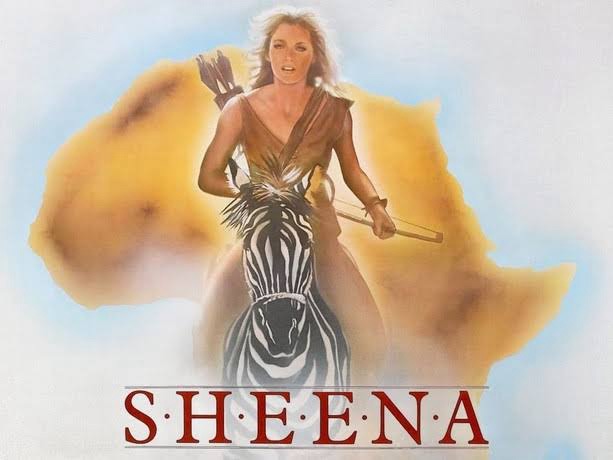
I was just browsing through some old eighties films—yes, even the cheeky ones—when a name suddenly flashed across my mind: Sheena. It’s funny how a single flicker of memory can transport you across decades, straight into the heart of your childhood. I found myself right back where I used to be at nine years old, sprawled in front of the television, eyes wide with wonder. Was that a female version of Tarzan, riding a zebra? Of course, it wasn’t a zebra, as I grew to find out. It was a horse painted with stripes. Poor thing, I think now, but back then – a whole different sense of wonder.

It was around that time I saw Anne of Green Gables for the first time—a story that nestled itself quietly but firmly into my imagination.

Those moments, those films, stayed with me. They’re not just entertainment; they are time capsules, gentle reminders of who I once was, and perhaps still am. Some people say memories make you look back in regret. I wouldn’t know—because without mine, I wouldn’t know who I am.

They shaped me. Moulded the values I still carry.

As a child, I believed in good things. Honour. Love. Trust. The quiet power of being a good human being. And sometimes, just sometimes, I wish I had never grown up. There was a kind of clarity in those days—a sense of wonder that made even the most ludicrous films feel profound. Looking back, I realise that even the silliest movies taught me something. They helped me connect with myself, define my likes and dislikes, and understand what moved me.

Growing up didn’t take that away. If anything, it deepened the meaning. But I often look over my shoulder at the younger me with a quiet smile—grateful for the dreams, the stories, and the belief that goodness mattered.

Because it still does.

Echoes

Lately, I find myself thinking back to my childhood—revisiting the past with a heart full of nostalgia, retracing the steps of a boy who once ran through the quiet lanes of Bandra. I remember those early mornings, the world bathed in golden sunlight, the short shrubs lined with tiny yellow flowers, and the delicate butterflies that flitted about, as if they were playing a game only they understood. There were four of us, my little gang of friends, always running, always laughing, revelling in the boundless joy that childhood so effortlessly bestows.

Perhaps I see it all now through rose-tinted glasses. Perhaps memory is kinder than reality was. But these moments are etched so deeply in my subconscious that they come back to me in vivid detail—the sunlight filtering through the trees, the movement of the butterflies, the thrill of being young and free.

Some memories stand out more than others. I can still see myself sitting in a classroom at St. Theresa’s High School. I don’t even remember which standard I was in, but I distinctly recall gazing out of the window and seeing the church steeples in the distance. A quiet moment of peace, a scene so simple yet so deeply comforting. Then there was the time I sat on my friend Virginia’s balcony, lost in thought, filled with anticipation for the day ahead—our trip to the beach. The sheer joy of that moment, the excitement of what was to come, is still so tangible in my mind.

And then there was my friend Sarvar’s house. He lived on the fifth floor, which, to me, felt like an extraordinary height. Having lived on the first floor all my life then, standing on his balcony and gazing out was an experience in itself. From there, I could see the TV tower at Worli, standing tall in the distance. In those days, Bandra had no high-rises, so the view was uninterrupted, stretching all the way to Worli. I can’t imagine that happening now—for any child to stand on a fifth-floor balcony and see as far as I did. The world has changed.

But then, doesn’t every generation say this? Doesn’t every generation look back with nostalgia, tinged with a quiet ache for what was? I understand now why memory is so important. It anchors us, reminds us of who we were, where we came from, and what once brought us joy.

Perhaps these thoughts have surfaced because my cousin sister has come to stay in Santa Cruz after a long time. She is the only member of my extended family whom I am still close to. I have lost so many over the years, and with her presence, old memories resurface, unbidden yet welcome. Every time I step out of my house, walking with the children through roads now choked with traffic, pollution, and relentless construction, I think back to a time when the sunlight touched the ground unfiltered, when the air was clean, when the fog in the mornings was not the result of smog but of nature’s own quiet magic—warm days, cool mornings, and nights filled with nothing but stillness.

I know I will never get those days back. Life moves on, things change, people leave. But memories remain. And in them, for a brief, beautiful moment, I can return to the lanes of my childhood, where the yellow butterflies still dance in the morning light.