
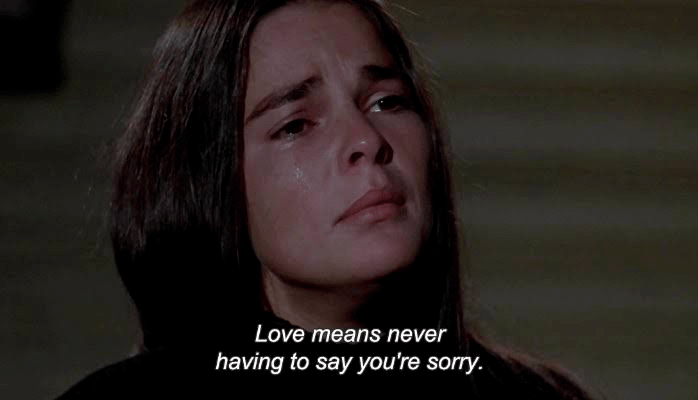
In Love Story, when Ali McGraw says, “Love means never having to say you’re sorry,” she offers a sentiment that I find deeply flawed. For me, love does mean saying you’re sorry – and often. When you care about someone, and your actions cause them pain, that pain becomes even more significant because of the love between you. It’s precisely why acknowledging that hurt and apologising is so crucial.
Consider a situation where you’ve made plans with someone. You’re delayed for reasons beyond your control, and by the time you arrive, they’ve been waiting for you – possibly having made all the necessary preparations and feeling excited to see you. When you finally get there, instead of offering an apology, you brush off the delay because it wasn’t your fault. You expect the other person to simply understand that external factors were to blame. However, this kind of thinking overlooks the other person’s feelings. Even though the delay wasn’t deliberate, the other person has still been affected by it.
This is the key issue: it’s not always about fault or blame. When we love someone, we need to consider how our actions, even if unintended, impact them. Love isn’t just about being right; it’s about understanding and acknowledging the other person’s emotional experience. Skipping the apology sends a message that their feelings don’t matter – that their hurt is irrelevant. It builds quiet resentment, and over time, this neglect can lead to the erosion of a relationship.
Add to this the fact that even when we know each other very well, there are always moments when we unintentionally hurt those we love. It might be something as simple as not being able to be quiet when your partner needs rest. If one person is disturbed and unable to sleep, it may be because the other finds it hard to stay quiet. Now, the person who has been disturbed could easily think, “Why can’t you just be quieter when I need it?” But instead of expecting that understanding, love should prompt the person who caused the disturbance to acknowledge it and apologise. That’s what love is about: trying your best to ensure the other person’s comfort. And if you can’t meet their needs in that moment, then at least show you recognise that by saying sorry.
The failure to apologise, to simply assume the other person should understand, misses the point of love’s emotional exchange. In fact, I believe this is why many relationships struggle. We often excuse ourselves, thinking that external circumstances, or aspects of our personality, excuse the hurt we’ve caused. But we forget that the hurt is real, regardless of fault. The key is to acknowledge it – to take responsibility for the emotional consequences of our actions, even if those actions were beyond our control.
Returning to Love Story, it’s worth noting that the idea of “never having to say you’re sorry” can also be seen as a reflection of patriarchy. When Ali McGraw’s character says this to Ryan O’Neal, she’s essentially excusing him from taking responsibility for her feelings, giving him a pass simply because they’re in love. But that’s not how love should work. When you love someone, you should be even more motivated to show that you never want to hurt them – and that if you do, you’re sorry for it, even if you didn’t mean to cause the pain.
At its core, love is about effort – about trying your best to make the other person comfortable, happy, and valued. When you can’t achieve that, an apology is the least you can offer. It’s not just about taking blame; it’s about showing empathy, understanding, and a desire to make things right.
Ultimately, love means always being willing to say you’re sorry when your actions, however unintentional, hurt the person you care about. An apology is not about blame or fault. It’s about recognising the emotional weight that love carries and showing that the other person’s feelings matter. After all, love is what makes those apologies – those simple acknowledgments of shared vulnerability – so necessary.
 Hearts Still Care