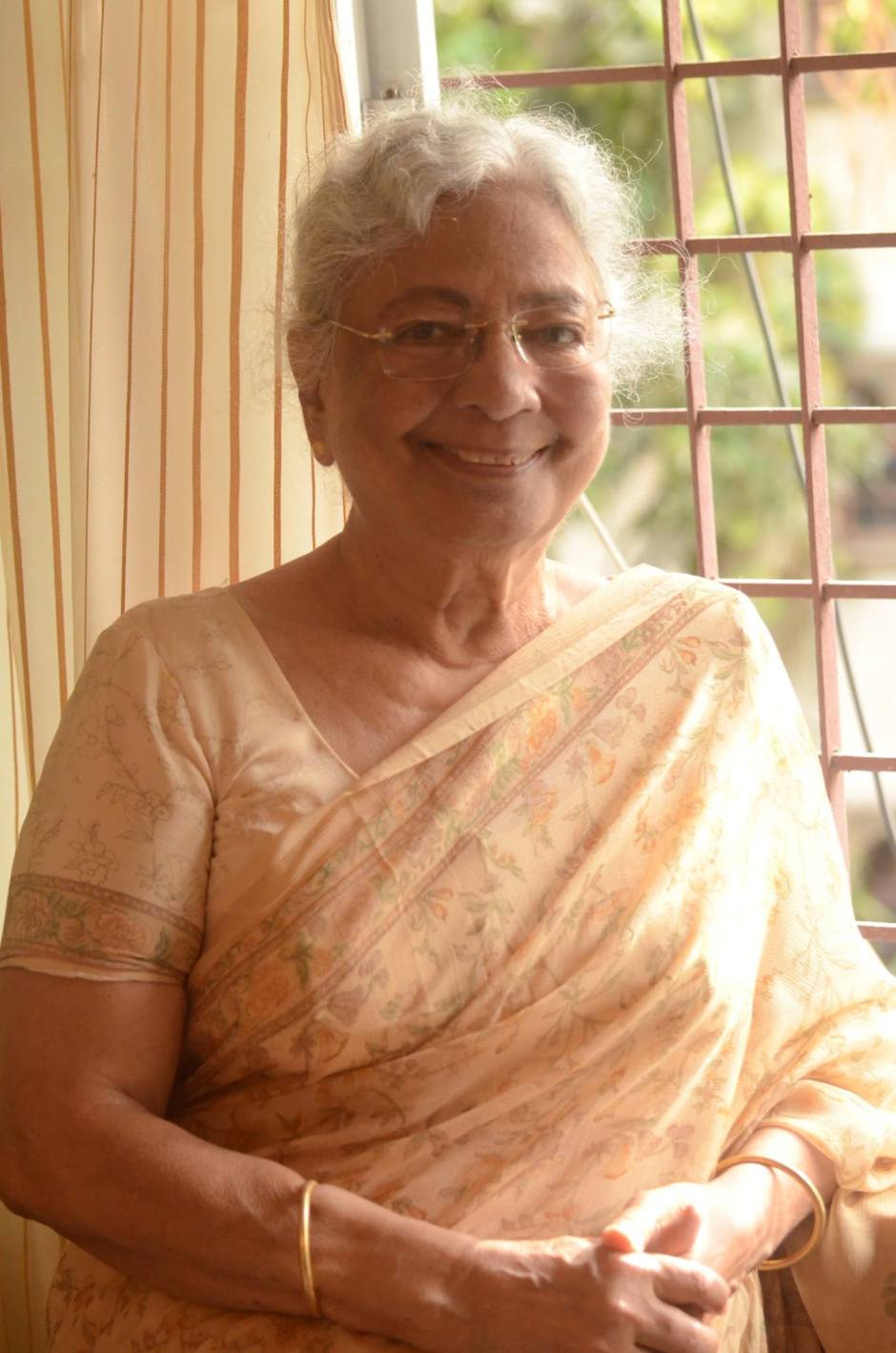
I was watching an interview with Neila Devi, Shammi Kapoor’s wife, a couple of days ago, and it reminded me of my elder bua, Rajshri Khote. Her friends called her Raj, but to me, she was Munni Pua. As a child, I couldn’t pronounce ‘bua’ properly; the ‘b’ became a ‘p’, and ‘pua’ stuck. Munni was her pet name at home, and her birth name was Rajinder. She adopted the name Rajshri after marrying Vinayak Khote (Vinoo Uncle), the year I was born.
How do I begin to talk about what she meant to me? Let me start by saying that she was the second person, after my mother, to whom I came out about my sexuality. I wrote her a letter when I was about 17, telling her about myself. She responded with a letter in which she said, “My love for you doesn’t change because of who you fall in love with. I love you for who and what you are, so there is no question of whether I shall accept you or not. It is a given.”
I don’t know exactly why I came out to her before my other aunt, with whom I was incredibly close. Perhaps, even at 17, I could sense and understand the intricacies of personality and character. And Munni Pua seemed more open to the world and its evolving ideas.
Outwardly, she appeared conservative. She always wore sarees in pastel shades and had a regal bearing that could rival the worthiest of royals. To me, she was the epitome of etiquette. She was a brilliant hostess and knew how to entertain large groups of people. She taught me many things about courtesy, diplomacy, and social graces. She was loving and proper, a character straight out of a Jane Austen novel.
She married late, at the age of 35, to a widower with four children from his previous marriage. I was reminded of Pua, while watching Neila Devi, because I heard Neila Devi say that she didn’t have children of her own, as she felt Shammi Kapoor’s and Geeta Bali’s children were hers. I immediately thought of what Munni Pua once told me: “Vinoo’s children were my own. I saw no need to have more.” She brought back the youngest daughter, who was then staying with her aunt, into the household. It took time for Vinoo Uncle and her to appreciate each other and settle into a loving relationship. But just as they finally found their footing in the marriage, he passed away.
By the age of 40, five years after her marriage, Munni Pua became a widow. Like her mother before her, she was left to care for children and deal with another struggle of proving her worth to the world. It was then that her depression fully took hold.
When I was between the ages of 5 and 13, I remember her as a stern woman who didn’t much like noise or tomfoolery. Once, during a week spent at her Grant Road home over summer vacation, she became irritated with me over a fight I had with my sister. She was so upset that she likely got an anxiety-ridden headache and wrapped a dupatta tightly around her head. My sister and I were so scared that we immediately stopped fighting and couldn’t wait to go back home. I didn’t understand what she was going through at the time. She wasn’t someone a child could easily become fond of, and in fact, I was a bit afraid of her. This is similar to how I am now — I only relate to children when they begin their journey into adulthood. I started understanding her only after I turned 15. Until then, my favourite aunt was Goodie Pua, the fun one, the strong one, and the one who always indulged me.
What I remember most vividly, however, was her complete acceptance of me when I came out to her. Over the years, she supported my mother when her own brother turned to alcoholism and unemployment. She was the one who stood by us when my mother decided to break away from the joint family and move into her own home. Mum still remembers her as the one who stocked our entire kitchen during those early years of struggle.
She stood by my mother when she asked for a divorce, and after learning about the abuse I suffered at my father’s hands, she held a massive grudge against him, even though he was her younger brother, and she had love for him. This, and so much more, made her the right person to come out to. And I did.
This brings me to the next great thing this lady did, not just for me, but for the LGBT community. As I entered my twenties, I became involved in the subculture and joined a fledgling group called GayBombay. I joined when they had their first 100 members on Yahoo Groups. A few months later, we started meeting on the first Sunday of every month. This was back in 1999. We used to gather at a McDonald’s in a central location in the city. At that time, homosexuality was still criminalised, and most gay activity was covert. The middle-class gay population was very introverted and reluctant to be associated with anything openly gay. But little by little, our Sunday meets gained popularity. It became a place where like-minded people could meet.
One Sunday evening, we were asked to leave McDonald’s by the staff. We didn’t know what to do when I had an idea. I was raised in Bandra, and both my grandmother’s home and Munni Pua’s new home (she had moved from Grant Road to Bandra to be closer to her mother) were nearby. So, I called her.
I said, “There are 25 of us, and we’ve been asked to leave in the middle of our meet. Can we please come to your home?”
She replied, “Of course, bring them all here.”
So, I took the group there, and the rest is history. She opened her home to strangers simply because I vouched for them and because we had nowhere else to go. We could have gone to a beach or another café, but what worked in our favour was the home she opened to us. The community members felt comfortable because the meeting was happening in a family home. They knew nothing untoward could happen with an elderly lady present. Her home and she made the meetings safe. This led to GB adopting the tagline, “Creating Safe Spaces.” I would like to commemorate my aunt’s memory with the creation of this safe space.
For the following 19 years, she kept her home open to anyone who wished to interact. GayBombay had its first, and perhaps the first ever, Parents and Relatives meet because of family members like her. My mum, Munni, and Goodie Pua were always on the panel for these meets. They got to know several boys from the community by their first names. Many of the LGBT people who came to know them referred to them as I did: Goodie Pua and Munni Pua. The difference between the ‘b’ and the ‘p’ didn’t matter to them, too. I cannot fully express what these ladies, including my mother, did, not just for me but for so many members of a marginalised, harassed community.
She always wanted to be around family, even when she was terribly depressed. She would lie down on the sofa while we chatted and say her heart was sinking. I would tell her to go and lie down in the bedroom, but she would say no — she wanted to be with us. Over time, as my understanding of people deepened, so did my understanding of her. I connected with her state of mind and her emotional stances. I inherited my moral compass from her.
She made the most awesome “makki di roti and sarson da saag”, frankies … and she taught me how to make kada prasad. I remember her each time I make it, and I miss her terribly when the saag season comes along…
In her final years, she took a home a few minutes away from mine, and I ended up spending a lot of time having sleepovers at her place. She was a night person, too, and we had long chats about the state of the world and human relationships. I came to realise just how deeply she loved people and what she would do for those she loved. In a way, I’m glad she died before her sister. She always wondered if she would suffer, but death came to her like a friend, with just a few minutes of difficulty. As it so happened, my mother was with her when she passed.
In her inimitable style, she had left clear instructions about what should be done when she died, all laid out in detail. She had even set aside the clothes she wanted to be dressed in, along with instructions. No rituals or a long, drawn-out wait for people; she insisted on a quick funeral, and that’s what I gave her.
When she left, a pillar of my support crumbled. She was such a strength to everyone around her. Quiet and strong, she was often overlooked because she always stayed behind the scenes. She didn’t have a flair for drama and, in fact, was embarrassed by it. But she was always meticulous about her beiges and clear whites. Not a hair out of place when she stepped out of her house. And when she did, everyone would smile and greet her because she loved asking after everyone — not just family members, but neighbours, watchmen, maids, rickshaw drivers, and vegetable vendors… She gave without being asked. That was Munni Pua, and that is how I shall always remember her.

 Hearts Still Care
You must be logged in to post a comment.