Being Politically Correct

I was just having a conversation with a friend on WhatsApp and he asked me, knowing how much I love the movies, how I liked the Oscars, this year. Honestly speaking, I was a little irritated by all the political correctness. Sometimes I feel the hosts of the show get a lot more leeway – let me correct myself, all of the leeway – at making astute jokes at the hypocrisy of the attitude behind most people’s motives.


I think everyone who should be given their due should be given it immediately. For example, I wish James Ivory was felicitated when Merchant was alive, when they brought out the phenomenal (and of flawed, too, in places, as any art can be – Maurice, for example, was  dark haired, not a blond as shown in the movie – a tiny detail that irked me to no end) retelling of the E. M. Forster novel, Maurice. It just won an award for Best Costume Design in 1988. I mean, really? That’s all people got from such a ground-breaking movie? Clothes? I mean, fashion and being gay, what a cliché!


In my humble opinion, The Shape of Water was a brilliant movie but when shown in comparison to Call Me By Your Name or Three Billboards In Ebbing, Missourie, it pales a little. But of course, the Academy must be politically correct, it had a girl who couldn’t speak, a fish (god) out of water, a cruel white man with a love for guns, a black compatriot and a gay side-kick. Everything that probably Donald Trump would hate, and I would love.


Don’t get me wrong, I love the nominees, but the selection process must be based on the movies themselves, and of course, the message that they bring is important, but we have to weigh the ‘collateral beauty’ of art when talking about the Oscars.


I resent that Greta Gerwig was made a nominee just because Natalie Portman happened to jokingly mention the line-up of all male directors at the Golden Globes for best director. Lady Bird is brilliant, the leads did a fantastic job of assaying the roles and it hit all the right spots of teenage angst. But bring Greta in for that, not just for the fact that she is woman. You have to look above and beyond this natural phenomenon – and if she was awesome, put her in the line-up of all the award ceremonies. I felt like jumping out of  a moving car, too.


If everyone declares Time’s Up, and protest by wearing black, make it a fait accompli and wear black for all the award functions. Wearing black for one award function proves what exactly? In that case, Meher Tatna, Blanca Blanco and Barbara Meier had it right: it’s not what you wear that makes a difference, it’s how you think and what you believe in your heart. It would have been so cool if all the women wore black for all the award ceremonies this year. That would have been a adequate statement.


“Oh, I can’t wear this brilliant piece for the Globes, but, let’s just wait for the Oscars, that’s the main event anyway.” Rolling eyes now.


Personally speaking, because this is all a personal opinion anyway, I don’t get how The Black Panther and Get Out are getting all these accolades. They are good movies, one is fantasy fiction and the other is a dark satire, no doubt that they are worthy of spending your time and money on, but why the hoopla? But against Lilies of the Field, To Sir With Love, Guess Who’s Coming to Dinner, The Color Purple, Hotel Rwanda, Invictus, Fences, Hidden Figures and Moonlight there is absolutely no comparison.


I was surprised when Remember Me won Best Song, I mean, in the current state of affairs, This Is Me should have won – it works for the politically correct theme being set up.


The Oscars got it right with Best Adapted Screenplay, Frances McDormand, Sam Rockwell and Gary Oldman. Thankfully.


It is sad to note, but maybe this has always been a sign of the times, that being politically correct and not speaking the truth for fear of chastisement is now become the norm of our Age. We all live in fear of being branded Right or Left, Capitalist or Communist, Right or Wrong that we fail to appreciate the beautiful, even if we do not agree with it.


So, in conclusion then, setting a paradox for this entire blog entry, I’d say I do not agree with many of the wins at the Oscars, but if other people consider them deservingly beautiful, and not to make their choice politically correct, then they rightfully won.
Woord, Wort, Word

I have followed Devdutt Pattanaik’s writings for some time now. I have known him personally and have agreed and disagreed with him on several issues over time. We have quietly agreed and quietly agreed to disagree when certain matters were discussed. I can say with the least prejudice that he is a brilliant man and writes his books with a world view that doesn’t choose to misrepresent on any account. He reads, he understands and he explains his understanding of the story. That is what most scholars and readers of other works do. One can only seek to glean a proportion – small or large – of any body of knowledge, because in doing so one attributes one’s own self to the perception of it.

In the light of the video that I have just watched yesterday amidst the tumult of news coverage of the past few days, I wanted to write in a few things. These are my opinions. Last I heard, this was a free country and I exercise my right to talk about how I feel without defaming anyone I disagree with. I have been a student of literature, having acquired my Masters in English (it’s a little perverse that I find myself having to write this) and I have a certain view to share regarding language and how it can be used to communicate.

Let me take the example of Chaucer, whom I had an avid interest and respect for. Geoffrey Chaucer, attributed as the Father of English Literature, wrote avidly in the 1400s. He wrote in the English vernacular, which may seem incomprehensible to someone who isn’t familiar with modern-day English language, in the first place. I will not go into intrinsic details of which word then means what now because that is – not – the point. I will say that the language, since his time, has changed and many a word he used can and, maybe, does mean something different now. One has to understand that language cannot be taken ad verbatim when dealing with any literary – and if I have to be completely specific, poetical – work.

What we are taught, as literature students, is to read between the lines. Understand what the poet or the author has tried to communicate and derive lessons from the subject… and in some cases, just enjoy the work as it is, without any need to dissect or personalize. I talk of the language of English in which I have earned my Masters, but I will propound that any language can be placed into the realms of literature and literature, by default, stands a test in time, to see how universally appealing it can be.

I think what makes a book good – and perhaps even great – is a universal theme. Any idea that can be applied to someone’s life, regardless of cultural and geographical differences. An idea that can make you feel the human condition, about human concerns and human nature. Isn’t that what should be promoted in the state of the world that we live in? Maybe, I am wrong: maybe, all it takes for a book to be great is for it to be banned.

A very important factor in understanding what makes art art is the fact of how differently it can appeal to different people. I may look at a Khajuraho sculpture and see virtuosity and someone else may look at the same sculpture and see porn. Neither of our aspects can be wrong, it’s just another way of seeing the world through your own life experience. A word like ‘awful’ wasn’t used derogatorily earlier, it literally meant ‘worthy of awe’, as in ‘the awful majesty of God’.

But then, what makes a word real? Who has the authority to define a word? A person who writes dictionaries? But then again, what about the new words that crop up: don’t they deserve the right to be? Have you heard ‘ship’ being used as a relationship: as in, “So, if I think Ranveer and Deepika should be together, I ship Ranveer and Deepika”. And these words may or may not remain in their current connotations. Could this also not happen in the days when language was forming, maybe, over a million solar years ago?

So then, coming to the words of history and mythology specifically: the words itself have undergone through their own process of deconstruction. History basically is a recording of present facts as they are. It comes from the Greek word ‘histor’ which meant ‘a wise man’ and ‘historia’ which means ‘narrative’ – or literally ‘his story’. It could be derived from Old French ‘estoire’ which meant ‘story’ or from Latin’s ‘historia’ which meant ‘narrative of past events’. Mythology comes from the Greek word ‘mythos’ which actually meant ‘speech or discourse’, later it came to mean ‘fable or legend’.

Devdutt Pattanaik writes, “Linear religions, which have a start and a finish, need history. Cyclical religions, like the ones that thrived in India, seek to outgrow history. History is seen as delusion, a foolhardy attempt of man to define and limit time in ancient Indian philosophies. Science is unsure if time is linear or cyclical, if there is one world or multiple coexisting realities. It is still work-in-progress.”

But, we are talking about languages that were used and may or not be filled with words that are archaic, including the language itself. And then comes the question of the dialects that formed out of the language that is said to be its mother. Latin was for the cultured masses, the language Chaucer used was the lesser form that appealed to the masses, that did not know Latin. But who were the original writers of the language? Did they create dictionaries? Have the dictionaries, if found, not been altered by the minds who read them? What guarantee that they have been changed or they have not been altered?

Devdutt mentions, “Languages are like rivers, transforming and changing as they enter new terrain, mingling and merging like tributaries, and breaking out as branches. We must be wary of indulging the ego by declaring a particular language is ‘older’, ‘purer’, and ‘original’ as we may be tempted to by the qualification of ‘classical’. However, we must also not stop acknowledging the history and geography of a language.”

It comes down to the question of choice and the choice is of what you would like to believe. Is Othello then a hero, because he chooses to act before he thinks? Is Hamlet then the villain, because he thinks so much that he fails to act? Maybe if Shakespeare was around, he could tell us what to think or for that matter, how to. Maybe then I, too, can, with all the vastness of my knowledge (I did say I have a Masters in the English Language), tell him where he went wrong with his work? And, since we are talking about who should be able to use a particular language, we must ask the other philosophical – and thereby controversial – question of whether Shakespeare was the one to write the plays, or were they written by someone who was not of such humble origins and education as he was?


Being Superman

I was just talking to my boyfriend about what people do and how they would be perceived at doing something. I think there is a world of difference between doing something for the sake of doing it because it makes one feel good, and doing something for the accolades and the recognition one earns on the way.

My aunt, for example, has been diligently teaching children from sections of society that do not have the means to get taught. She has never talked about it for the reason of getting applause. She teaches. Students learn. Simple. My writing about it here may gain her appreciation, but again, this is a by the way.

Don’t get me wrong, I am not dissing the fact that fame can be used for a cause and also that a cause can bring in fame, that’s all well and done, but sometimes, it’s not necessary for Superman to bring down a plane and save hundreds of lives, sometimes, sometimes, it’s nice when he picks up a cat stuck high up in a tree and bring it down to the scared, little girl waiting for it, under the tree. No camera. No applause. Just Superman being Superman.

As Gandalf says, “Some believe it is only great power that can hold evil in check, but that is not what I have found. It is the small everyday deeds of ordinary folk that keep the darkness at bay. Small acts of kindness and love. Why Bilbo Baggins? Perhaps because I am afraid, and he gives me courage.”

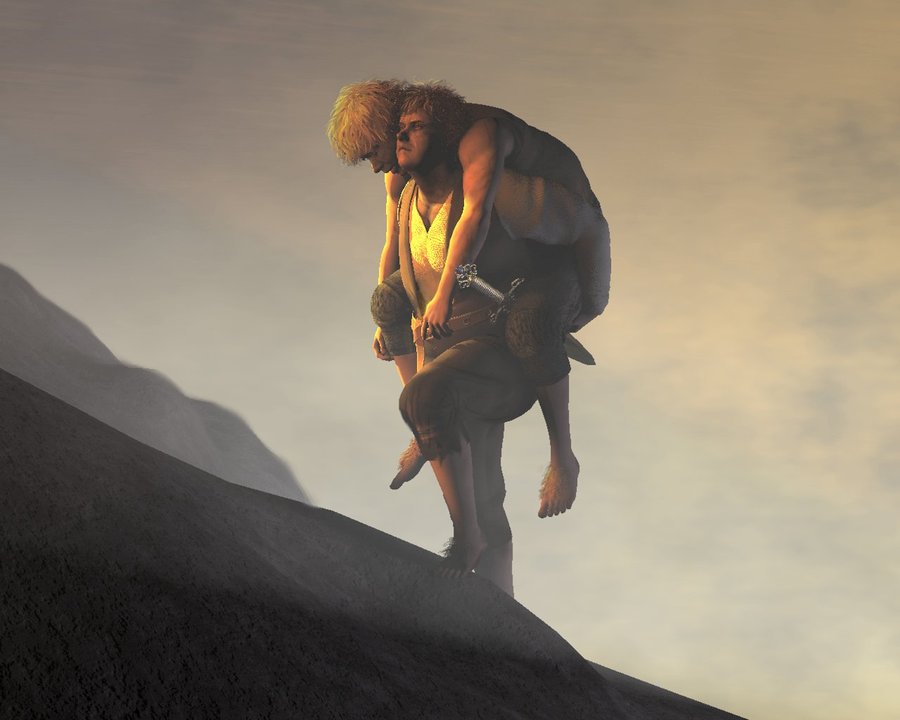
But apart from Bilbo’s journey, one of the heroes I shall always admire and respect is Samwise Gamgee. I think why should by now be understood.