Am I Gay Enough? The Side Debate and the Pressures of Conformity

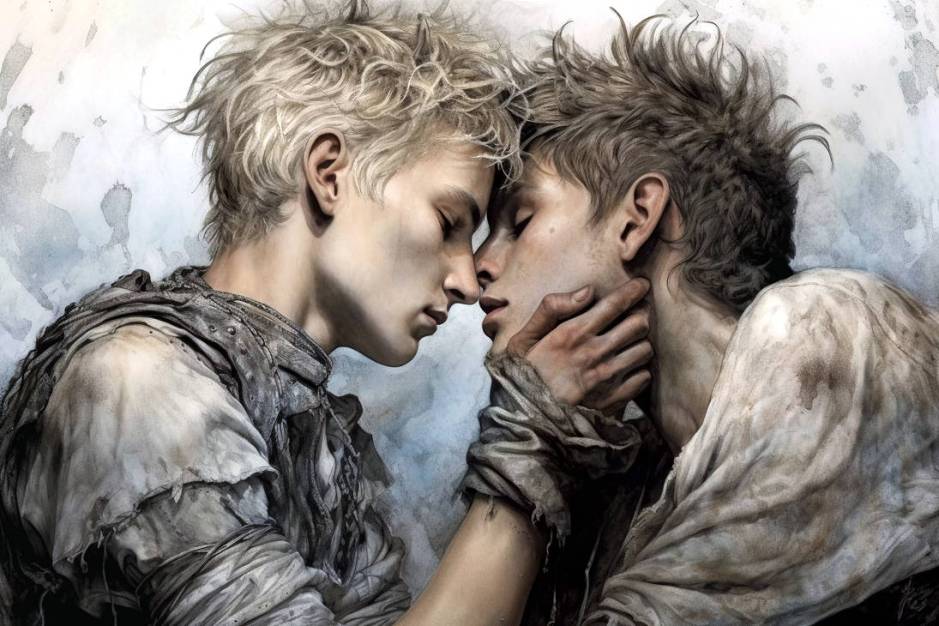
I’ve been in a loving gay relationship for 25 years. I’ve been attracted to men for as long as I can remember—my first love was Superman when I was five. Yet, here I am, still having to defend my sexuality because I identify as a side. Apparently, for some, that disqualifies me from being “properly” gay. It’s absurd, but it’s also revealing. It shows how much pressure we, as gay men, place on each other to conform—not just to straight norms, but to the rigid sexual roles we’ve constructed within our own community.

Growing up, I knew that straight people expected me to conform to their world. They wanted me to be straight, to marry a woman, to have kids, to blend in. And when that failed, they at least wanted me to be the right kind of gay—either the tragic figure hiding in the closet or the overly sexualised stereotype. But what I didn’t expect was that, even after coming out, I’d have to deal with a different kind of policing—from my own people.

At some point, gay men started mimicking the worst aspects of straight culture, forcing labels on each other: top, bottom, versatile. As if our entire existence boils down to what we do in bed. It’s ironic—our community has fought against being reduced to just sex, yet we’ve turned around and done the same to ourselves. If you don’t fit into these roles, you’re treated as an anomaly, an incomplete gay man. Before I even knew what “side” meant, guys used to tell me I was into “body sex,” and I suppose that’s what they meant—that I preferred intimacy without penetration. But instead of that being just another way to be, it became something that needed justification.

When I first read the Huffington Post article in 2013 about sides, it was a revelation. Until then, I had internalised the idea that maybe I was broken, that I was missing some essential “gay” experience. Because that’s the message that gets drilled into us—not just from straight people but from within the LGBTQ+ community itself. The idea that real sex has to include penetration, that masculinity is tied to what you do in bed, that the spectrum of gay relationships has to mimic the dynamics of straight ones. And if you don’t fit in? You’re sidelined. (Pun fully intended.)

It’s exhausting to navigate a world where both straight and gay people are telling you how to be. Straight society pressures us to assimilate, while gay culture tells us to conform in a different way—be masc, be a top, be a bottom, fit into a category. If you’re anything outside of that, you’re made to feel less valid, less desirable, even less gay. It’s ridiculous. My 25-year relationship with a man, my lifelong attraction to men, my love, my desire—those define my sexuality. Not some arbitrary checklist of sexual acts.

The truth is, being gay isn’t about what you do in bed. It never was. It’s about who you love, who you desire, who you build a life with. And no one—not straight people, not other gay men—gets to tell you that you’re not gay enough.

How Women Can Be Their Own Worst Enemies

We talk so much about men being the problem—and let’s be real, patriarchy is a man-made hellscape—but what we don’t talk about enough is how often women themselves keep this toxic cycle alive. It’s not just men enforcing these outdated, oppressive rules. Sometimes, it’s mothers, aunts, teachers, older sisters—the very women who should be fighting for the next generation but instead become their biggest roadblock. And it’s not always because they’re evil or malicious. A lot of times, it’s because they never had the chance to break free themselves.

When Women Become the Enforcers of Patriarchy

Ever met a woman who’s so bitter about her own lack of choices that she makes damn sure her daughter has just as few? It’s tragic, but it happens all the time. A mother who was forced into an arranged marriage at 18 won’t let her daughter marry for love because she wasn’t allowed to. A woman who had to give up her education to be a housewife makes sure her daughter stays “in her limits” instead of pursuing a career. It’s the whole “If I suffered, so should you” mentality.

Why? Because freedom can feel like an insult to those who never had it. Instead of seeing their daughters break the cycle and being proud, they see it as a slap in the face. A reminder of what they never got. And so, they pull their own daughters back into the same trap, justifying it as “tradition,” “duty,” or “the right way for a woman to be.”

Audre Lorde said it best: “The master’s tools will never dismantle the master’s house.” If women keep enforcing the same patriarchal rules that were forced on them, how does anything ever change?

Women Who Defend Their Own Oppression

Then there’s another category: the “pick me” women. The ones who will do anything to be validated by men, even if it means throwing other women under the bus. These are the ones who say, “I’m not like other girls,” who shame feminists, who defend men like Andrew Tate, and who parrot the same misogynistic nonsense they’ve heard from their fathers, brothers, and boyfriends.

This isn’t new. It’s the same reason so many women campaigned against their own right to vote back in the early 20th century. It’s why you’ll find women justifying domestic abuse, policing other women’s clothing, or preaching that a woman’s biggest achievement is “being a good wife and mother”—even when it’s clear they themselves are miserable in those roles.

It’s internalised misogyny at its finest, and it’s exhausting.

Queer Men and the Femme Stigma

As a queer person, I understand this on another level. The world punishes femininity—whether it’s in women or men. One of the reasons so many gay men get bullied isn’t just because they’re gay; it’s because they’re femme. Because in this cis male-dominated world, nothing is seen as more pathetic than a man who acts like a woman. It tells you everything you need to know about how society sees women.

And let’s not forget, a lot of homophobic bullying by boys? It’s done to impress girls. I’ve seen it firsthand—boys making fun of the “gay kid” just to get a few laughs from the girls around them. And some of these girls? They laugh because deep down, they’ve been taught that men being soft, vulnerable, or feminine is disgusting. They’ve learned that from their mothers, who learned it from their mothers, and the cycle goes on.

Let’s break this pattern!

We can’t just say “men need to do better” and leave it at that. Because the reality is, if women are still raising their daughters to be obedient and their sons to be dominant, nothing really changes.

• Teach kids young. This isn’t just about telling girls they can be strong; it’s about telling boys they can be soft. That crying isn’t weak. That being kind isn’t “gay.” That respect isn’t conditional.

• Call out internalised misogyny when you see it. If a woman is tearing another woman down, question it. Ask why. Make her reflect.

• Stop raising women to suffer. If you’re a mother, an aunt, a sister, an older cousin—don’t clip another girl’s wings just because yours were clipped. Let her fly.

At the end of the day, we’re all hurting in one way or another. The least we can do is stop adding to each other’s pain. Instead of telling people to “rise above” their suffering, maybe we should start pulling through it together.

The Power of Cinema: How The Black Stallion Has Carried Me Through Life

The power of cinema lies in its ability to transport us—to take us back to moments of pure joy, to remind us of who we once were, and sometimes, to lift us from the depths of despair. For me, that film has always been The Black Stallion.

I first saw it when I was five years old, in a cinema called New Talkies in Bandra. My grandmother took me to watch it, and then my mother took me again. I watched it several times over the years, and in the 1980s, without access to OTT platforms, DVDs, or even regular TV broadcasts, we had to rely on someone with a VCR and a VHS cassette to revisit a beloved film. And revisit it I did—again and again, probably thousands of times.

There’s something about The Black Stallion that speaks to me on a level no other film does. It’s a simple story—a boy and a horse, forming a bond that goes beyond words, beyond logic, beyond any relationship I’ve seen depicted in film before or since. They meet in isolation, stranded on a deserted island, both alone in the world. And in that loneliness, something unbreakable is forged. The purity, the energy, the synergy between them—boy, animal, landscape—it all fills me with a deep, complete contentment.

Lately, I’ve been particularly low. Depression has a way of creeping in, weighing me down, making even the simplest things feel exhausting. And when that happens, I go back to The Black Stallion. I put it on, and I watch the first half—just the boy and the horse, with no dialogue, no human noise, just the sound of the waves, the wind, the hooves against the sand. The barren landscape, the golden light of the setting sun, the ocean stretching endlessly—it all carries me away. There are so many metaphors at play, but to a child watching in the cinema all those years ago, it was simply magic. A connection to aspire to.

And that’s still what I aspire to. Beautiful connections. Connections where words aren’t necessary—where love, need, and the desire to run free are enough.

Carroll Ballard’s direction is nothing short of breathtaking. There’s one shot, in particular, that I always come back to—the one where Alec, played by Kelly Reno, offers the horse a piece of seaweed as the sun sets behind them. The way the camera lingers on that moment, the hesitation, the trust, the silent understanding—it always makes me smile, no matter how heavy my heart feels. In those moments, I forget everything else.

That’s the true power of cinema. It lets you go back. It takes you to the moment when you first experienced it—before life got complicated, before the losses, before the weight of the world settled on your shoulders. When Alec Ramsey climbs onto the horse in the sea and they gallop together for the first time, the music swells, and I feel it in my bones. I feel that rush of freedom, that joy, that dream of running wild and untamed.

Very few movies can do that. The Black Stallion does. The only other film that comes close, for me, is Anne of Green Gables—another story that exists in a world untainted by cynicism, by corrupt logic, by the exhausting battles between overbearing liberalism and catatonic conservatism. A story where beauty is simply beauty.

And even now, as I write this, I feel lighter. I think about the music, about Alec, about the horse, about the island. I think about the sun, the waves, the wind, the freedom. And I smile.

That is the power of cinema.

A Few Facts About The Black Stallion:

• The film was directed by Carroll Ballard, known for his ability to capture the raw beauty of nature and animals on screen. His work in The Black Stallion is widely praised for its poetic visual storytelling.

• The cinematography was done by Caleb Deschanel, whose stunning compositions turned the film into a visual masterpiece. The way he shot the island sequences made them feel almost dreamlike.

• The film’s score was composed by Carmine Coppola, father of Francis Ford Coppola, who also produced the movie. The music is hauntingly beautiful, especially in the moment when Alec first rides the stallion in the water.

• The titular Black Stallion, Cass Ole, was an Arabian horse known for his beauty and grace.

• Sadly, none of the main cast members are alive today. Teri Garr recently passed away, Mickey Rooney before her, and Kelly Reno, who played Alec, stepped away from acting long ago. Even Cass Ole is gone. But the film remains—a legacy left behind, a piece of art that still touches the heart of someone who first watched it 45 years ago.

And that, more than anything, is proof of cinema’s power.