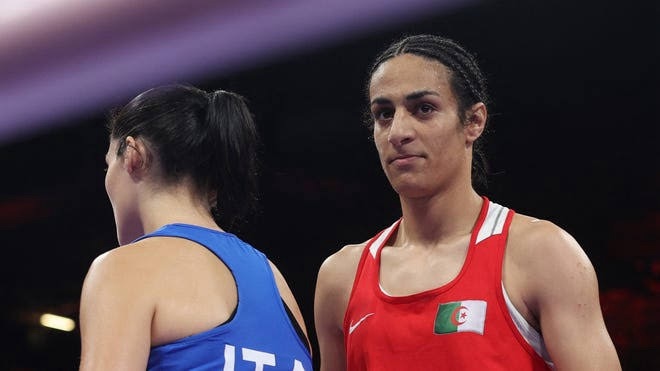
Imane Khelif has emerged as a prominent figure in women’s boxing, known for her skill, dedication, and perseverance. As a representative of Algeria, she has become a symbol of hope and inspiration, particularly for young women in her country and beyond. Khelif’s journey in boxing is a testament to her hard work and the barriers she has broken in a sport that is often dominated by men. In fact, her father had not wanted her to join the sport of boxing as it isn’t considered appropriate for a Muslim girl to participate in what is considered to be a “man’s sport”.
Ironically, the controversy began when Khelif was accused of being a man by Carini, a rival boxer who refused to fight her. The accusations were baseless and seemed to stem from Carini’s inability to face Khelif in the ring. After a day of backlash and public outrage, Carini issued an apology. However, the damage had already been done. The initial accusations had spread far and wide, casting a shadow over Khelif’s reputation. The apology, while necessary, could not undo the harm inflicted by the reckless and irresponsible comments.
Social media platforms can amplify misinformation at an alarming rate. The accusations against Khelif quickly went viral, leading to widespread speculation and judgment. The power of social media lies in its ability to reach millions of people instantaneously, but this power comes with a responsibility that is often neglected. When influential personalities share unverified claims, the consequences can be devastating for the individuals involved.
The damage was done, and the repercussions were swift and severe. Prominent figures like J.K. Rowling, Martina Navratilova, Chris Evert, and Boris Becker weighed in, with some stating that Khelif might be transgender. The hate was clear when the designated pronouns were he/him/his. Such statements, particularly when made without evidence, have a catastrophic impact due to the influential status of these individuals.
It is worth noting that it took an entire day for concerned individuals to raise their voices. Hate spreads rapidly, while wisdom takes time to take hold. It’s crucial to diminish the influence of those who spread hate, but it is disheartening to see that those in positions of power often perpetuate it.
Elon Musk acquired Twitter, then rebranded it as X. He is powerful and wealthy. While his intentions for the platform are varied, he unfortunately contributed to the controversy by calling Imane Khelif “crazy”, a distressing stance, which is particularly noteworthy given that his own daughter is transgender. It is no surprise then that his daughter chose to publicly disown him.
I once adored J.K. Rowling and all of her work, writing essays and articles about her rise and brilliance. As a gay individual with a tough childhood, I found solace in her books, especially in the character of Dumbledore, whom she outed in 2007 after the series had concluded. At the time, I dismissed any reservations, accepting it as her right to explore her creations.
However, in 2019, my admiration turned to dismay when she posted a tweet rife with transphobia. Since then, I’ve felt a deep sense of disgust and betrayal, especially with her recent tweets about Imane Khelif. Without any basis, Rowling questioned Imane’s gender, an act that is particularly appalling from someone who calls herself a feminist. What she is doing is despicable.
I must further note, J.K. Rowling adopted the pen name “J.K.” to appeal to a broader audience, particularly aiming to attract young male readers who might have been hesitant to pick up a book written by a woman. This strategic choice, advised by her publisher, underscores the gender biases in the publishing industry. Now, as a prominent figure who publicly champions feminism, this decision might seem hypocritical, especially in light of her controversial views on transgender issues, which many critics argue are at odds with inclusive feminist principles. The dissonance between her early career decisions when she wanted to be read and her current stance once she has all her wealth, highlights the complexities and contradictions in her public persona and advocacy.
All of this brouhaha definitely reflects the complexities and contradictions present in the social media landscape and the urgent need for more responsible dialogue. This incident highlights several critical issues. First, it underscores the need for responsible behavior on social media, especially from public figures. The spread of misinformation can have real-world consequences, tarnishing reputations and causing emotional distress. Second, it brings to light the prejudices and biases that still exist in sports. Accusations of being transgender as a means of undermining an athlete’s success are not only baseless but also reflect a deep-seated intolerance.
Furthermore, the incident raises questions about the measures in place to protect athletes from such slander. Governing bodies in sports must take a more active role in addressing and preventing such controversies. Athletes, regardless of gender, deserve respect and fair treatment, free from baseless accusations and societal prejudices.
White privilege often upholds narrow and exclusionary standards of beauty and behavior, marginalizing those who don’t conform. Not just Imane Khelif, but Serena Williams, and Simone Biles have all faced bigoted criticism for not aligning with these restrictive ideals of how a woman “should look.” Khelif just faced racial and gender prejudices that undermine her recognition. Williams, despite her dominance in tennis, is frequently subjected to racist and sexist remarks about her physique. Biles, an extraordinary gymnast, has been scrutinized for her appearance rather than celebrated solely for her achievements. These instances highlight how deeply ingrained stereotypes about race and gender continue to limit the respect and recognition that diverse individuals deserve, revealing the intersectional challenges women of color face in their respective fields.
Imane Khelif’s experience serves as a terrible tale about the power and pitfalls of social media. While it has the potential to celebrate and elevate athletes, it can also be a platform for spreading harmful and unfounded claims. The involvement of high-profile individuals in propagating such misinformation only exacerbates the issue. As a society, it is imperative that we strive for greater accountability and responsibility, ensuring that the successes and struggles of athletes like Khelif are recognized and respected for what they truly are.



 Hearts Still Care
You must be logged in to post a comment.