Love Means Always Having to Say When You’re Sorry

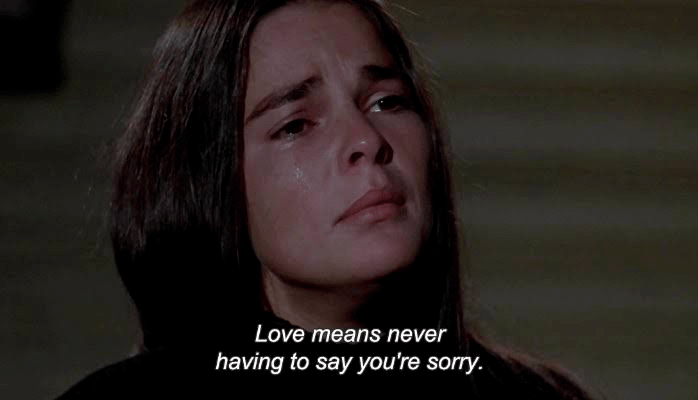
In Love Story, when Ali McGraw says, “Love means never having to say you’re sorry,” she offers a sentiment that I find deeply flawed. For me, love does mean saying you’re sorry – and often. When you care about someone, and your actions cause them pain, that pain becomes even more significant because of the love between you. It’s precisely why acknowledging that hurt and apologising is so crucial.

Consider a situation where you’ve made plans with someone. You’re delayed for reasons beyond your control, and by the time you arrive, they’ve been waiting for you – possibly having made all the necessary preparations and feeling excited to see you. When you finally get there, instead of offering an apology, you brush off the delay because it wasn’t your fault. You expect the other person to simply understand that external factors were to blame. However, this kind of thinking overlooks the other person’s feelings. Even though the delay wasn’t deliberate, the other person has still been affected by it.

This is the key issue: it’s not always about fault or blame. When we love someone, we need to consider how our actions, even if unintended, impact them. Love isn’t just about being right; it’s about understanding and acknowledging the other person’s emotional experience. Skipping the apology sends a message that their feelings don’t matter – that their hurt is irrelevant. It builds quiet resentment, and over time, this neglect can lead to the erosion of a relationship.

Add to this the fact that even when we know each other very well, there are always moments when we unintentionally hurt those we love. It might be something as simple as not being able to be quiet when your partner needs rest. If one person is disturbed and unable to sleep, it may be because the other finds it hard to stay quiet. Now, the person who has been disturbed could easily think, “Why can’t you just be quieter when I need it?” But instead of expecting that understanding, love should prompt the person who caused the disturbance to acknowledge it and apologise. That’s what love is about: trying your best to ensure the other person’s comfort. And if you can’t meet their needs in that moment, then at least show you recognise that by saying sorry.

The failure to apologise, to simply assume the other person should understand, misses the point of love’s emotional exchange. In fact, I believe this is why many relationships struggle. We often excuse ourselves, thinking that external circumstances, or aspects of our personality, excuse the hurt we’ve caused. But we forget that the hurt is real, regardless of fault. The key is to acknowledge it – to take responsibility for the emotional consequences of our actions, even if those actions were beyond our control.

Returning to Love Story, it’s worth noting that the idea of “never having to say you’re sorry” can also be seen as a reflection of patriarchy. When Ali McGraw’s character says this to Ryan O’Neal, she’s essentially excusing him from taking responsibility for her feelings, giving him a pass simply because they’re in love. But that’s not how love should work. When you love someone, you should be even more motivated to show that you never want to hurt them – and that if you do, you’re sorry for it, even if you didn’t mean to cause the pain.

At its core, love is about effort – about trying your best to make the other person comfortable, happy, and valued. When you can’t achieve that, an apology is the least you can offer. It’s not just about taking blame; it’s about showing empathy, understanding, and a desire to make things right.

Ultimately, love means always being willing to say you’re sorry when your actions, however unintentional, hurt the person you care about. An apology is not about blame or fault. It’s about recognising the emotional weight that love carries and showing that the other person’s feelings matter. After all, love is what makes those apologies – those simple acknowledgments of shared vulnerability – so necessary.
Luck

When I reflect on my life, I often hear people telling me, “You are so lucky.” A recent conversation with a friend brought this to the forefront when I shared my journey—coming out to my mom at 16 and to the rest of the family by 19, eventually gaining their acceptance. His response, “you are so lucky,” struck a familiar chord. But each time I hear it, I can’t help but feel a bit uneasy. It’s not that I don’t appreciate their sentiment; it’s just that I don’t see my path as a matter of luck.

I once heard Oprah say something that resonates with me deeply: it’s not luck that places us where we are, but the choices we make… way before Albus Dumbledore said it. And I couldn’t agree more. My decision to come out wasn’t a matter of fortune. It was an active, conscious choice made from a place of certainty about who I am. I was, and still am, absolutely sure of my sexuality. It is an irrefutable part of my existence. When I came out to people, I made it clear that this is who I am, and there would be no argument or debate about it.

Luck didn’t play a role in those moments; courage did. Courage, as C.S. Lewis wrote, “is not simply one of the virtues, but the form of every virtue at the testing point.” Coming out required that kind of courage—the courage to be unapologetically myself, even at the risk of rejection. I didn’t present my sexuality as a negotiable part of me, but as a fundamental truth. As Mark Twain once remarked, “Courage is resistance to fear, mastery of fear—not absence of fear.”

Yet, despite this courage, I rarely take credit for what I’ve achieved. I’ve often compared myself to others, feeling I fall short in the shadow of their accomplishments. But when I look back on my own life, I see that my journey, my milestones, have been remarkable in their own right. My family’s acceptance wasn’t a matter of luck; it was a result of my unwavering stance. I gave them no choice but to accept me as I am. And if they didn’t, I was ready to move on without them. It was simple, and they recognized that strength.

As Ralph Waldo Emerson wisely noted, “The only person you are destined to become is the person you decide to be.” I decided to live authentically, and the world had no option but to accept it. I don’t stand for mere tolerance, because tolerance, to me, is just a polite way of saying, “We don’t like you, but we’ll put up with you.” That’s not the life I want. I want to be accepted wholly, and if that’s not possible, then I’ll move on.

So, what is luck to me? It’s a fleeting concept, a brush of serendipity that might bring someone into your life. But beyond that, luck holds no lasting power. People come and go despite your best efforts. The truth is, I don’t attribute my journey to luck. Instead, I credit my honesty with myself and others. As Seneca once said, “Luck is what happens when preparation meets opportunity.” In my case, preparation took the form of self-awareness, honesty, and courage. I choose to live according to who I am, and that is the only role I play in this life.

Ultimately, the notion of luck feels like a disservice to the courage it takes to live authentically. For me, it’s about ownership of who I am and the choices I make. Those choices—not luck—are what shape my life and define my future.

BDD

I recently watched Heartstopper Season 3, which is not only an excellent LGBTQ+ series but also refreshingly inverts the typical media landscape by placing queer characters at the centre. This representation makes straight people feel like the “odd ones out.” One of the key themes in this season is body dysmorphia—a mental health condition that involves an obsessive focus on perceived flaws in one’s appearance. This series led me to reflect on how common body image issues have become, particularly in the age of social media.

What is Body Dysmorphic Disorder (BDD)?

Body Dysmorphic Disorder is defined by the NHS as a mental health condition where individuals spend a lot of time worrying about flaws in their appearance, often minor or unnoticeable to others. It can significantly impact daily life and self-esteem. According to the International OCD Foundation, around 1 in 50 people are affected by BDD, making it a relatively common condition, particularly among teenagers and young adults.

Social Media and Body Comparison

These days, platforms like Instagram and TikTok exacerbate body dysmorphia. Filters, perfect lighting, and curated images set unrealistic standards. Studies show that 88% of women and 65% of men compare themselves to images on social media, often leading to negative body image and dissatisfaction with their own appearance. In fact, adolescents who frequently use social media are at greater risk for developing body image issues.

Childhood Experiences and Body Image

My personal experience aligns with these findings. As a Sikh boy growing up, I remember being teased about my turban and physical traits. Bullying around body image or appearance is not uncommon in childhood, and these early experiences can embed long-lasting insecurities. For me, it wasn’t just about my hair—I was also teased for being effeminate, having a small torso, and larger hips, which added to my body image struggles.

Body Changes and Identity Formation

Body image concerns tend to worsen during adolescence. The body undergoes significant changes between the ages of 13 and 18, a critical time for identity formation. As I transitioned through these phases, I gained weight during my teens and then lost it during college. This constant flux made me more conscious of my appearance. Like many, I looked to male ideals—broad shoulders, muscular torsos—standards that I didn’t feel my body met.

Gay Men and Body Image

In the gay community, body image pressures can be particularly intense. Studies suggest that 42% of gay men report body dissatisfaction, compared to 29% of heterosexual men. As a gay man, I felt these pressures acutely, from worrying about my weight to comparing how my body looked—chest, abs, even penis size—against societal expectations. The pervasive focus on physical perfection in the gay dating scene can lead to unhealthy self-comparisons, which was well-illustrated in Heartstopper.

Clothing and Body Protection

For me, fashion became a protective layer. I found comfort and confidence in clothes, which acted like a second skin. This isn’t uncommon; research shows that clothing and appearance are often used as coping mechanisms for body image dissatisfaction. Styling others also gave me joy, reinforcing that appearance can be empowering, but it also masked deeper insecurities.

The Paradox of Love and Physical Attraction

While we often say that love is about looking beyond the physical, I believe that initial attraction is deeply tied to appearance. Studies suggest that physical attraction is often the first spark in romantic relationships, and it takes time for emotional and intellectual connections to develop. Over time, though, emotional bonds replace the need for constant physical attraction. Ironically, in long-term relationships, people sometimes let their physical appearance slip, leading to a potential decline in mutual attraction.

The Toxic Cycle of Body Image and Relationships

This creates a toxic cycle: we start questioning our own bodies when we feel a loss of attention or attraction from our partner. It’s common for people to feel they’ve “let themselves go,” leading to self-blame and even more body dissatisfaction. Despite knowing that true love should transcend physicality, it’s difficult to escape these ingrained notions. The pressure to mould ourselves to fit societal standards remains strong, as Heartstopper poignantly highlighted.

Body Dysmorphia and Relationship Dynamics

Heartstopper Season 3 forces us to confront how deeply body image issues are interwoven with romantic relationships. Body dysmorphia affects how we view ourselves and how we approach love. Until we address these toxic perceptions—rooted in societal conditioning, social media, and early experiences—our relationships will continue to be shaped by the way we see our own bodies.

This thought process integrates statistics and definitions, placing your personal reflections within a larger framework of body image, social conditioning, and mental health.