Manchester By the Sea

Casey Affleck, Casey Affleck and more Casey Affleck, is what I say!

He carries this haunting tale of a cataclysmic mistake on his shoulders, through the entire saga. The movie took me back into the days when I studied William Faulkner, Ernest Hemingway and Theodore Dreiser. The tone is like a piece of music – with adagios and allegros all mixed up. It’s like cinematic opera, or like a Renaissance tragedy filled with realism.

It moves in a series of flashbacks and present time scenes. There is a buildup of Casey’s character. His eyes speak volumes, blue and surreal. He’s a Catholic boy who works as a janitor and as the story unfolds we understand the reason for his withdrawn and inhibited existence. I don’t see him smile a single time throughout the movie. And in the scenes, where I think he may be smiling, are all shot in long shots, so you can’t really make that out.

I cannot dwell enough on what a powerhouse performance he has acted out here. His character has this mayhem within and except for one major outburst at a police station, we see quiet ruptures of self harm, in an otherwise calm and even polite demeanor that covers this tension. There is this need to be better when faced with his nephew’s guardianship, but there is the ultimate realisation that things don’t truly get better. He usurps each frame where he is present – one cannot see anything else.

I was wondering what Michelle Williams was doing in the movie, I even mentioned it in an aside to fellow watchers of the movie – until the one scene where she blows your mind away. Both Affleck and she have this one scene where they both meet after years and they both are so tortured and so stark and so naked before each other, the scene melts away any doubts as to why she was nominated for an Academy Award. The way her voice breaks, the way the demons in him claw to get out and overtake his being, the entire scene is so filled with abject pathos that you cannot help but weep along with both.

The other actor that has done a brilliant job in this film is Lucas Hedges. His performance is what brings the ripples in an otherwise dark, dangerous and deep waters.

The entire film is shot in the cold of winter. The imagery is harsh and barren and the cold outside is more than just a metaphor in the movie. It is a take on how nature can be horribly cruel and unyielding, if the ground is unforgiving and hard for a dead body to be buried in, the opposite of the cold: fire, is the thing that can destroy lives.

Kenneth Lonergan’s direction is crisp, and yet lifelike. He knows his art and more than concentrating on camera angles and effects, and colours, he uses his actors to give meaning to the themes of grief, trauma, heart break and loss. There is a redemption for Lee, but he chooses not to take it – and the director allows him to make that choice.

This deserves the Best Picture Award, Best Director Award, Best Actor Award!

Moonlight

In moonlight, black boys look blue. The moon and being blue, surreal and vibrant. I watched the movie with trepidation, I thought like most movies dealing with homosexuality, the end would be tragic. But it’s actually beautiful. Breath-taking almost.

My favoured colour tones permeate the tone of the movie. Blue, white and black. The movie divides into three.

i. Little – the hounding of a boy thought to be different. The lack of a father figure, and soon, the lack of maternal love. The bullying of other children, because children are instinctual, they sense differences, but most are also doubly cruel because they can. No love forthcoming from the mother who also cannot face with the conclusion she has drawn about her son’s sexuality. She plunges into drugs – and the only consolation Little derives is from, ironically, a drug dealer and his partner.

ii. Chiron – teen years, filled with angst, because the bullying has only got worse. In a world filled with hypermasculinity, Chiron has no recourse but to hide away. The one who should be protecting him, has thrown him into the wild, bereft and alone. The night he spends haunting the metro and the beach because he cannot return home is so tragic that it makes your heart crumple inward. The only hope he receives is from his childhood friend, Kevin. That hope is short-lived and ends in disaster.

iii. Black – a grown man now, embodying that same masculinity that he used to run away from. The sensitivity of Little and Chiron finds its way in nuances of Black. The character has evolved and yet the silver on the teeth is just a façade.

The movie touches each theme so delicately, it’s almost as though it was moonlight itself. Silvery and effervescent. The starkness of reality hits you with such force like the sun shooting directly into your eyes, before the dark envelopes you again. The night provides a respite, whenever we see the character go through the experiences that make him better, we see them happen at night. It is only under moonlight that we see the beauty.

Ashton Sanders is spectacular, as is Naomie Harris. James Laxton has done a wonderful job with cinematography, you feel the emotions through the camera almost as much through the actors.

The world is of a black boy, a black teenager and a black man – but the themes of drug abuse, neglect, imprisonment, poverty, abandonment and bullying are so prevalent that the movie can speak to its audience on any level. The cinematography is brilliant, the dept of fields used create a singular focus on the character presented – the world is myopic and seen through each individual lens. It brings down the larger vision to the inevitability of fate. But pathos is presented in such a fantastic aura of dappled light that makes you understand how poetry is created. Even the ice water used as a cold transition cannot truly wash away the goodness within Chiron. And that is what makes you root for him.

Hacksaw Ridge

I just finished seeing Hacksaw Ridge and I came here to write down my feelings, because I have been moved deeply by the movie. Mel Gibson has always been a favoured director, and though I will say, only Steven Spielberg can make War seem like a Wilfred Owen poem, full of pathos and terrible beauty, Gibson doesn’t fall short of depicting the horror that is War. I still think of Schindler’s List as superlative when we talk of War movies, but Hacksaw Ridge is a very worthy attempt at the genre, and it speaks so beautifully of the central idea of conscientious objection.

Gibson has this knack for bringing light into pain. He did this right from his first directorial venture – he takes every shred of pain and makes it burst from visual sinews on screen. No doubt from the beginning there has always been an element of sadism in his point of view, and the scene where the child uses a brick to lash out, embodies his art, but I will admit, that from this burst of horror we are shown the clamouring into relief. It’s the flagellation of Christ that resurrects the soul and makes beauty burst out of that golden iris, so much so that tears rain down from heaven. It’s like childbirth almost, complete pain, tearing of tissue, viscous and bloody that leads finally up to an ease and love which makes one forget that the pain existed in the first place.

The movie depicts the religious undertones strongly, especially those of baptisms and ascensions, considering the director is after all, Mel Gibson, and though I am an atheist I admit I am a fan of his work, if you couldn’t already tell. Being an atheist, I can still relate to the movie, because peace is something we all desire, irrespective of varying beliefs in theology or the lack thereof. And considering the times we live in, the anti-war theme is bang on.

I think this movie deserves many more accolades than it has already received. I cried through quite a few of its scenes, because being a non-aggressionist and anti-militarist, I could understand the concerns that the movie speaks of. Desmond Doss is certainly a hero, and that is not just because he sticks to what he believes in, but because being a pacifist isn’t the same as being a coward, which he valiantly proves – without intending to, which is the point of it all.

Andrew Garfield has done an exemplary job as this wry young man who has the courage to stick to his convictions, through some pretty rough times. But I will say that Hugo Weaving stays in my mind, he has done some fantastic work in the movie and deserves a special mention, as the soldier from the Great War, who has let his PTSD overtake his life, transforming him into an uncaring and abusive father and husband. His character graph is so well-wrought, leading right up to his being there for his son, when the latter needed him the most.

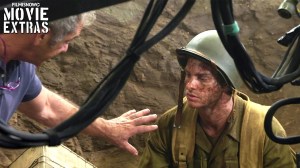
maxresdefaultMel Gibson is back, and he uses some very good actors, like Vince Vaughn and Sam Worthington, to bring his vision to life. The battle scenes are crafted almost like they echo the burst of a machine gun. I always equate a great battle scene to the first few minutes of Saving Private Ryan, and the battle reenactment of Okinawa, though doesn’t surpass Spielberg, it surely stands beside. The utter chaos of War is what Gibson tried to show and for me he succeeds brilliantly.

This movie makes you cheer for Desmond Doss; it shows the strength of his character, it voices the madness that is War, the bravery of those who participate in it, the cruelty of it by itself and portrays the surreal upliftment of Mercy and Succour.

I am very glad you are back in the Director’s chair, Mel!