Xena

I don’t know when exactly the anxiety turned into something heavier, but I know it has been building for weeks. Maybe months. With Xena, nothing happens suddenly — it gathers, quietly, until one day it asks to be acknowledged.

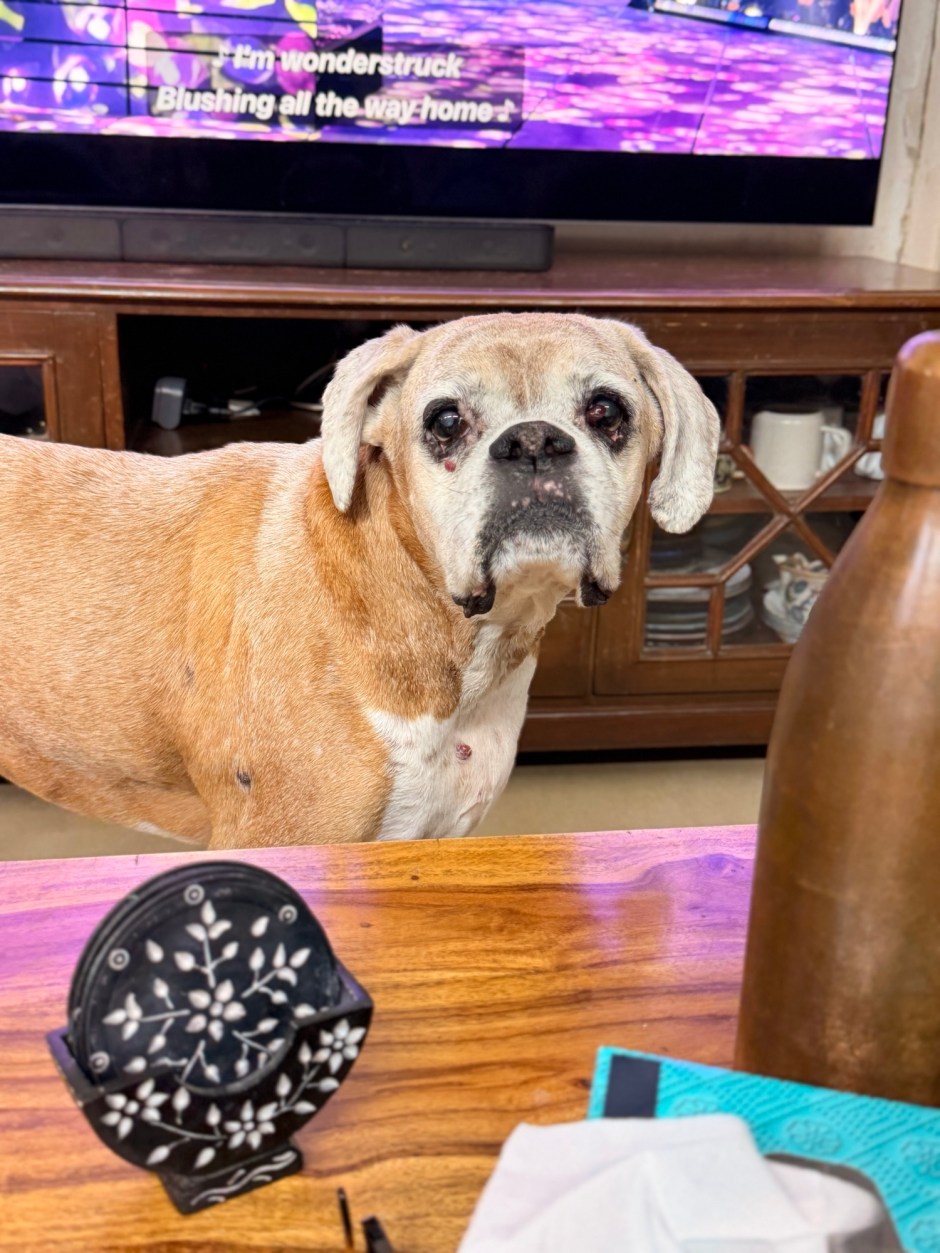
Xena has mast cell tumours. Not one or two, but many — scattered across her body like reminders that her system has been fighting a long, unseen war. Most of them have been manageable. They rise, they settle, they dry out when left alone. I learnt early that touching, creams, and over-intervention only make things worse. When I stopped fussing, some of them calmed. One on her ear even healed completely, turning skin-coloured, no longer bleeding, no longer angry. That gave me hope — perhaps this was how we would manage things. Carefully. Gently. Day by day.

But the one in her eye was different.

It sat on the third eyelid, fragile and vascular, in a place that cannot truly rest. When it bled the first time, it terrified me — not just the blood, but the panic in her body, the confusion, the sudden loss of calm. We learnt how to stop it. Cold compresses. Pressure. Emergency visits. Antihistamines. Steroids. Each time, the bleeding stopped. Each time, I hoped it might behave if left alone.

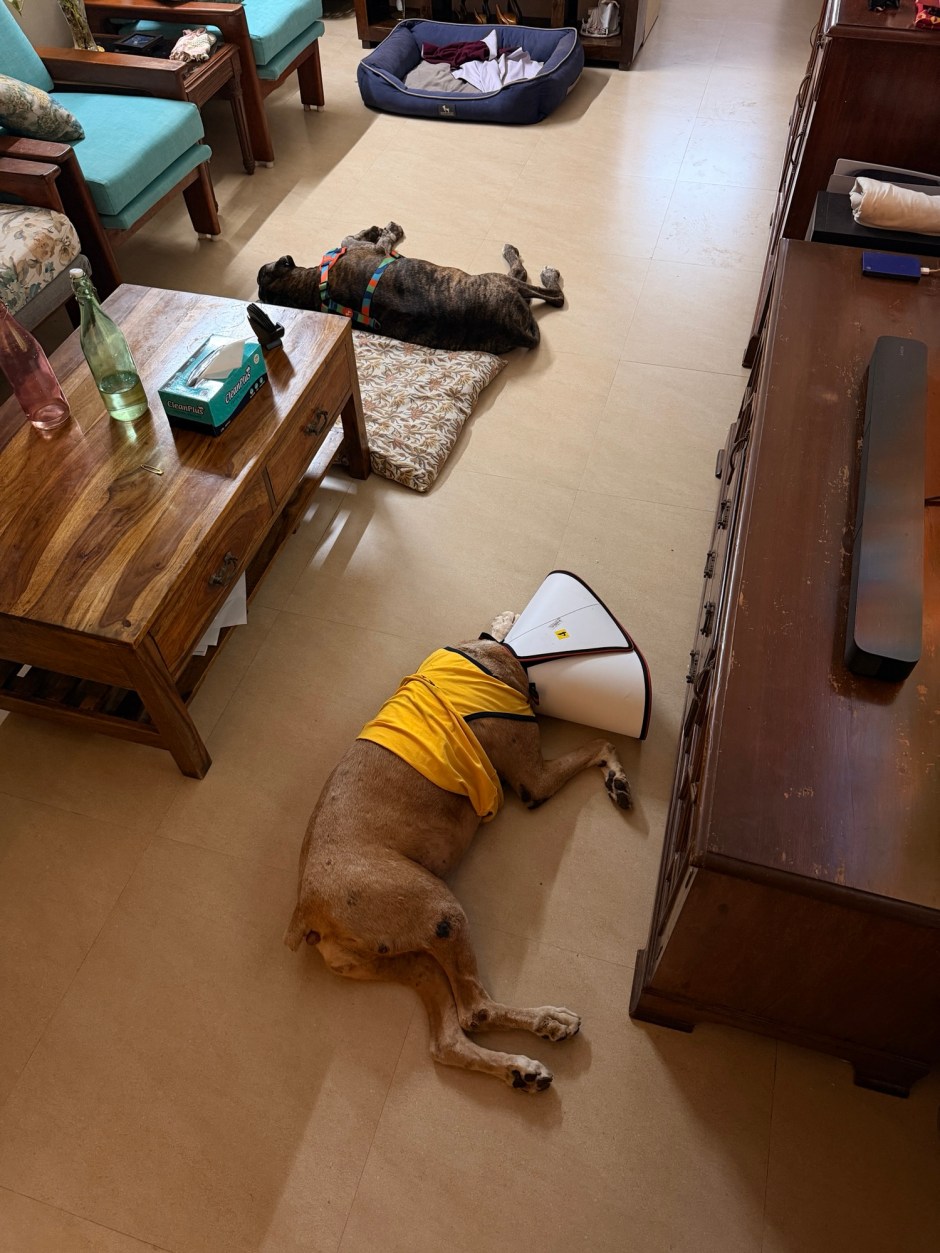
We put the cone on her. She hated it. I hated it more. Watching her try to sleep, try to exist, with that plastic barrier around her head felt cruel, even though I knew it was protecting her. She struggled at first, then slowly began to make peace with it. Or maybe she was just too tired to fight.

Medication complicated everything. Morphine made her dazed and unsteady, her hind legs unreliable. It wasn’t a bad reaction — she ate, she drank — but she wasn’t herself. Gabapentin added to the fog. I kept watching her, trying to tell the difference between pain, sedation, fear, and surrender. I kept questioning myself: am I helping her, or just managing my own fear?

All the while, I was holding another truth — that Xena is not my only sick child. Zach’s body is failing him too, in quieter but relentless ways. Cancer, steroids, muscle loss. Watching both of them struggle at the same time has been more than I know how to process. I wanted to lift them both onto the sofa, gather them into the safety of my arms, but even that felt impossible. Xena wanted down. The cone went back on. Another small grief.

I told myself we would wait. Observe. Give it a few days. Let the morphine wear off. See how the eye behaves if she doesn’t scratch it. Try to maintain the status quo. Surgery terrified me — general anaesthesia, her age, her cancer, the risks, the fear of harming the eye, the fear of losing her on a table instead of in my arms.

Then today, at the vet, the eye bled again.

Not dramatically. Not uncontrollably. Just enough to tell us what we already knew but didn’t want to accept: this was no longer stable. This was no longer something we could manage indefinitely at home, no matter how careful we were.

Dipti called and said we should come at one. They would do quick blood work. An ECG. Check her heart. And then — an emergency surgery in the afternoon. The eye tumour would be removed. And if she did well under general anaesthesia, they would remove the problematic mast cell tumours on her chest too. If not, they would stop.

That conditional sentence mattered to me. If she does well. Not force. Not ego. Not ambition. Just care.

I realised then that this wasn’t panic. This was listening. Listening to her body, which had finally said, I can’t keep doing this.

I am terrified. I am sad. I am exhausted from loving so fiercely. But I also know this: I have not ignored her. I have not rushed her. I have not abandoned her to suffering. Every step has been watched, weighed, questioned, and chosen with love.

I don’t need miracles anymore. I don’t need cures. What I want — what I am choosing — is peace. Fewer emergencies. Less fear in her body. Fewer moments of blood and panic and confusion.

Xena has been brave since the day she travelled alone in a crate from Bangalore to find me. She is still brave now. And I will be brave for her, even when my hands shake.

Whatever happens next, I want to remember this:

I did not look away.

I stayed.

I listened.

And every decision I made was rooted in love.
When Love Has to Learn Helplessness

There is a kind of sadness that doesn’t arrive all at once.

It builds quietly, in layers — in cones and pills, in unsteady legs, in the way a body you know by heart begins to move differently.

I’m watching my two dogs, Zach and Xena, navigate illness at the same time, and it feels like the ground has shifted beneath me.

They say a parent doesn’t have favourites. I know that’s meant to be comforting, but it isn’t always true. Xena is my baby girl. She came into my life in May 2014 — a tiny thing, travelling alone in a crate from Bangalore, brave before she even knew what bravery was. I loved her from the moment I knew she was coming. Some bonds form slowly. Some arrive fully formed.

Now she has mast cell tumours. One of them is in her eye, and to protect her from hurting herself, she has to wear a cone. Watching her struggle to make peace with it breaks something in me every time. I want to take it off. I want her free of it. But I also don’t want her to bleed again, to panic again, to hurt again. Holding those two truths at once is exhausting.

Zach is another kind of heartbreak. My big firstborn son. My Virgo boy. The gentleman who loves women, especially strangers. His hind legs are giving way — cancer, muscle loss, steroids. I see him trying to stand tall in a body that no longer cooperates. I wanted to lift both of them onto the sofa with me, to gather my family the way I always have. But Xena wanted down. The cone went back on. The moment passed.

There is grief in these small things.

I can handle my own pain. I’ve done that my whole life. I can handle illness, fear, uncertainty — when it belongs to me. But not this. Not when it’s my children. They look to me. They trust me. And there are moments when I can’t fix what’s happening to them.

What makes it harder is memory.

They’ve seen my aunts alive.

They’ve seen my mother.

They’ve seen me truly happy in a new home.

They are woven into my life’s milestones, my becoming, my survival. Zach, my steady beginning. Xena, my brilliant, intuitive girl — the one who always looks back for me on walks, the Aries family soul who makes sure everyone is accounted for before moving on.

Xena understands more than people give dogs credit for. She watches. She waits. Even now, groggy from medication, she tries to cooperate with a world that feels suddenly restrictive. Zach, even in weakness, still believes in affection. Still believes people are kind.

I have done grief before. But never this — never two lives I love this deeply hurting at the same time. It feels like life keeps adding new levels to sadness, as if asking, Can you carry this too?

And yet… love remains.

That is the part I am holding on to.

I don’t need miracles anymore. I don’t need guarantees. What I want — what I hope for with everything I have — is that they do not suffer more than they already have. That their days are gentle. That fear does not dominate what time we have. That there is peace, even if there is no cure.

Peace looks like rest without pain.

Peace looks like safety.

Peace looks like being surrounded by someone who knows every inch of you and still chooses you, again and again.

If I cannot give them long lives free of illness, then I will give them this:

presence, dignity, softness, and love without condition.

And maybe — just maybe — that is enough.

Soldiering On

Zachary and Xena. My dogs. My kids.

Both are fighting cancer.

Zach has lymphoma — stage three. His hind legs are slowly failing him now. He can’t stand up on his own anymore, but when I lift him, he still walks. He still wants to.

Zena has aggressive mast cell carcinomas. Most are calm, except two on her chest that flare because of daily friction. They’re dressed, monitored, and she isn’t in pain — the doctors have been clear about that.

They are both on high-dose prednisone. This is palliative care.

Surgery is an option — but not one I’m choosing.

General anaesthesia. A long recovery. A month of inactivity.

When the prognosis is months, not years, I won’t trade living for procedures. I want their time to be time, not convalescence.

There will come a moment — as it always does — when I’ll have to make the hardest decision. Anyone who has loved animals knows this. These are never easy calls. I’ve made them before. With Zoe. And they stay with you forever.

Caretaking is not new to us.

My sister, Anand, and I cared for our mum through cancer for two years.

Then Rolf. Diana. Zoe.

Now Zach and Xena.

Caretaking isn’t heroic.

It’s repetitive. Exhausting. Quiet.

It’s lifting, cleaning, medicating, watching, waiting — and taking each day as it comes.

And this is why I cannot stay silent when I see what’s happening outside these walls.

When animals are culled. Discarded. Dehumanised.

When compassion is mocked with lazy arguments — why don’t you take them home, why do you eat meat, why bother at all.

None of those arguments survive when you are face to face with another living being’s vulnerability.

Care is not conditional.

Empathy is not transactional.

Life — human or animal — deserves dignity.

This is the world inside my home right now.

And it stands in sharp contrast to the world we seem to be becoming.

Choose compassion.

Even when it’s inconvenient.

Especially when it’s hard.