
There are films you watch, and then there are films that meet you exactly where you are.
I walked into Project Hail Mary carrying grief — missing Zack and Xena, already undone before the lights dimmed. And somehow, this film didn’t distract me from that emotional state; it held it, reframed it, and quietly gave it meaning.
Directed with clarity and emotional restraint by Phil Lord and Christopher Miller, and adapted from Andy Weir’s novel, the film balances hard science with deeply human vulnerability. The cinematography by Greig Fraser is expansive yet intimate — vast cosmic emptiness contrasted with the fragile interiority of one man’s fear, doubt, and eventual courage.
At its centre is Ryan Gosling, who delivers a performance filled with quiet tremors. There is something strikingly vulnerable about him here — a softness, an openness — that makes you believe every hesitation, every flicker of resistance. He feels less like a conventional hero and more like an ordinary man dragged into extraordinary responsibility. At times, I found myself thinking of him as a kind of Hollywood Ranbir Kapoor — not in style, but in that emotional accessibility.
The Story & Its Emotional Core
The premise is deceptively simple: a microorganism — Astrophage — is draining energy from the sun, threatening life on Earth. Governments assemble a desperate scientific mission. Three astronauts are sent across the stars towards Tau Ceti, humanity’s last hope.
But what elevates the story is not the science — though it is fascinating — but the moral weight placed on an unwilling participant. Gosling’s Ryland Grace is not a man eager to sacrifice himself. He is a biology teacher, a reluctant participant, someone who cannot instinctively subscribe to the idea of “the greater good”.
And that tension — between obligation and personal truth — runs quietly beneath everything.
The Visuals & Special Effects
The special effects are nothing short of breathtaking.
The Tau Ceti sequences, particularly when Astrophage is released onto the planet to observe its behaviour, are mesmerising. There is a sense of scientific wonder rendered with almost poetic beauty — light, texture, and motion working together to create something both alien and believable.
But the most astonishing achievement is Rocky.
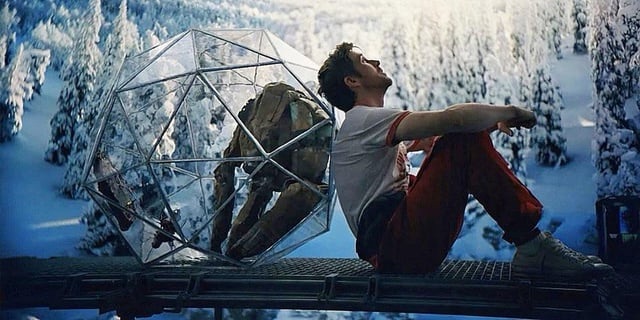
Rocky — an alien who, at first glance, resembles nothing more than a living rock — becomes one of the most expressive characters in the film. Through voice modulation, rhythmic sound patterns, and physical gestures, he communicates emotion, humour, loyalty, and intelligence. The voice work and sound design behind Rocky are extraordinary; they transform the unfamiliar into something deeply intimate.
Rocky: The Heart of the Film
Rocky is not a side character. He is the soul of the film.
Their friendship — built without a shared language, without shared biology — becomes a testament to connection beyond form. Rocky speaks of a partner of 186 years, and in that detail lies something profound: a quiet reflection on love, companionship, and endurance that transcends human frameworks.
There is no need to impose labels on it. It simply is love — steady, enduring, and unquestioned.
(Spoiler Alert: Ending Discussed Below)
What stayed with me even after the film ended was how its thematic core differs subtly from Project Hail Mary itself. Andy Weir’s writing has always leaned heavily into science as process — the joy of problem-solving, of intellect battling extinction, much like in The Martian. The novel is rooted in logic, in method, in the slow satisfaction of answers earned through persistence. Even Rocky, in the book, is as much a collaborator as a companion — a scientific equal with whom Grace builds trust through shared curiosity rather than emotional dependence. The idea of survival is intellectual, almost procedural.
The film, however, shifts that axis gently but decisively. It is less interested in how we solve the universe and more in why we choose to. The science remains, but it takes a back seat to something more fragile — connection. Rocky here becomes more than a collaborator; he becomes an emotional anchor, almost a quiet rebuttal to the chaos and cruelty we associate with humanity. And that is where the film resonated deeply with me. Where the novel asks whether intelligence and cooperation can save us, the film dares to ask whether love — even if it is for just one being — is reason enough to try.
The film’s most powerful turn lies in its moral reversal.
We learn that Grace did not heroically volunteer — he was coerced. Forced into the mission for the sake of humanity. And when faced again with a choice — to return to Earth as its saviour or to turn back and save Rocky — he chooses Rocky.
Not the abstract idea of billions.
Not the “greater good”.
But a singular, tangible bond.
And in that moment, the film quietly dismantles a long-standing cinematic myth — that heroism must always be self-sacrifice for humanity at large.
Instead, it suggests something far more intimate: that love, loyalty, and connection — even with one being — are enough.
Rocky, in turn, saves him. Builds him a home. Gives him a life.
And that reciprocity — that mutual choosing — feels like the truest form of humanity the film offers.
Final Thoughts
If I’m being critical, the script isn’t always tight. There are stretches where pacing wavers, and certain transitions feel less precise than they could be. But somehow, it doesn’t matter.
Because the film lands where it needs to.
Emotionally, it resonates.
And perhaps that is why it stayed with me.
Walking in, I felt a kind of exhaustion with humanity — with its violence, its cruelty, its endless justifications. And strangely, the film doesn’t argue against that feeling. It doesn’t glorify humanity blindly.
Instead, it finds redemption in something smaller.
More honest.
One bond. One choice. One act of love.
And for me, that is enough.
 Hearts Still Care